Gauff outlasts Zheng in epic WTA Finals showdown

Six years after their junior clash, Coco Gauff summoned every bit of grit to defeat Zheng Qinwen in a three-hour thriller, securing the WTA Finals title and capping a demanding season with hardcourt mastery.
Their rivalry began on the sun-drenched hard courts of Plantation, Florida, during the 2018 Orange Bowl, where a 14-year-old Coco Gauff mounted a comeback to defeat 16-year-old Zheng Qinwen in three sets for the girls’ 18s singles title—the youngest champion in 15 years at that prestigious junior event. Fast-forward to the 2024 WTA Finals in Riyadh, Saudi Arabia, where these two emerged as the youngest players in the elite draw, their combined age of 42 marking the most youthful finalists in two decades, reminiscent of Serena Williams and Maria Sharapova’s prodigy duel. The indoor arena’s swift surface set the stage for a clash that blended explosive power with unyielding endurance, transforming a childhood encounter into a defining professional milestone.
Season’s grind forges final paths
The WTA tour that year unfolded across 55 tournaments in 25 countries, producing 35 different champions in a grueling calendar that distilled the top eight singles players to Riyadh for what felt like an All-Star culmination. Gauff, now 20, had secured titles in Auckland and Beijing but endured the disappointment of failing to defend her US Open crown; she rediscovered her rhythm in China, winning nine of 10 matches in Beijing and Wuhan, which propelled her to straight-sets victories over world No. 1 Aryna Sabalenka, 7-6(4), 6-3, and No. 2 Iga Swiatek, 6-3, 6-3, across three intense days. Those triumphs were especially poignant against Swiatek, to whom she had lost 11 of 12 previous meetings, highlighting her sharpened return game and mental composure under pressure.
Zheng, at 22, arrived with her own surge, claiming two Hologic WTA Tour titles and a singles gold medal at the Paris Olympics before racking up 12 wins in 15 matches at the US Open, Beijing, and Wuhan. Her group-stage successes over Elena Rybakina and Jasmine Paolini came despite a loss to Sabalenka, and in the semifinal, she dispatched Wimbledon champion Barbora Krejcikova in straight sets, propelling her into her debut year-end final as only the second Chinese player to reach this stage after Li Na in 2013. The hardcourt’s low bounce and quick pace amplified her flat forehand and serve, yet the season’s cumulative toll tested her ability to sustain aggression through extended rallies.
“Six years later,” Gauff reflected, “here we are.”
Aggressor’s edge fades in decider
Under the bright lights of King Saud University Indoor Arena, the crowd’s electric buzz swelled as the players took the court, infusing the air with the pent-up energy of a long campaign’s climax. Zheng seized the initiative immediately, her booming serve and flat forehand crosscourt overwhelming Gauff in the opening set, which she captured 6-3 in under an hour while saving all five break points faced, her one–two combinations keeping the American on the defensive with deep, penetrating balls. The Chinese player’s momentum carried into the second set, building a 3-1 lead as her inside-out forehands opened the court wide, forcing Gauff into stretched retrievals on the true-bouncing surface.
Gauff’s tactical shift emerged gradually, her returns gaining depth as she anticipated Zheng’s toss and redirected serves with topspin to neutralize the power, breaking at love in the sixth game and again in the eighth to claim the frame 6-4. The third set turned into a test of wills, with Zheng breaking twice early for a 3-1 advantage and later serving for the match at 5-4, only to falter under the weight of the moment, unleashing four unforced errors that allowed her opponent to level at 5-5. Gauff’s down-the-line backhands and inside-in forehands maintained pressure in longer exchanges, her underspin slices dipping low to disrupt rhythm, culminating in a dominant 7-6(2) tiebreak where she seized control from the first point.
The match stretched to an exhausting 3 hours and 4 minutes, the longest WTA Finals decider recorded since tracking began in 2008, with Gauff edging the serving battle through six aces, 29 unreturned serves, and 70 percent of first-serve points won, her varied pace turning Zheng’s explosive style against her in the hardcourt’s endurance crucible.
“Just staying resilient, fighting for every point,” Gauff said afterward. “I know I was like a couple points away from losing, but I just tried to stay in the moment, honestly, and I’m really proud of myself. I never gave up.”
Exhaustion crowns a historic champion
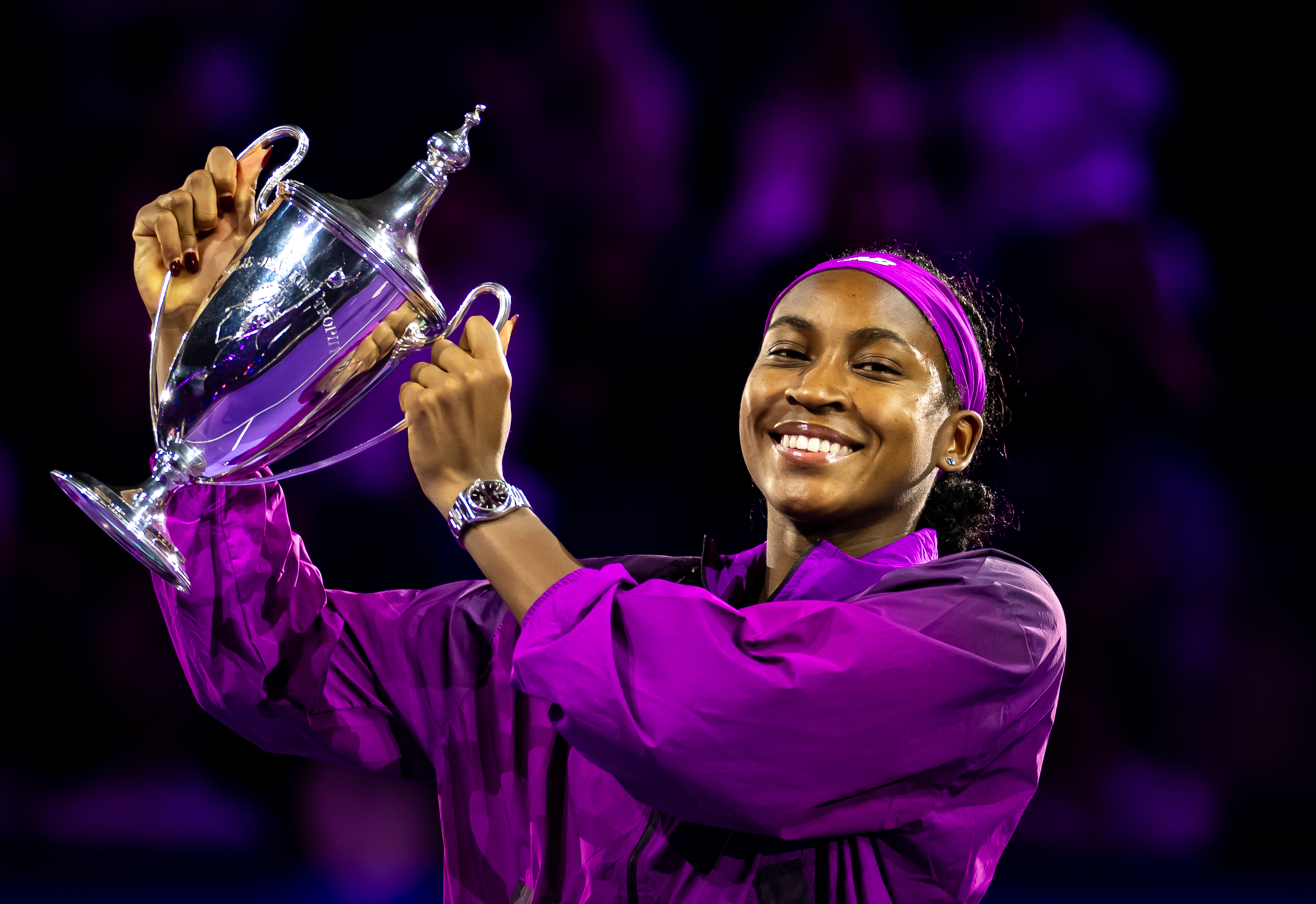
As the final point echoed through the arena, Gauff collapsed flat on the court, her body yielding to the season’s relentless demands after outlasting Zheng in yet another deciding set, six years after their Orange Bowl encounter. She lifted the Billie Jean King Trophy and pocketed nearly $5 million, becoming the youngest WTA Finals champion in 20 years—since Maria Sharapova’s 2004 victory, the year Gauff was born—while extending her flawless 8-0 record in hardcourt finals to an Open Era benchmark. This win not only validated her tactical growth but also underscored the psychological fortitude built through a year of peaks and valleys, from junior promise to year-end supremacy.
Zheng’s run, marked by her aggressive baseline patterns thriving on the indoor speed, ultimately bowed to the match’s marathon nature, where patience proved as vital as power. She later noted the physical and mental layers at play, her candor revealing the fine line between dominance and depletion in such high-stakes tennis.
“This match is very [much about] endurance, instead of explosive tennis,” Zheng observed. “Yes, a lot of physical, but I would say sometimes, maybe in this match, I wasn’t that patient.”
Gauff’s unplanned tumble captured the raw relief of victory, a moment of stillness amid the roaring celebration that spoke to her earned resilience. “At the end of the match, when I fell on the floor, I didn’t think I was going to do that,” she shared. “The way the match went, I was like, ‘I’m just tired. I just want to lay on the ground.’” With this triumph, the American positions herself as a hardcourt force poised for more defining battles, where mental steel and adaptive play will continue to define her ascent.