Iva Jovic navigates Top 20 pressures in Dubai debut

Eight months after breaking the Top 100, the 18-year-old American faces her first WTA 1000 seeding amid swirling expectations and a packed schedule. Her opening win hints at the fighter’s resolve needed to sustain the climb.
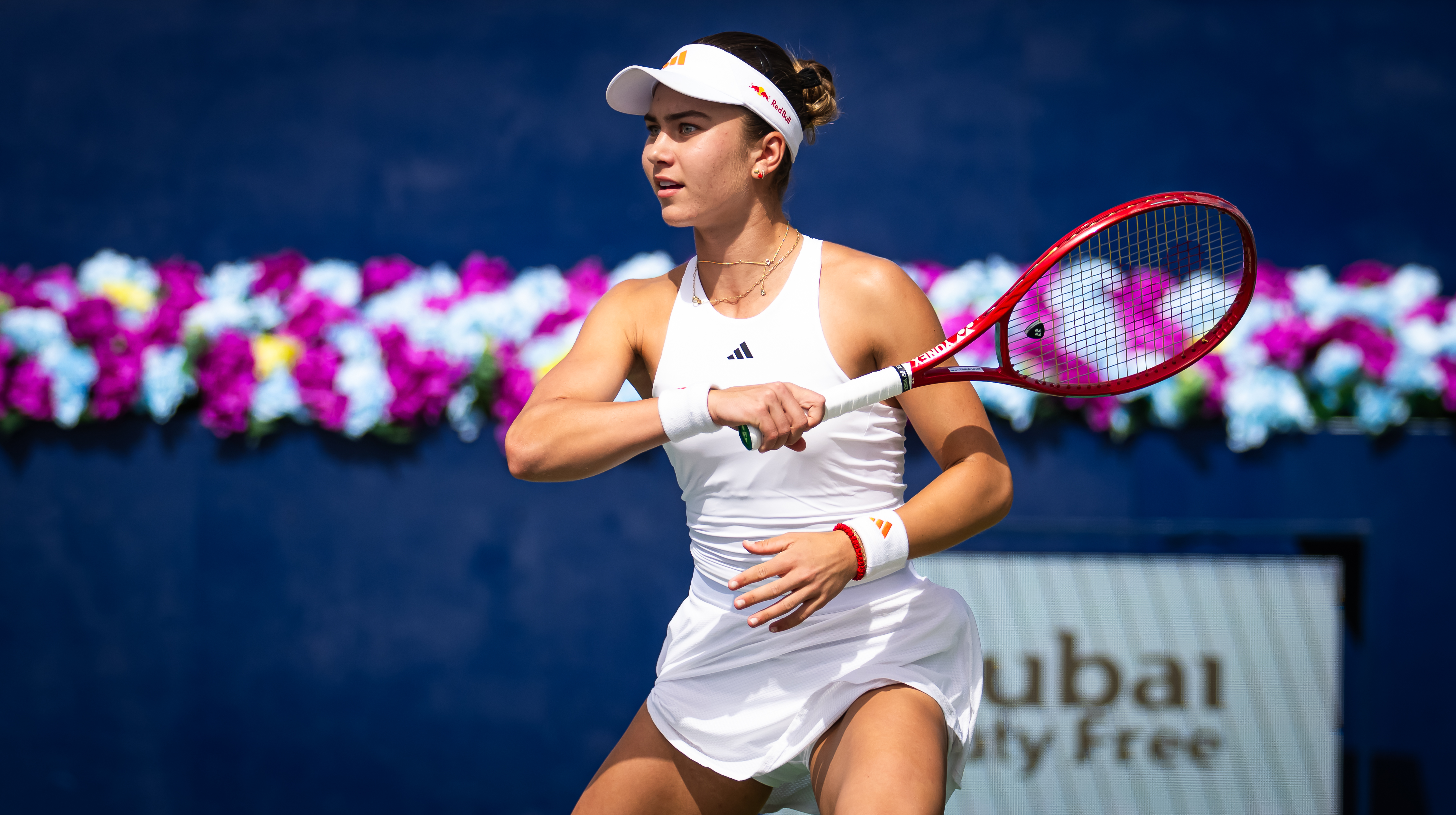
Under a cloudless desert sky where temperatures nudge 30 degrees, Iva Jovic steps onto the court at the Dubai Duty Free Tennis Championships as the No. 16 seed, her debut in that role at a WTA 1000 event. Twelve months ago, the now 18-year-old American endured freezing rains during an ITF W50 in Spring, Texas, where sub-zero chill delayed matches and ultimately canceled her final against Mary Stoiana. This whirlwind ascent from No. 167 to inside the Top 20 carries her into a tournament that tests not just her heavy topspin baseline game, but the mental recalibration of sudden elite status.
Her first-round victory over lucky loser Kamilla Rakhimova unfolded in whiplash fashion: a 6-1 opener built on deep crosscourt forehands that pinned the opponent deep, a 1-6 second set marred by unforced errors as fatigue surfaced, and a 6-1 decider where Jovic mixed underspin backhands to disrupt rhythm and fired inside-out winners to seize control. The fast hard courts here reward her aggressive 1–2 patterns, allowing quick redirection of pace, yet expose any lapses in footwork during extended rallies. With Scores, Draws, and Order of play charting the path ahead, her second-round matchup against Diana Shnaider looms as a tactical crossroads, where Shnaider’s flat backhand returns could neutralize Jovic’s spin if serve placement doesn’t vary enough.
“I remember that week so well,” Jovic said. “I’ve never had delays for matches just because of how cold it was. Fountains were frozen over. it’s definitely nicer to be here.”
From Texas chill to Top 20 heat
Jovic cracked the Top 100 just eight months ago, a breakthrough that accelerated with her first WTA title in Guadalajara three months later, propelling her into the Top 50 through resilient down-the-line passes in key moments. Four months on, a quarterfinal run at the Australian Open—fueled by low slices to reset rallies and improved net approaches—sealed her Top 20 entry, turning potential defeats into ranking leaps on varied hard-court bounces. This surge defies simple momentum, rooted in consistent deep runs where she defends break points with angled crosscourts, yet now demands surface-specific tweaks as opponents scout her preference for inside-in forehands to open the ad side.
In Guadalajara, she escaped match point against Victoria Jimenez Kasintseva with a precise lob that halted an advance, a fine margin underscoring how fortune favors persistence amid the rankings math. Dubai’s grippy hard courts, with medium pace and true bounce, amplify her power but challenge transitions, much like the Australian swing’s toll that prompted a vital post-Melbourne break to rebuild technique. She speaks of the shift with steady calm, her voice cutting through the tournament’s hum as she eyes unfamiliar foes like Shnaider.
“Even though my ranking is where it is right now, I still feel very new on the tour,” she said. “There’s a lot of girls that I haven’t played yet. it’s going to be my first meeting against Diana [Shnaider] tomorrow [in the second round], so I do feel like there’s a lot I still need to learn. But obviously it’s nice when you feel you’re still developing, but you’re already in a nice place. I’ve earned my spot to be in these nice places and hopefully it can stay this way.”
Adapting mindset from hunter to hunted
The rite of passage for any rapid riser involves shedding the free-swinging hunter’s abandon for the hunted’s calculated defense, a psychological bend Jovic navigates with level-headed zoom-outs on her trajectory. Youth brings buffers like endless energy and wide-eyed thrill at the tour’s rhythm, allowing her to sustain focus in heat-sapping rallies, but lacks the veterans’ depth in clutch problem-solving, drawn instead from junior battles where grit outlasted polish. Against Rakhimova, the second-set dip—rushed down-the-line attempts clipping the net—stemmed partly from post-Australian fatigue, a reminder that pro tempos demand quicker pivots than ITF circuits.
She acknowledges this gap plainly, emphasizing how seasoned pros tap experience to counter patterns like her one–two serve-forehand combo, forcing her to vary with drop shots or deeper returns on these faster surfaces. The advantages of freshness shine in recovery between points, yet Dubai’s electric buzz amplifies every error’s weight, turning the crowd’s murmurs into a mirror of internal pressure. Jovic counters by focusing on process, refining her spin consistency to exploit openings without overcommitting.
“You’re young, you’re fresh, everything is fun and amazing, you don’t get tired as much,” she said. “That’s good, but there’s a maturity level that some of these well-seasoned pros have. Just a problem-solving experience to tap into in tough moments, which I don’t really have. I go back to my junior experience, but it’s obviously quite different.”
Balancing schedule with technical sharpening
A denser calendar as a Top 20 player erodes the precision honed in extended practice—topspin loops flattening under match load, footwork lagging in prolonged exchanges—forcing smarter gym integration to preserve explosive first steps for covering wide inside-out angles. Last year’s age restrictions offered uninterrupted building time, a luxury now traded for heavier competition that Jovic manages by prioritizing on-court drills between events, cleaning up strokes like her backhand slice to maintain variety. The Rakhimova match’s oscillation highlighted this tension, her decider recovery via paced underspin serves drawing errors and restoring control on the hard courts’ grip.
Her goal extends beyond trophies to forging a pro identity as the enduring fighter, emulating junior deep runs where she clawed through draws without surrender, now layered with tactical nuance like angled crosscourts to evade Shnaider’s aggression. This proactive stance—blending gym work with pattern refinement—positions her to extend consistency amid the season’s majors and 1000s, where heat and pace will strain but also reveal her adaptability. As the desert sun climbs, Jovic’s even keel turns potential pitfalls into resilient strides, her heavy balls carving paths that hint at sustained elite presence.
“I tried to not have a lot of expectations,” Jovic said. “I definitely felt I was getting better and doing the right things, but you never know when it’s going to click and how long it’s going to take you.”
In the juniors, she was the player crafting deep runs weekly, not always claiming titles but never exiting without a battle, a reputation she aims to etch in pro circuits through fights like the one awaiting in Dubai. The Top 20 perch brings seeded draws and billing perks, yet amplifies mental loads, every hold a step against slides. Channeling that junior fire with pro adjustments—deeper returns to blunt big serves, varied spins to keep returns guessing—could redefine her arc, transforming the hunted’s burden into fuel for quarters and beyond.
“In the juniors, I was always that player who was making deep runs every single week,” she explained. “I wasn’t maybe winning all the titles, but I was there every single week and I would never go out without a fight. So it’s like, let’s try to make that reputation in the pros too. So far, it’s been great. I’ve been finding my footing in all these tournaments.”
Amid the tournament’s star-studded field and rising intensity, Jovic’s emergence stirs fresh dynamics, her story of quiet determination cutting through the glare as she eyes deeper statements on these courts.