Pegula Peaks Late in Dubai Desert Heat

Jessica Pegula, nearing 32, claims her first Dubai title by outlasting Elina Svitolina, turning a season of resets into a masterclass of refined aggression and unyielding drive.
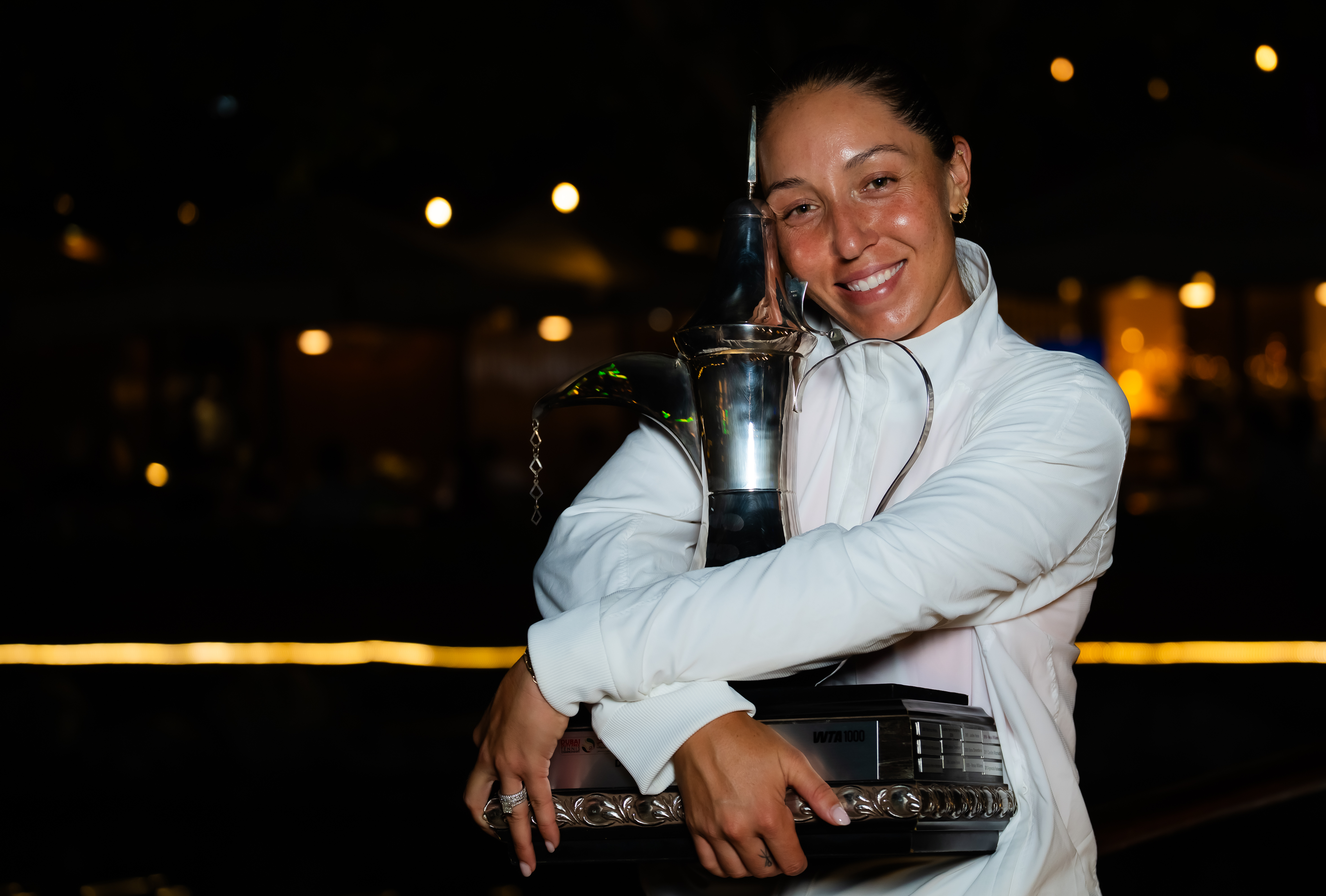
Jessica Pegula crossed the Dubai finish line with an ace that echoed through the stadium, sealing a 6-2, 6-4 win over Elina Svitolina in the final of the Dubai Duty Free Tennis Championships. At nearly 32, she dismantled a draw stacked with Top 20 talent, her strokes crisp under the evening lights, each one a product of offseason drills that bridged her natural timing to sharper footwork. This wasn’t a fluke; it was the culmination of a career arc bending toward peak form, defying the early pressures of the women’s tour.
Her path here twisted through smart scheduling after a semifinal push at the Australian Open. Skipping Doha allowed a reset in Florida amid the post-Melbourne shuffle to the Middle East, a move that preserved her edge for this one-week stand. Pegula arrived knowing her game clicked on hard courts, where true bounces let her take the ball early and skid flat shots low.
“Honestly, every year I surprise myself,” Pegula told Cole Bambini of wtatennis.com. “Because tennis is really hard. It’s so week-to-week. And you have to be able to go through each week as a new week and not have a lot of highs and a lot of lows.
“I think I’m really, really good at that. My personality, I’ve been able to find a really good niche of how to carry myself throughout the weeks, not to take losses too deeply. And when I do well, I’m able to get right back to work and move on to the next thing. It’s something I’ve been able to figure out over the last couple of years.”
Reset rhythms fuel desert surge
The 73-minute final showcased Pegula’s composure, her forehand down-the-line slicing past Svitolina’s defenses like a knife through silk. Svitolina, 31 and fresh off a three-hour semifinal against Coco Gauff that stretched past 11 p.m., fought with slices and counters but couldn’t match the American’s depth. Pegula’s team erupted after the last point, coach Mark Knowles finally looking up from his phone to join the embrace, a light moment amid the tension.
Earlier rounds tested her adjustments against varied foes. She chipped deep returns to Iva Jovic, setting up a one–two: crosscourt forehand to stretch the court, then inside-in backhand to finish points short. Against Clara Tauson, Pegula looped heavy topspin to draw errors, her evolved spacing letting her recover for down-the-line redirects that left the Dane scrambling.
Amanda Anisimova fell in the semis to Pegula’s rhythm, built late in that match and carried over. Pegula took balls on the rise, her flat groundstrokes skidding through the court, forcing Anisimova’s power to falter on the grippier Dubai surface. The crowd’s murmurs built to cheers as Pegula found her groove, the air thick with the scent of victory.
This marked only the second time Pegula beat four Top 20 players in one event, her fourth WTA 1000 title—all on hard courts, from Guadalajara in 2022 to Montreal in 2023 and Toronto in 2024. Svitolina’s run, her first such final since Rome in 2018 and the longest gap since the format began in 2009, highlighted two veterans thriving late.
A first title in Dubai 😍@JPegula | #DDFTennis pic.twitter.com/eecF3lwxpB
— wta (@WTA) February 21, 2026
Hard courts amplify disguised strikes
Pegula’s game thrives where footing stays predictable, no bad bounces to jar her timing. She explained her edge: “I take the ball very early. Hard court, I like the footing on hard. I like that there’s no bad bounces, things that can go wrong. There’s a very true bounce so I can get into a good rhythm pretty easily. I hit pretty hard, deep and flat, so I think my ball kind of skids through the court.” That skid powered her week, turning baseline exchanges into opportunities for sudden direction changes.
Andrea Petkovic captured it on Tennis Channel, joking about taking that forehand to dinner. Pegula disguises from both sides better than most, feinting crosscourt before whipping inside-out to the line. Over six months, coaches refined her footwork to sync with her hand-eye coordination, making passive stances explode into winners.
“I think that’s something I’ve always been able to do really well,” she said of her redirection skill. “It’s funny, sometimes people ask me, ‘I don’t know how you hit the ball so hard but it looks like you’re just sitting there, chilling. All of a sudden it just springs off your racket.’ I think one of my traits that makes me a good player is I have good timing and really good hand-eye coordination.” Embracing that led to offseason focus on flowing through shots, even as injuries limited practice.
Her preseason was rough, barely scraping into Brisbane where she reached the semis. But post-WTA Finals, she honed essentials: spacing, efficiency. Australian Open success followed, building to Dubai where she flipped fatigue into focus, her backhand slice jamming returns before forehand lasers opened angles.
Against Svitolina, Pegula shortened her backhand to counter underspin, forcing the Ukrainian to lift high and expose the court. The match’s tempo quickened in the second set, Pegula’s ace ending it as the stadium lights cast long shadows, her hop-skip celebration a burst of joy.
Late peaks redefine tour longevity
At 32, Pegula entered the year-end Top 10 first at 28 in 2022, now chasing a fifth straight. Injuries in her early 20s preserved her body, letting maturity sharpen her game without the wear of constant starts. “I’m obsessed with becoming a better player,” she said. “That’s something that’s kept me at the top of the game—that I always want to improve. I love to compete and I love to win tournaments, but at the end of the day what really motivates me is becoming a better player—every single day.”
In a tour of depth, that drive keeps her elite. She adapts fast, picking up drills and executing under lights, her quick learning turning tweaks into matches won. Playing Svitolina, another late bloomer, proved age bends to care and evolution, no 18-year-olds needed to dominate.
“I hope I can inspire girls to show that you don’t have to be 20 years old,” Pegula reflected. “You can still play really good tennis if you take care of your body and keep improving. So, yeah, I’m really proud of myself that I can do that as a player at 32 now. I don’t think that’s necessarily the norm, but we saw that on the men’s tour and women, too. It’s a different age now.” Her offseason, despite setbacks, emphasized mindset over miles, turning potential derails into disciplined progress.
For a Grand Slam, she eyes more weeks like this. “I think matches like this week really help,” she noted. “Building confidence on how I need to play and things I still want to get better and improve. Just keep chipping away and building that. Maybe a little luck.” Dubai’s trophy, an early birthday gift, signals majors loom, her obsession the key to unlocking them amid the tour’s grind.
Like the 1971 Clairol ad’s quip—you’re not getting older, you’re getting better—Pegula lives it, her reverse arc from 2008’s Benjamin Button fantasy to real prime. The desert win sets a tone for 2026, where mental steel meets tactical polish, promising deeper runs ahead.