Defending a WTA Finals title pushes limits

Coco Gauff’s rocky start in Riyadh reveals the grueling reality of repeating as champion, where year-end fatigue clashes with the tour’s deepest field in a high-stakes finale.
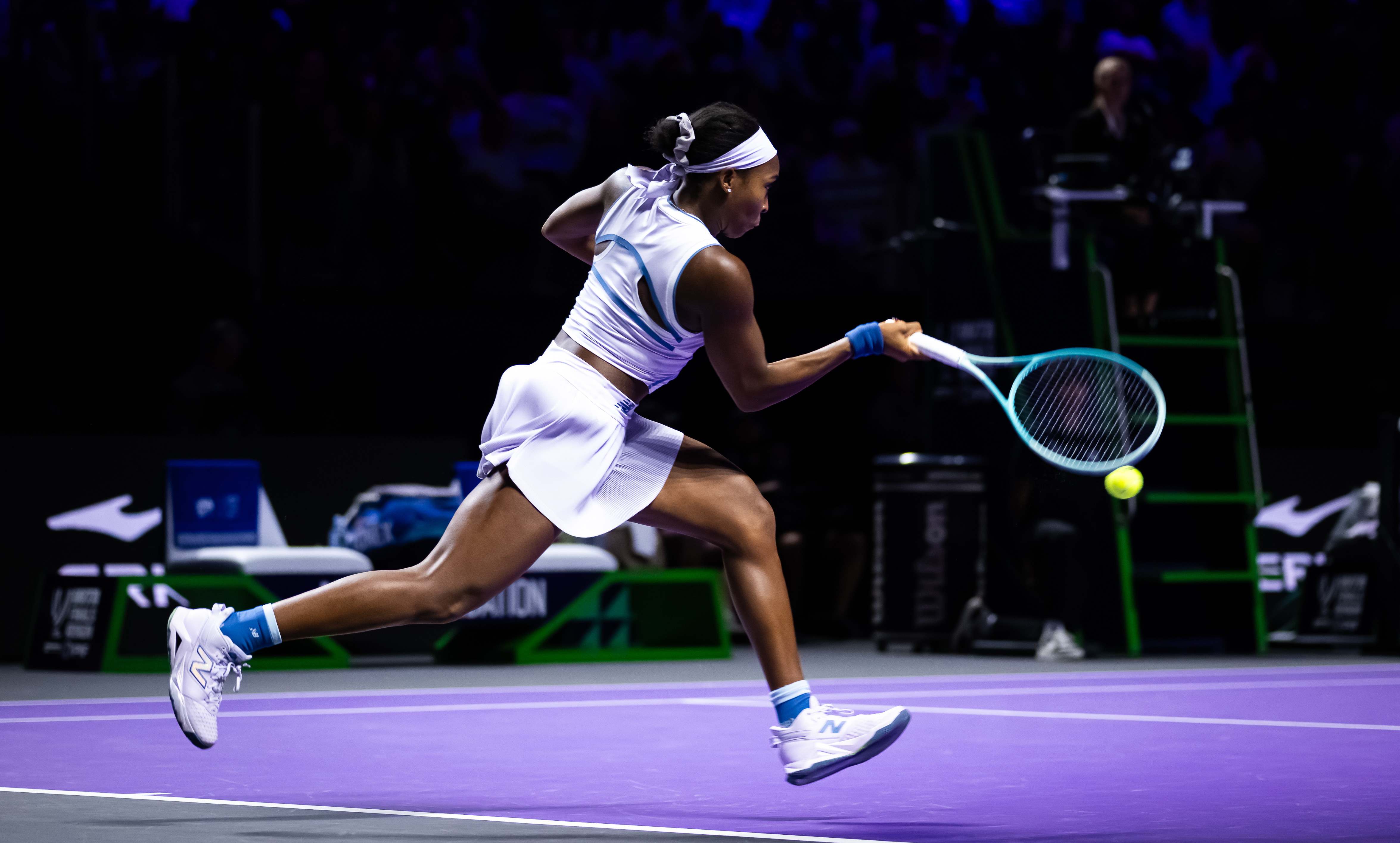
In Riyadh’s gleaming arenas, the WTA Finals pulse with the weight of a season’s culmination, where every baseline exchange carries the echo of months on the road. Defending champion Coco Gauff enters as the No. 3 seed, her 2024 triumph still fresh—a run of four straight victories that toppled No. 1 Aryna Sabalenka, No. 2 Iga Swiatek, and Zheng Qinwen in a tense third-set tiebreak. Yet the stats paint a sobering picture: only three women have repeated here over the past 25 years, a testament to how timing, endurance, and the sport’s growing depth turn this event into tennis’s ultimate test.
Gauff’s campaign kicked off unevenly against fellow American Jessica Pegula, a match marked by double faults and errant forehands that betrayed mounting frustration. One awkward bounce from Pegula left her frozen, racket barely moving, as the crowd sensed the shift in momentum. Now facing possible elimination against No. 7 Jasmine Paolini on Tuesday, she must recalibrate quickly in the round-robin format.
“I think, A, it’s one of those tournaments you’re not guaranteed a spot in every year,” Gauff said before the event. “Some people win and aren’t able to even qualify. B, the top eight in the world, it’s very hard to I think win this tournament in general, let alone replicate it back-to-back years. But I’m not thinking about that. I really just want to focus on my first match ahead. I think that’s what I did last year.”
Gauff confronts mounting pressures
The opener’s 6-4, 6-3 loss to Pegula exposed vulnerabilities in Gauff’s game, with seven double faults disrupting her 1–2 patterns on the indoor hard courts. Pegula’s flat backhands forced defensive crosscourt replies, pulling her wide and testing her inside-out forehand recovery. Post-match, Gauff eyed the Paolini rematch as redemption, recalling their Wuhan encounter where the Italian’s aggressive returns differed from what might unfold here on the faster surface.
“Yeah, every match here is tough,” she reflected. “I played her in Wuhan, so I expect her to play differently than she did in that match. It’s another opportunity to be better and hopefully I can win that one to give myself a chance to qualify for the semis.”
Paolini arrives with late-season momentum, her quick footwork and drop shots demanding Gauff vary depths to avoid prolonged rallies. The desert venue’s medium pace favors early ball-taking, where Gauff’s flatter groundstrokes could shine if she commits to net approaches against the Italian’s speed.
Fatigue defines the season’s close
Chris Evert, an 18-time Grand Slam winner, peaked in the summer majors—Roland Garros, Wimbledon, the US Open—before the fall circuit drained her reserves. She captured four WTA Finals titles, fourth all-time behind Martina Navratilova’s eight and the five each from Steffi Graf and Serena Williams, but admitted the end-of-year grind tested her limits.
“Most of the players peak during the summer,” Evert explained. “After the [US] Open, I was done. It was a struggle for me to play Stuttgart and the other fall tournaments, even the year-end championship. It’s really, really hard. It’s at the end of the year. It’s the last tournament and everybody’s starting to feel a little fatigue, mentally and physically.”
Simona Halep, who qualified five times and reached the 2014 final in her debut—losing 6-3, 6-0 to Williams in Singapore—described the honor of arrival tempered by low energy. That defeat ended Serena’s three-peat, the last repeat until now, as every matchup feels like a Grand Slam final amid the top-eight field.
“It’s an honor to qualify, and you look forward to it,” Halep said. “But when you finally get there your level of energy is a little bit low. And then there is another reason, the biggest one: It’s also the players. You play a final of a mandatory tournament or a Grand Slam every match. This is also a big pressure.”
Aryna Sabalenka, with four Grand Slam titles, has neared this crown but fallen short—losing the 2022 Fort Worth final to Caroline Garcia, then semifinals to Swiatek and Gauff. Her fitness coach Jason Stacy points to the event’s timing, while tactical coach Anton Dubrov highlights how qualifiers’ freshness varies: early-year standouts arrive rested, but players like Paolini and Elena Rybakina ride recent rolls.
“It might just be [the season’s] timing,” Stacy noted. Dubrov added, “It’s the eight best players who perform the best during the year. For example, one player might have their best matches at the beginning of the year. Maybe it’s helpful for them because they’re more fresh. But then you have [Jasmine] Paolini and [Elena] Rybakina, who played the last couple of tournaments. It might be helpful because they’re on a roll right now.”
Sabalenka’s power relies on deep crosscourt forehands and inside-in returns, but over 10-plus months, maintaining that edge proves elusive against defenders who extend points with underspin and depth.
Depth demands mental sharpness
The women’s game’s rising parity has made repeats rarer, unlike Navratilova’s five straight singles titles in the mid-1980s or her 10 of 11 doubles from 1980-89. Monica Seles won from 1990-92, Graf three of four between 1993-96, but since 2015, no champion has defended—Dominika Cibulkova, Garbine Muguruza, and Garcia even missed qualification the next year.
Extenuating factors played roles: the 2015 winner Williams, world No. 1, withdrew post-US Open with injury; 2020’s event canceled amid COVID-19 left no 2021 defender. Elina Svitolina, 2018’s champion, reached the 2019 final as No. 8 seed before a 6-4, 6-3 loss to Ashleigh Barty. Since 2000, only Kim Clijsters in 2003, Justine Henin in 2007, and Williams in 2013-14 have repeated.
Tournament director Muguruza, surprised by the low count, emphasized qualifying then surviving round-robin intensity without injury, where off-days mean dissecting opponents’ down-the-line threats and crosscourt patterns.
“Only three players?” she asked. “That’s a really low number. First you need to already qualify, then survive the round-robin format, not getting injured in these intense matches. There is not one day that you can even relax a little bit. If it’s not the day of the match, the day in between you already need to prepare and know that now I’m playing against this other player, all the achievements they’ve done. It’s really mentally tough knowing that every single match you have to be on your 100 percent, or at least 80 percent.”
Evert credits the tour’s depth for tight margins, where a strong first half can fade without sustained focus, boiling down to mental resilience in the pressure cooker.
“There’s so many ups and downs,” she said. “You can have a strong first half of the year and then it’s hard to keep it up. Kudos to the depth of the women’s game and how close everybody is. Skill-set-wise and talent-wise, it very often comes down to the mental part. Who’s the most mentally focused?”
As Gauff readies for Paolini under Riyadh’s lights, the crowd’s energy builds, her serves cracking like thunder in the cool night air. The real contest unfolds in the mind, where one sharp adjustment could reignite her title defense and etch her name among the elite repeaters.