Amanda Anisimova channels power into poised resurgence

After a mental reset and tactical overhaul, Amanda Anisimova has turned raw firepower into efficient dominance, storming to WTA 1000 titles and Grand Slam finals while eyeing Riyadh’s year-end stage.
Amanda Anisimova first ignited the tennis world six years ago, claiming the Bogota title at 17 as the youngest American champion since Serena Williams two decades earlier. Two months on, she stunned Roland Garros by ousting defending champion and World No. 3 Simona Halep in the quarterfinals, only to fall to eventual winner Ashleigh Barty in the semifinals. That prodigious spark carried the weight of immense expectations, testing her in profound ways.
Rebuilding amid burnout’s shadow
The pressures of early fame eroded Anisimova’s passion, leading her to step away from the tour in 2023 for mental health reasons. Her ranking plummeted to No. 359 by year’s end, a humbling low that underscored the fragility of elite paths. Returning in 2024, she rebuilt methodically, slashing unforced errors from neutral rallies and anchoring her stance at the court’s center to channel power into controlled aggression.
This evolution sharpened her groundstrokes, favoring inside-out forehands to stretch opponents wide and crosscourt backhands to drive them back. On hard courts, her flatter trajectories gained precision, minimizing wild swings while maximizing first-strike opportunities. The shift not only restored her confidence but positioned her for a 2025 breakout, blending raw talent with newfound structure.
“I really came out there with not an ounce of fear. I feel like I really made a point to myself, and also maybe to other people, that if you really put a positive mindset out there, just try and work through things, then you can have a positive outcome.”
Breakthroughs test tactical maturity
February brought validation in Doha, where Anisimova captured her first WTA 1000 title in over three years, defeating six Top 40 players—all ranked above her—to beat Jelena Ostapenko in the final. Eight years after her Miami debut at that level, the victory highlighted her serve-plus-one patterns that neutralized returns and opened down-the-line angles. Her 45-16 record through the season reflected this efficiency, turning potential chaos into consistent threat.
At Wimbledon, she toppled World No. 1 Aryna Sabalenka in three sets to reach her first Grand Slam final, her low-bouncing underspin backhands disrupting the Belarusian’s rhythm on grass. The 6-0, 6-0 loss to Iga Swiatek exposed gaps in extended rallies, yet the Centre Court roar fueled her resolve. Just 53 days later, at the US Open, Anisimova reversed course, downing Swiatek in straight sets during the quarterfinals with inside-in forehands that exploited the Pole’s positioning.
That defining win, amid the electric hum of Arthur Ashe Stadium, propelled her past two-time champion Naomi Osaka in the semifinals via improved net rushes and slice variations. She pushed Sabalenka to a second-set tiebreak in the final, securing a career-high No. 4 ranking and her debut WTA Finals spot in Riyadh. The hard-court tempo suited her one–two combinations, rewarding quick footwork and aggressive baseline holds.
Rebounding toward Riyadh’s spotlight
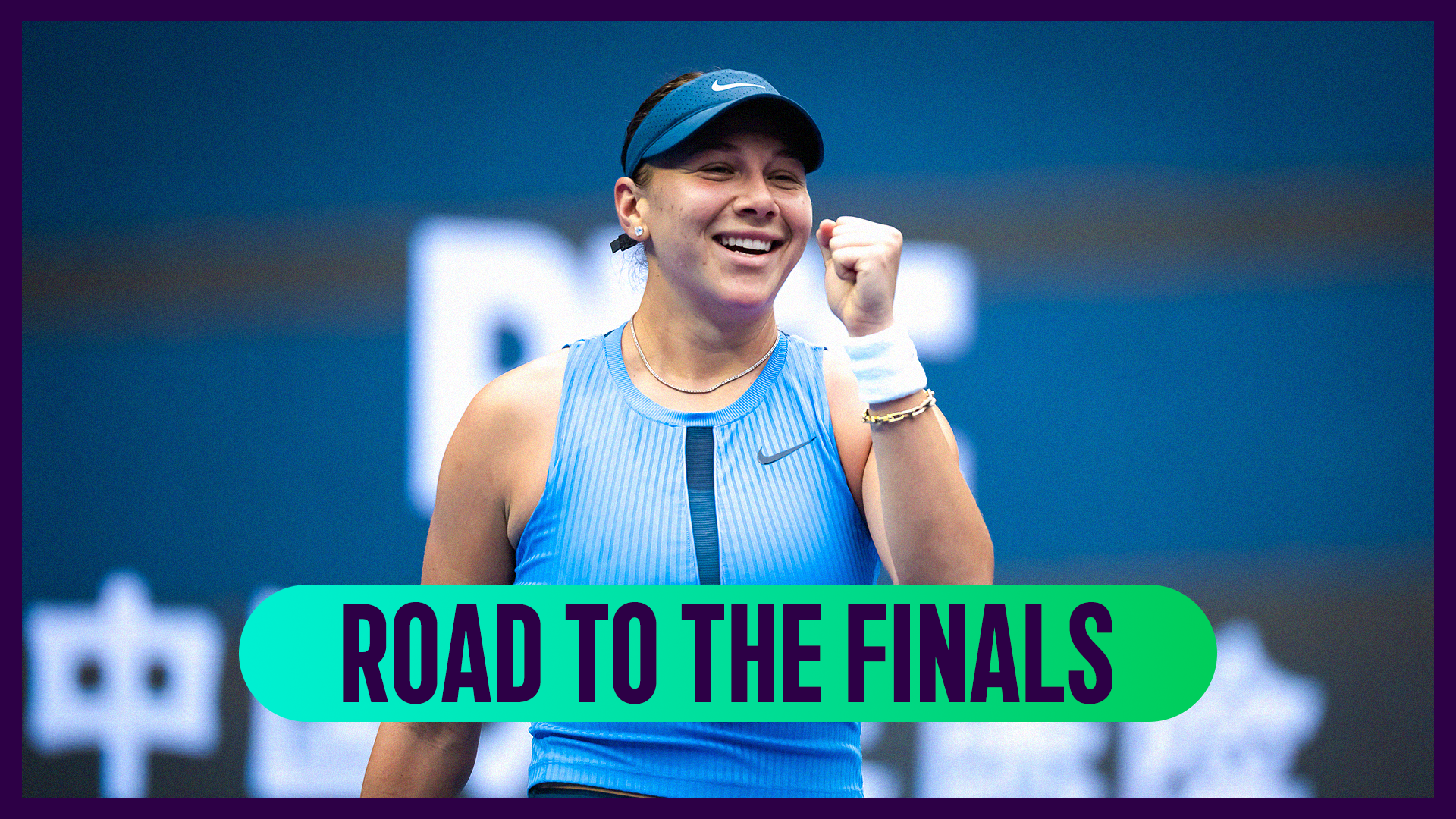
Undeterred by the final’s sting, Anisimova claimed the Beijing WTA 1000 title, outlasting Coco Gauff with deep crosscourt lobs in the semifinals and Linda Noskova via relentless pressure in the final. Her backhand, once glimpsed in flashes, now thundered consistently, pinning foes deep and forcing errors. This haul of two WTA 1000 crowns marked her ascent from rebuild to elite contender.
As profiled in the Road to the WTA Finals series—starting with Monday, Oct. 20: Road to the WTA Finals: How Sabalenka has set the standard in 2025, continuing on Tuesday, Oct. 21: Road to the WTA Finals: Swiatek proved versatility is her greatest weapon, and including Road to the WTA Finals: Gauff overcame adversity, added to championship resume—her journey echoes peers’ trials while standing apart through sheer perseverance. Greg Garber describes the year as a thunderclap on her career, evoking a Hollywood arc from lows to highs. Brad Kallet praises her transformation of mental hurdles into elite strength, a narrative that resonates beyond the lines.
Post-US Open, Sabalenka forecasted a major for Anisimova soon; though not in 2025, Riyadh’s indoor hard courts align with her refined game, where center-court poise and error-free rallies could deliver the breakthrough that caps her story with triumph.