Babos unearths her WTA Finals dominance in Riyadh

Six years after her last appearance, Timea Babos arrives in Riyadh with three WTA Finals titles under her belt and a new partner in Luisa Stefani, ready to remind the field of her pedigree amid a grueling qualification chase.
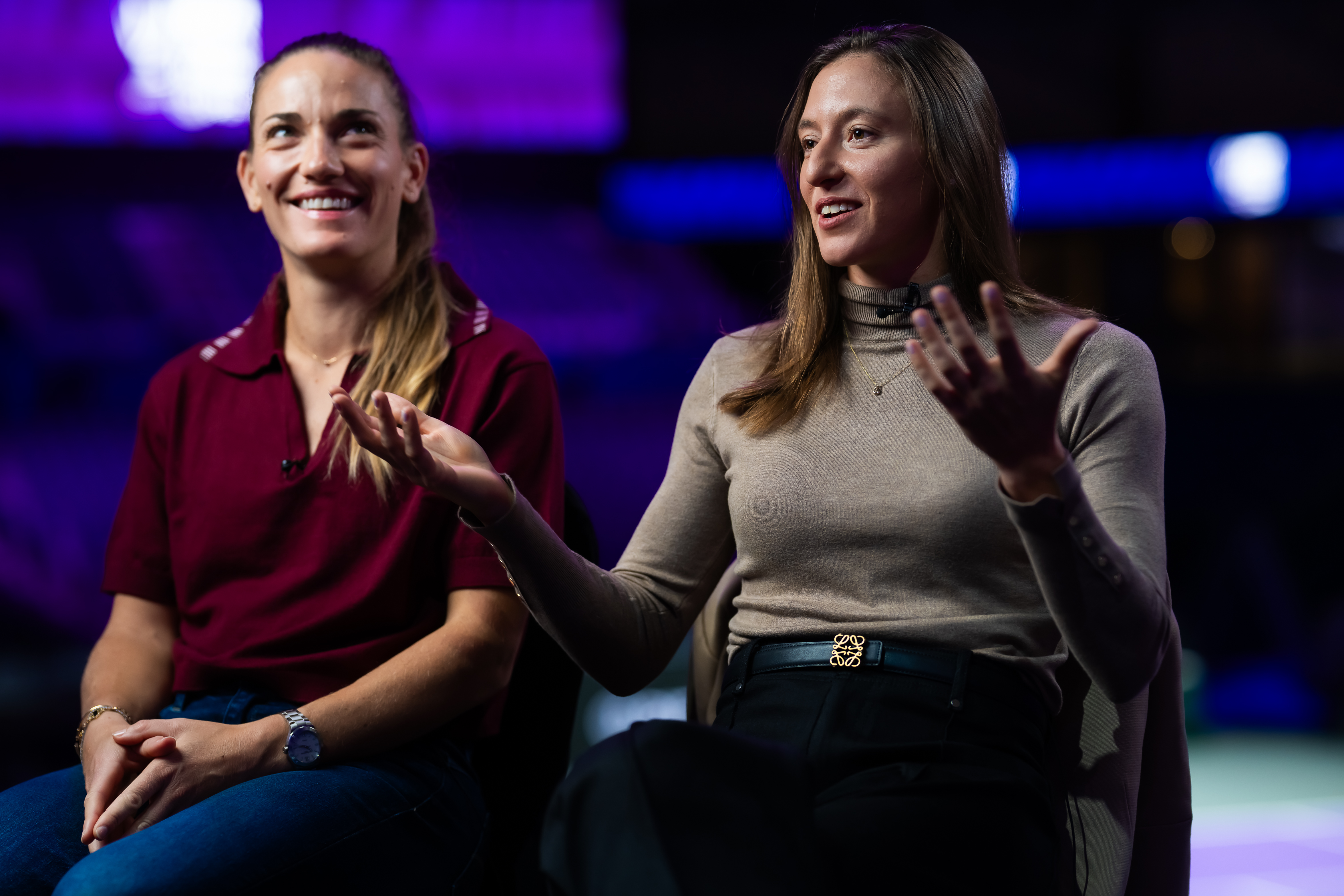
In the opulent arenas of Riyadh, where the 2025 WTA Finals summon the tour’s elite doubles pairs under desert lights, a simple quiz cuts through the pre-tournament buzz: Who among these contenders owns the most year-end championships? Guesses fly toward recent standouts, but the answer resides with a veteran whose streak defined an era, her return laced with the tension of reinvention and the thrill of fresh synergy.
Unearthing a forgotten triple crown
The correct response points to Timea Babos, the 32-year-old Hungarian whose three consecutive WTA Finals victories from 2017 to 2019 stand as a modern benchmark. She secured those titles twice with Kristina Mladenovic and once alongside Andrea Sestini Hlavackova, capping a run of five straight qualifications that began in 2015. After a six-year absence, Babos reenters the fray not as nostalgia but as a tactical force, her experience steadying the draw’s younger talents.
Others stumble in the trivia. Katerina Siniakova, the 29-year-old Czech boasting 11 Grand Slam doubles crowns, garners nods despite her solitary Finals win three years ago in Guadalajara with Barbora Krejcikova. Iga Swiatek’s 2023 singles triumph and Coco Gauff’s from last year each yield one trophy, while Elise Mertens, marking her seventh Finals outing with a fifth partner, holds just a single doubles victory from Fort Worth three years back paired with Veronika Kudermetova.
“OK,” said Kudermetova, squeezing her eyes shut, racking her brain. “Maybe, maybe … it’s Babos! Yes, yes!”
Babos acknowledges the oversight with quiet assurance. “Of course I knew that,” she said. “It’s a unique achievement.” Her words evoke the intensity of those past finals, where sharp volleys and deep crosscourt returns turned pressure into points, the crowd’s murmurs building with each escalating rally.
Forging bonds through serendipitous calls
The path back unfolded with doubles’ signature unpredictability. Babos, whose ranking had eased into the 50s following seven consecutive Top 10 seasons from 2015 to 2021, opened 2025 with Nicole Melichar-Martinez, posting a 5-3 mark across their first three events. Meanwhile, Luisa Stefani, the Brazilian navigating recovery from knee surgery that disrupted her 2024 finale, hunted for matches to regain her edge.
Chance aligned in Linz, Austria, where steep entry cuts thwarted Stefani’s plans with Ingrid Martins. Spotting Babos listed with singles player Lulu Sun, Stefani dialed a number she’d never used before. “Hey, Timmy, this is Luisa. Like I’m here, the cut is really strong. Do you want to play together so we can both get in?”
Babos, just a two-hour drive from home in Hungary, embraced the impulse. “It’s close. Get some matches. Why not?” Ranked No. 84 upon entry, the pair dismantled the WTA 500 draw, ousting Siniakova and Zhang Shuai in the semifinals through crisp one–two patterns—Stefani’s forehand drives opening lanes for Babos’s down-the-line strikes—and prevailing over Lyudmyla and Nadiia Kichenok in the final with relentless net pressure. Babos surged 36 ranking spots, birthing a partnership that netted three more crowns in Strasbourg, Tokyo, and Sao Paulo, plus a Ningbo runner-up finish to clinch their Riyadh invitations.
“Doubles is about partnerships,” Babos said, “and I needed a very good partner. I mean, yeah, obviously I am very proud of that. But I needed Luisa to be here again.”
“Vice versa,” said her partner Luisa Stefani, who is playing in her first WTA Final.
Their collaboration thrives on Stefani’s forehand-side anchoring, freeing Babos to patrol the backhand while leveraging her partner’s elite net instincts. On Strasbourg’s clay, Stefani’s topspin loops controlled crosscourt exchanges, drawing lobs that Babos smashed with authority, the slower surface amplifying their build-up play. Hard courts in Tokyo demanded pace adjustments, where inside-out forehands from Stefani stretched opponents wide, setting up Babos’s inside-in finishes amid the swift indoor tempo.
Embracing pressure for renewed fire
Late-season qualification demands forged their edge, turning mathematical urgency into motivational fuel. With spots dangling on tournament outcomes, the duo exceeded expectations, Babos reflecting on the grind as both arduous and exhilarating. “We not only held the pressure good, but we outstepped our own limits,” she explained. “It was very tough but fun and good at the same time.”
Stefani admires the fire that drives her teammate. “I like her competitive spirit, her passion—the way she brings it on the court and backs herself up. Like …” Babos interrupts with humor: “… Basically, I’m nuts a bit.” This candor evolved their dynamic, shifting from cautious politeness to frank discussions on volleys and positioning, resolving tactical hitches swiftly.
In Sao Paulo, Stefani’s hometown roar fueled their title run, her underspin slices disrupting serves to feed aggressive approaches, while Babos’s baseline depth pinned returns deep. Honesty proved pivotal, Babos notes, as initial restraint gave way to direct feedback. “In the beginning, when we didn’t know each other you’re trying to be too nice, go around certain things. Maybe don’t be direct about what I think she should do better or could do better. This we improved a lot. After honesty, we solved the problems.”
“Obviously, we complement each other good. She stays on the forehand side, which obviously I need. Her skills on the net are very unique. She’s one of the best there. I’m glad we found each other.” As the No. 7 seeds, they launch against No. 2 Siniakova and Taylor Townsend, a clash demanding early disruption—crosscourt returns to blunt Townsend’s lefty serve, slice approaches to jam Siniakova’s passes. Babos’s three trophies gleam in her Hungarian living room, the final one from Martina Navratilova, whose 13 doubles titles set the gold standard. In Riyadh’s charged air, their story hints at more hardware, pressure harnessed into the pulse of volleys thudding tape and partnerships syncing under the lights.