Maya Joint’s 2025 Breakthrough Exceeds All Bounds

The 19-year-old Australian rocketed to No. 32 with two WTA titles, outpacing her own ambitions. As she gears up for 2026’s bigger challenges, Joint’s mental and tactical growth signals even greater heights ahead.
Maya Joint entered 2025 with straightforward aims: break into the top 100 and reach the main draw at every Grand Slam. The 19-year-old Australian not only achieved those but soared to a career-high No. 32, claimed two WTA 250 titles, and became her country’s top-ranked player. This rapid ascent, fueled by consistent results across surfaces, turned a promising rookie year into a defining breakthrough on the WTA Tour.
Joint’s path traces back to a 2023 decision to relocate from outside of Detroit, Michigan, to Brisbane, Australia. Though her father hails from there, she had visited only once as a baby, making the move feel like a true first step onto Australian soil. Tennis Australia’s warm reception, from staff to fans, eased her into a sense of belonging that amplified her drive.
“I definitely didn’t expect to end up this high in the rankings,” Joint said from Brisbane. “It’s definitely a pleasant surprise. Just the way that my season was going, I was playing some really good tennis and just having consistently good results on all surfaces.”
Initially without a dedicated coach, Joint practiced with her mother and borrowed mentors from junior players during travels. Tennis Australia soon paired her with Chris Mahony, who shifted from administrative duties to full-time guidance. His expertise rebuilt her technique, serve, and movement while strengthening her psychological edge, earning him the 2025 Coaching Excellence -- Performance award.
Building momentum through early tests
Starting the year at No. 116 after a 2023 year-end No. 773, Joint gained traction on the ITF circuit and WTA 125 events, including quarterfinals in Canberra and semifinals in Warsaw. She broke into the 2024 US Open main draw via qualifying, defeating Laura Siegemund in the first round. These steps built a foundation for her 2025 surge, where Hobart’s semifinals kicked things off with wins over Olga Danilovic, Magda Linette, and 2020 Australian Open champion Sofia Kenin.
A wild card into the Australian Open put her against Jessica Pegula right away, a tough opener that highlighted the elite level ahead. Losses to players like Iga Swiatek, Amanda Anisimova, and Emma Raducanu followed throughout the season, but each encounter sharpened her adaptation. By facing more top talent, Joint grew accustomed to the tour’s intensity, reducing the novelty of new venues and opponents.
“I’ve gotten more used to the top level of players,” she reflected. “I’ve just played a lot more of them this year than I did last year. I think it’s going to be exciting to have a second year on tour where I’m going to mostly places that I’ve already been to, so it’s less new and scary in getting to find your way around.”
Clay triumph sparks title run
May’s Rabat event on clay felt winnable from the draw, building on her quarterfinal in Merida’s WTA 500 and Hobart semifinal. Joint powered through in straight sets, except for Ajla Tomljanovic’s second-set retirement in the semis. Her final against Jaqueline Cristian ended 6-3, 6-2 when a forehand return sailed long, prompting Joint to collapse in jubilation over her pivotal first tour-level title.
The victory, paired with a doubles crown, brought disbelief amid the red dirt’s patient rallies. Joint used heavy topspin forehands to control crosscourt exchanges, setting up inside-in winners that exploited openings. This breakthrough on a surface she once questioned unlocked confidence for the grass ahead.
“It was a lot of disbelief,” she said. “I was just surprised that I did that. I really wanted to win that one. It was just wild.”
Grass resilience seals top-50 rise
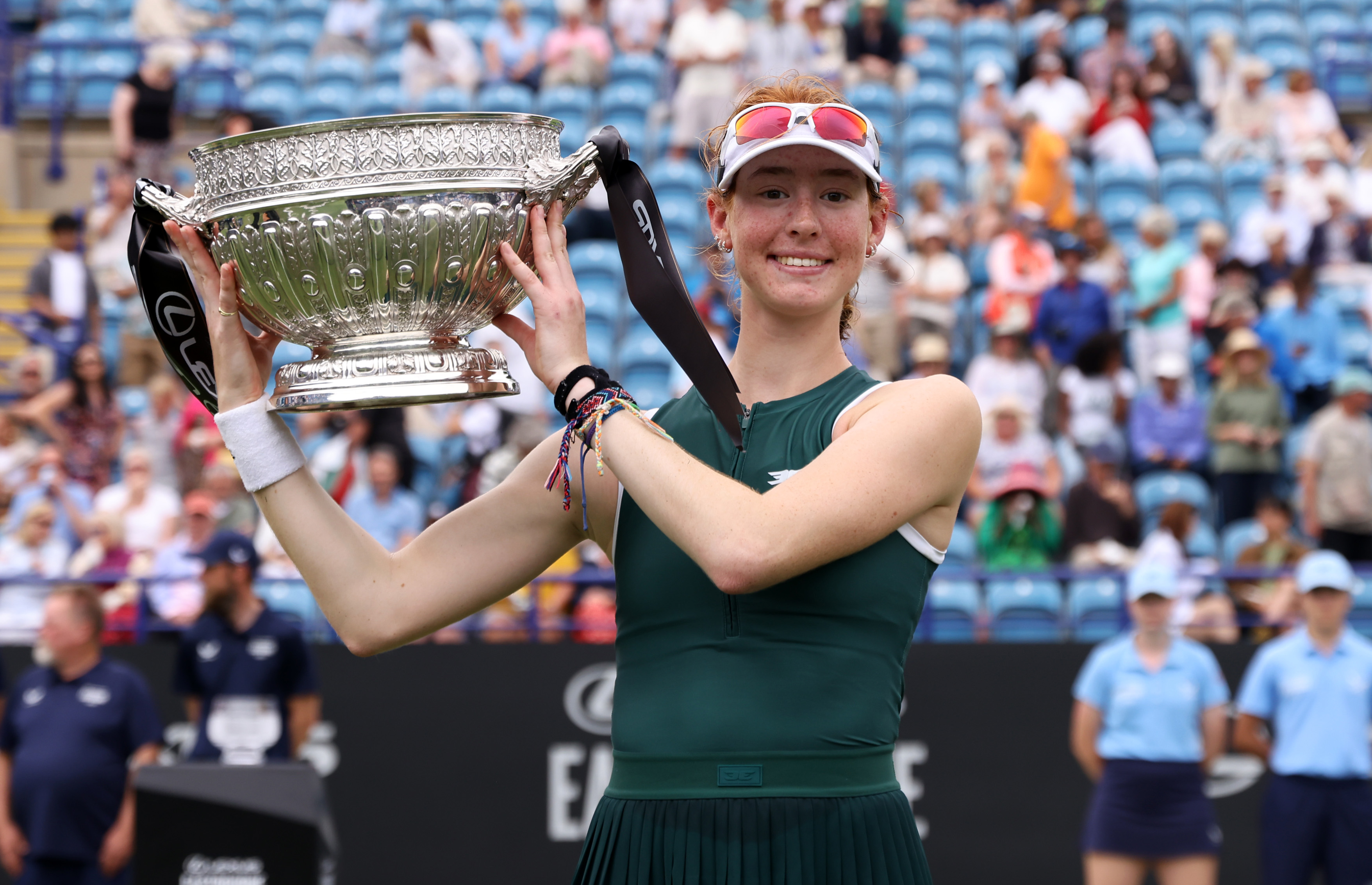
Eastbourne’s grass courts in June presented a sterner test, starting with former World No. 2 Ons Jabeur, whom Joint dispatched 7-5, 6-2 by absorbing power and redirecting with slice underspin. She then edged 2021 US Open champion Emma Raducanu 4-6, 6-1, 7-6(4), relying on a 1–2 pattern of body serves followed by crosscourt forehands to disrupt variety. Wins over Anna Blinkova and Anastasia Pavlyuchenkova advanced her to the final against Alexandra Eala.
The decider went to a third-set tiebreak, where Joint saved four championship points with low slices and aggressive inside-in forehands to secure 6-4, 1-6, 7-6(10). This grit on a surface she had dismissed transformed grass into a strength, propelling her into the top 50. The close battles honed her fight, turning potential setbacks into mental armor.
“The Eastbourne title definitely boosted my confidence more,” Joint noted. “I had some pretty close matches that I had to fight through. Every single match was difficult, and it was on grass, which was the surface that I had convinced myself I didn’t like.”
“I kind of blacked out in that last tiebreak. I don’t know what happened.”
Late-season semifinals in Seoul and Hong Kong capped her year, overtaking Daria Kasatkina as Australia’s No. 1 in October at No. 32. Nominated for the Newcombe Medal after being Tennis Australia’s Junior Female Athlete of the Year in 2024 with Emerson Jones, Joint’s consistency across clay’s grind, grass’s speed, and hard courts’ pace marked her versatility.
Offseason in Brisbane focuses on serve reliability to cut double faults, plus net transitions and slice variations for an all-court game. Training six days a week mixes on-court sessions with fitness, while work with psychologist Michael Lloyd refines strategies for holding breaks or facing favorites. She emphasizes playing the opponent, not the ranking, keeping focus sharp amid tour pressures.
“it’s just focusing on playing the person on the other side of the net, and not really the number or what rank they are,” Joint explained. “Everyone on the WTA Tour can play tennis, and the ranking doesn’t really matter at the end of the day. I just need to shift my focus a little bit and focus less on rankings.”
“He fixed everything, fixed my technique, my serve, movement,” she added of Mahony. “He works really well on the psychological part of the game. He’s just so knowledgeable and calm.”
The United Cup launches her 2026 in Sydney, with Australia in Group D facing Czechia’s Barbora Krejcikova and Norway’s Malene Helgo. Team events bring unique pressure, blending national duty with season-opening nerves, but the format energizes her start. Direct entries into higher events, including the Middle East swing, ease logistics for deeper runs.
Joint’s goals for 2026 build higher: a WTA 500 title, fourth round at a WTA 1000, and third round at a Grand Slam. From manifesting top-100 entry to top-50 reality, her trajectory suggests these ambitions are ripe for transcendence. With Brisbane’s courts now home, Joint carries 2025’s lessons into a year poised for Australian tennis revival.