Amanda Anisimova’s Rebuilt Path to 2025 Glory

From an eight-month mental reset to two Grand Slam finals, Amanda Anisimova fused inner resolve with physical edge, storming into the elite ranks and toppling the world’s best.
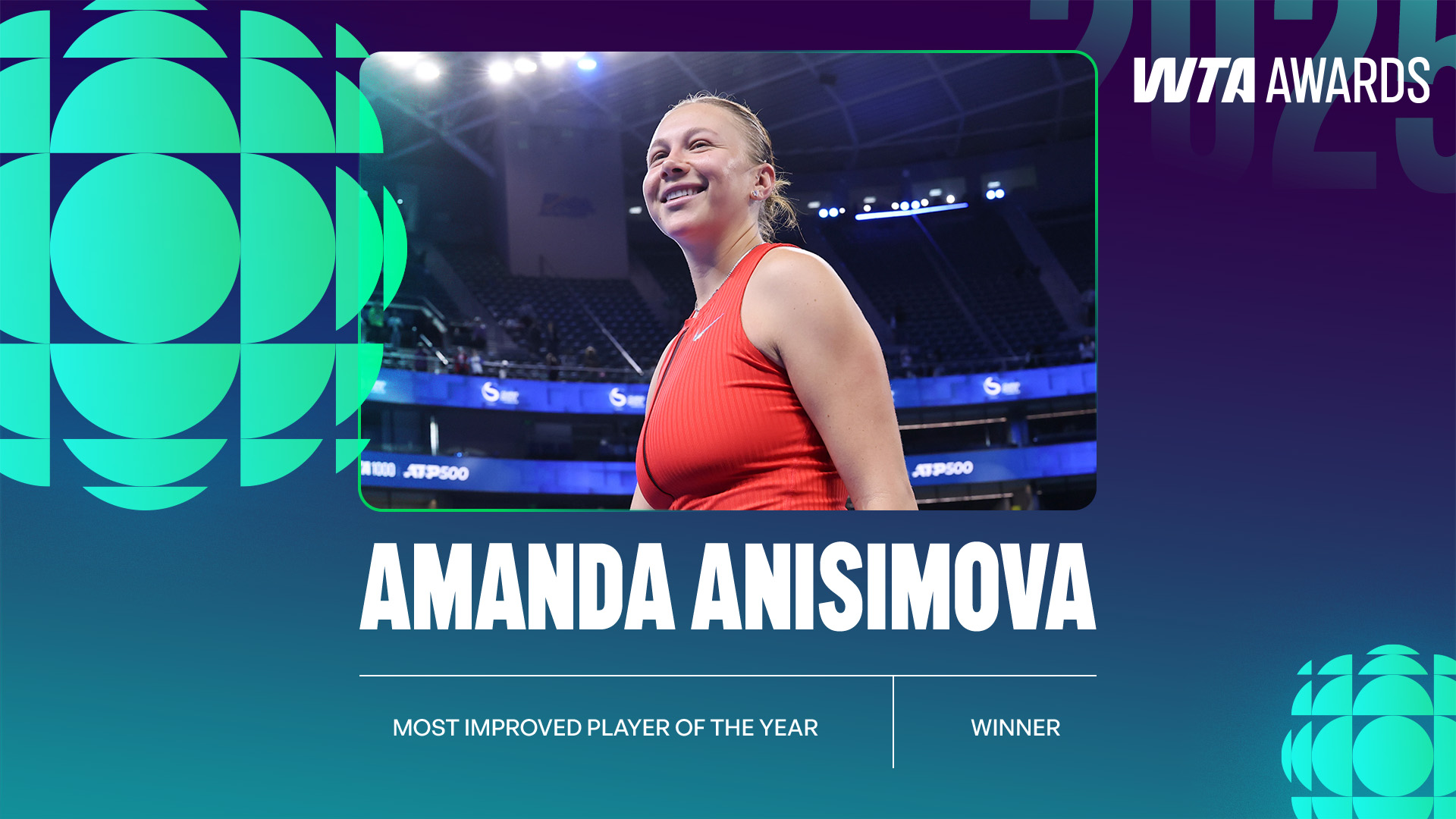
Amanda Anisimova’s 2025 surge began in the quiet of an eight-month break, where she rebuilt her mindset away from the tour’s glare. Returning in 2024, she paired that inner work with rigorous fitness drills, transforming doubt into a weapon that carried her through majors and high-stakes clashes. By year’s end, the 24-year-old American had rocketed 32 spots in the PIF WTA Rankings to No. 4, earning WTA Most Improved Player honors after a season of raw breakthroughs.
“I think all the hard work I did on the inside was what really paid off for me,” she said last month in Riyadh.
Coach Hendrik Vleeshouwers joined ahead of the grass-court swing, zeroing in on endurance to help her embrace long rallies without fear. They drilled on sustaining power through extended points, building trust in her strokes on faster surfaces. That foundation let her redirect heavy topspin crosscourt with conviction, turning tentative play into aggressive patterns that defined her ascent.
Grass-court grit meets final heartbreak
The leap crystallized at Wimbledon, where Anisimova outlasted World No. 1 Aryna Sabalenka 6-4, 4-6, 6-4 in the semifinals, mixing inside-in forehands with slice approaches to extend points on the slick grass. The crowd’s roar built as she absorbed pace and fired backhands down-the-line, forcing errors in the decider. Euphoria faded fast in the final, though, as Iga Swiatek dismantled her 6-0, 6-0, exposing gaps in her topspin loop against flat drives.
Yet Anisimova’s grace in the postmatch speech revealed a champion’s poise, turning devastation into fuel for the hard-court grind. Vleeshouwers watched her handle the sting without crumbling, a sign of the emotional ballast from her mental overhaul. That resilience echoed through the humid battles of Montreal and Cincinnati, where uneven results tested her recalibration under growing pressure.
“I think the way she handled that was amazing—we all said that, too, afterward,” Vleeshouwers said. “I mean, only true champions can do it like that. She stole our hearts even more.”
US Open fire reignites major runs
Regrouping for the US Open, Anisimova pored over Wimbledon highlights in her hotel, sharpening her edge for a quarterfinal rematch with Swiatek. She struck first with a 6-4, 6-3 win, varying her 1–2 punch—deep serves into heavy forehands inside-out—to disrupt the Pole’s rhythm and pierce her backhand. Arthur Ashe Stadium pulsed with energy as she saved deuce points, her footwork covering cracks without fading.
Advancing past Naomi Osaka in a three-set semifinal thriller, she navigated two tiebreaks with underspin slices that neutralized power, opening the court for crosscourt winners. The final fall to Sabalenka came 6-4, 6-3, but it sealed WTA Finals qualification and proved her belonging in the crucible. Those deep runs amplified every practice rep, blending psychological prep with shot selection that wore down foes across surfaces.
In Riyadh, she topped Swiatek again 6-7(3), 6-4, 6-2 to reach the semifinals, holding serve in clutch games while varying pace with down-the-line backhands on the indoor hard courts. The victory felt earned, not shocking, after a year of tough matches that honed her capabilities. Doha and Beijing fell next as WTA 1000 titles, where aggressive net rushes and rally tolerance turned transitions into dominance, finishing 47-18 with over $7 million in prize money.
Elite stats signal sustained rise
Anisimova’s ledger dazzled: victories over all four reigning Grand Slam champions, a feat unseen in seven years; 10 Top 10 scalps, topping her prior career total; and 13 straight three-set wins at Grand Slams, WTA 1000s, or 500s. She outclimbed Ekaterina Alexandrova’s 18-spot gain and Madison Keys’ 14 from No. 36 at 2024’s close, crashing the top 10 from furthest out. Vleeshouwers first glimpsed her raw potential in a 2024 Libema Open qualifying loss, molding it into a fluid machine of one–two setups that exhausted opponents.
“No,” she explained, “I don’t think I was surprised or shocked at any point in the match. I feel like I belong at this point, and I’ve played a lot of tough matches this year. So yeah, I know my capabilities.”
At 24, with her 25th birthday in August, her path echoes Sabalenka’s—first major at the same age, now four from 11 attempts and 10 semifinals. The coach eyes 2026 with optimism, leveraging this year’s data for emotional stability in big spots. As off-season reflections settle, Anisimova’s inner alignment promises more surges, where mind and body sync to chase those elusive titles across the tour’s relentless cycle.