Chris Evert’s trailblazing path to the WTA’s first No. 1

In the fog of subjective rankings, Chris Evert’s 1975 dominance cut through with unyielding precision, launching an era where consistency crowned champions and reshaped women’s tennis forever.
On November 3, 1975, women’s tennis shed its cloak of opinion-driven ambiguity as Chris Evert, at just 20, became the inaugural No. 1 in the freshly minted WTA rankings. The computerized system, unveiled two years after the tour’s birth, tallied points across the calendar with impartial rigor, elevating her season of relentless baseline control to official supremacy. From clay courts where her flat groundstrokes pinned foes deep to indoor arenas buzzing with tension, Evert’s game embodied the shift toward year-round accountability.
Clarity emerges from ranking chaos
Before this innovation, top billing hinged on whims, with Evert and Martina Navratilova often sharing the crown in fractured views—the ITF leaning on her Grand Slam edge while other metrics favored her rival’s indoor surges. She recalled the era’s haze from her academy in Boca Raton, Florida, where debates swirled without resolution. The new formula brought mathematical relief, weighting Virginia Slims stops alongside majors to honor sustained excellence over fleeting triumphs.
Evert’s voice warmed with the memory of that dawn. “When the computer rankings came on, it was like, ‘Oh, my God, it was so clear,'” she said. “There’s so much more clarity now—it’s certain. The computerized rankings really recognized the importance of the Virginia Slims events. It recognized the importance of consistency throughout the year. This was a more balanced system. You really knew where you stood.”
“When the computer rankings came on, it was like, ‘Oh, my God, it was so clear,'” she said. “There’s so much more clarity now—it’s certain. The computerized rankings really recognized the importance of the Virginia Slims events. It recognized the importance of consistency throughout the year. This was a more balanced system. You really knew where you stood.”
That precision mirrors today’s landscape, where Aryna Sabalenka has stood as the PIF WTA Rankings’ No. 1 player for more than one year running. Earlier this week, it was announced she’s already locked up the year-end top spot, securing her place as the 29th woman to reach the summit and one of six active players there, including Iga Swiatek, Venus Williams, Naomi Osaka, Victoria Azarenka, and Karolina Pliskova. Evert’s own 260 weeks atop the list rank fourth all-time, trailing Steffi Graf’s 377, Navratilova’s 332, and Serena Williams’ 319.
“I was very proud,” she added of that inaugural day. “It was kind of a big deal.”
49 years ago today, on November 3, 1975, @ChrissieEvert became the first-ever No. 1 ranked player in the @WTA.
She would hold the No. 1 spot for a total of 260 weeks. 👏 pic.twitter.com/rT7INL0sCh— Billie Jean King (@BillieJeanKing) November 3, 2024
Dominance forged in 1975’s pressure cooker
Evert’s campaign that year verged on flawless, her 16 titles from 22 tournaments and 94 wins in 100 matches outpacing modern pacesetters—Sabalenka, Swiatek, and Coco Gauff combined for nine crowns and under 56 victories this season. Losses came sparingly, twice each to Navratilova’s net-rushing assaults and Billie Jean King’s versatile counters, plus defeats against Evonne Goolagong’s grass-court glide and Virginia Wade’s gritty returns. On red clay at the French Open, her second straight title arrived through extended crosscourt exchanges, inside-out backhands carving angles that forced errors under Paris sun.
Her first U.S. Open crown on hard courts demanded swift adaptations, flat forehands slicing through steamy New York rallies to neutralize Wade’s variety, while the Italian Open echoed her clay mastery with probing slices that disrupted rhythm. The Virginia Slims Championships, her third there, unfolded amid Madison Square Garden’s electric hum, 16,000 fans nightly amplifying the stakes as she built momentum from one baseline duel to the next. Now 70, she laughed over the phone at the recounting, her tone laced with awe.
“Well, that’s incredible,” Evert said. “Consistency, that’s what I was known for. That was my strength. Short memory, going on to the next tournaments. Picking up that momentum. It was a big year.”
Those traits shone in her rivalry with Navratilova, a stylistic showdown that flipped the No. 1 spot repeatedly—Evert claiming it nine times, her foe eight, with six rebounds in between. They tracked shifts keenly, as seeding perks made the perch a tournament lifeline, often eclipsing single Slam glory. “Oh, yes,” she confirmed. “Because it reflects in the seeding of the tournament—of course. It was a bigger deal to be No. 1 back then than it was to win a Slam. Hands down.”
Legacy echoes in the tour’s boom
The 1970s surge owed much to Virginia Slims backing, which beamed matches onto national screens and swelled crowds, turning every weekend event into a cultural pulse point. Evert noted how scrutiny expanded beyond majors to the full grind, each crosscourt winner or down-the-line pass stacking toward year-end verdict. Under Billie Jean King’s stewardship, the tour pioneered women’s sports elevation, with Evert’s poise amid the roar a beacon for the era’s trailblazers.
“The question had always been, ‘How did you do in the Slams?' The focus went from that to the whole year, where every week counted, every tournament was important,” she reflected. “At the end of the day, the 70s were the tennis boom. It was the perfect storm, because all of this came together. The tour, women’s tennis players really being the first women athletes to get to that high level and be leaders for other women’s sports. People say, ‘Gosh, wouldn’t you love to be playing in this day and age—with all the money?' No. I’m so happy I came up when I did under the guidance of Billie Jean [King] and that group of leaders. To follow in their footsteps, to witness that and be a part of that, I would never trade that in a million years.”
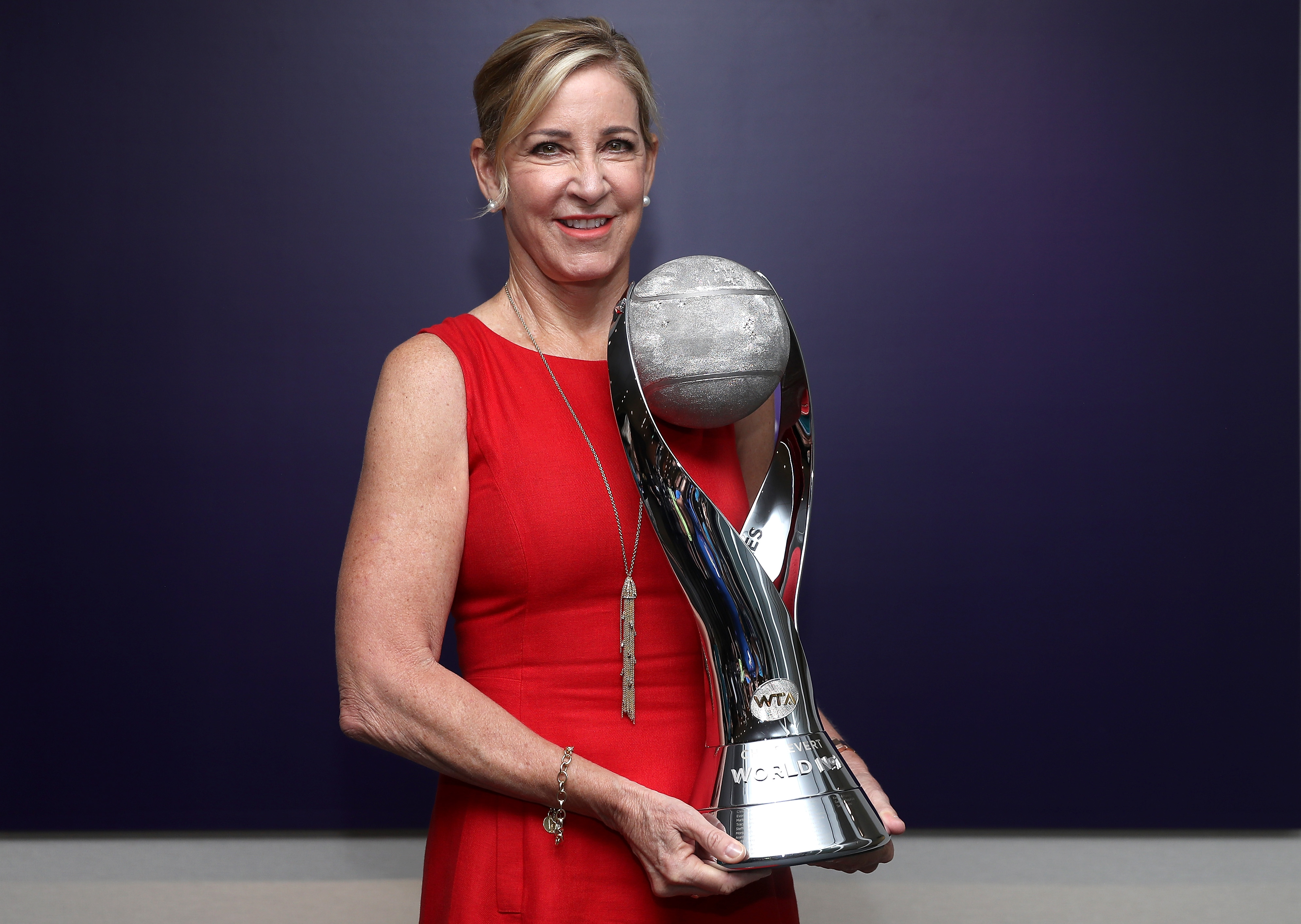
A 2018 ceremony at the WTA Finals in Singapore etched her milestone into permanence, bestowing her name on the year-end No. 1 trophy. Her career tally—154 titles, a 1,304-144 record topping 90% wins—crystallized the focus that propelled her. “I’m honored and privileged to have my name on this trophy,” she said then. “It’s the ultimate achievement to be No. 1 in the world in any endeavor. When I was a young girl, I always dreamt of winning a Grand Slam, but I had bigger dreams about being No. 1. Because it’s about being consistent, focused and having a lot of quality wins during the year, and that, to me, is a champion.”
“It’s nice to have one thing in my name,” Evert concluded with a chuckle. “It’s something forever. It’s a legacy. Hopefully, they won’t take my name off it.” As Sabalenka cements her reign, Evert’s blueprint of mental steel and tactical depth reminds the field that true No. 1 status demands conquering the calendar’s every twist, from quiet academies to thunderous finals.