Zverev’s Limits Tested in Alcaraz Marathon

Alexander Zverev pushed Carlos Alcaraz to the brink in a record-breaking Australian Open semi-final, falling just three points short after a five-set war that drained them both. The German’s reflections reveal the raw edge of major pursuits on Melbourne’s hard courts.
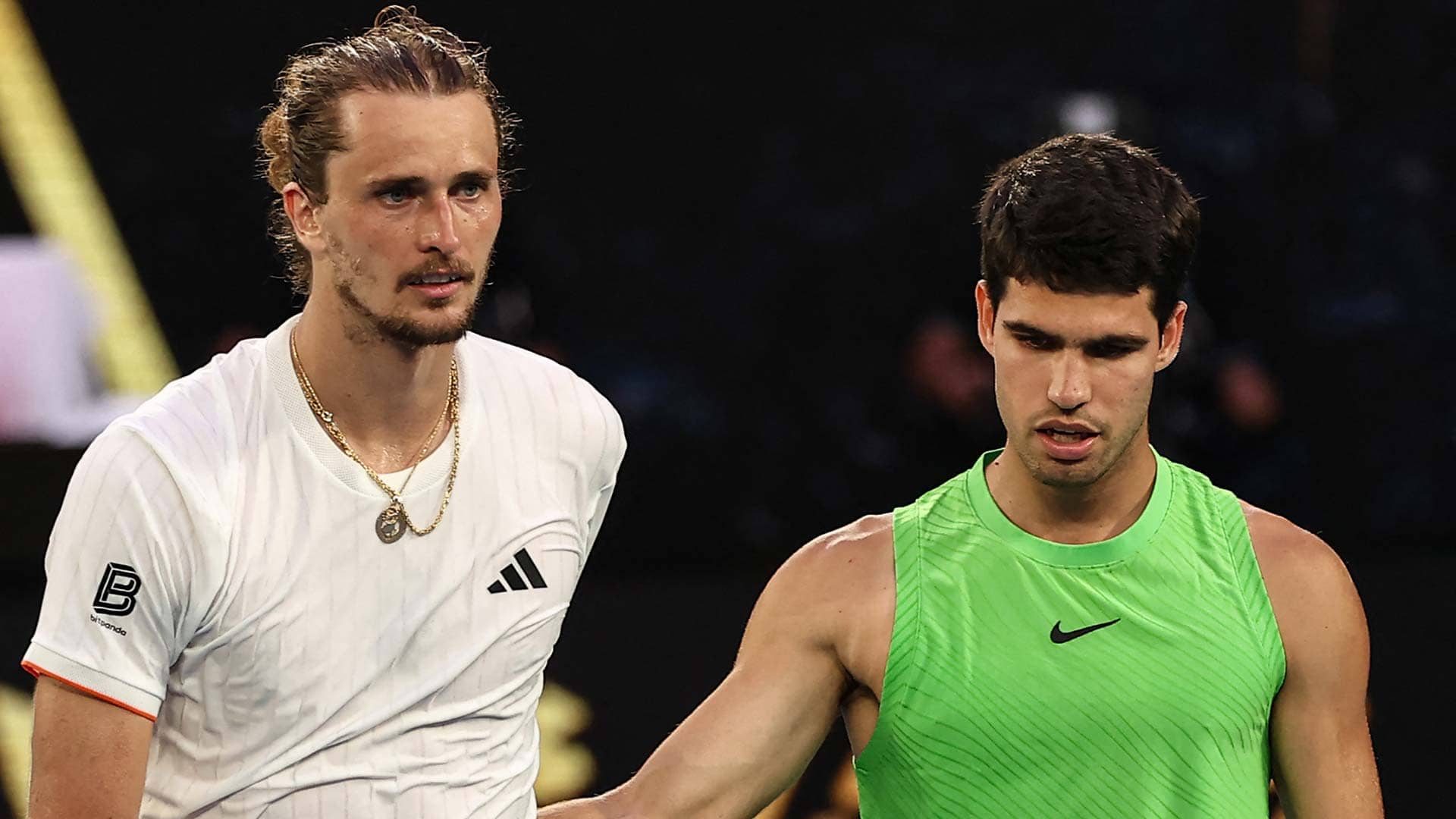
The Rod Laver Arena lights buzzed under Melbourne’s night sky, where the thud of balls on hard courts echoed a duel for survival. Alexander Zverev stood three points from his first major title, serving at 5-4 in the fifth against Carlos Alcaraz, but the Spaniard refused to yield, rallying from 3-5 to claim a five-hour, 27-minute victory—the longest semi-final in Australian Open history. This clash, the third seed’s latest brush with Grand Slam glory, left Zverev physically spent and mentally recalibrating for the season ahead.
From two sets down, Zverev’s comeback showcased his baseline power, with heavy topspin forehands pinning Alcaraz deep and inside-out backhands carving angles on the fast surface. Yet the decider’s chaos, marked by slipping footing and labored breaths, turned every point into a test of will. The crowd’s murmurs built to a frenzy, sensing the shift as Alcaraz’s quick adjustments—low slices forcing errors—eroded the German’s lead.
“Unbelievable fight, battle. Unfortunate ending for me, but to be honest, I had absolutely nothing left in me,” Zverev said. “To be honest, I think I’m way too tired to have emotions right now, so like in two days, I’ll probably have more, but right now I’m just exhausted,” the German later continued. “I think we both went to our absolute limits, so somewhat I’m also proud of myself, the way I was hanging on and came back from two sets to love.
Exhaustion clouds the immediate sting
In the press room’s dim glow, Zverev’s fatigue showed in his slumped shoulders, the weight of the 28-year-old’s pursuit—a fourth major final and second straight Australian Open title match—pressing down. He spoke of pride in the fight, crediting offseason work on footwork and serve returns that fueled his rally, yet the early-year grind amplified the letdown. This opener sets the tone; a deep run here builds momentum for the majors to come, easing the shadows of past heartbreaks.
Alcaraz‘s physical hiccups in the third set, with cramps slowing his explosive movement, offered a window Zverev couldn’t fully seize. The Spaniard’s 15-1 five-set record loomed, but Zverev brushed it aside during those final serves, his mind fixed on holding upright amid the humidity. Their head-to-head, now 7-6 for Alcaraz, underscores a rivalry where endurance often tips the scale on hard courts.
Second set haunts more than the finish
Zverev’s regrets centered not on the fifth-set scramble but on the second, where serving at 5-4, his one–two pattern—big serve into crosscourt forehand—cracked under Alcaraz’s returns skidding low off the surface. Unforced errors crept in, backhands sailing long, letting the Spaniard level and reset the mental flow. Had he closed there, with Alcaraz’s cramps emerging soon after, the match’s physical toll might have swung differently.
“The second set, that one, I felt like I should have won,” Zverev reflected. “Especially serving for it, I didn’t play a good game serving for it. Funny enough, I don’t have many regrets in the fifth set, because I was hanging on for dear life, to be honest. I was exhausted. But the second set. I think going up, being one set all, and him starting to cramp in the third set, that probably would have made a difference.”
This tactical slip, over three hours before the end, highlighted how early momentum shapes marathons; Zverev’s deep returns had dominated earlier, but a lapse allowed Alcaraz to mix underspin passes with down-the-line winners, exploiting the court’s pace. The German’s slice backhands, effective in defense, lost sting as fatigue set in later, forcing longer rallies that tested his reserves.
Physical parity fuels forward resolve
Zverev downplayed Alcaraz’s long-match edge, pointing to his own solidity—proven in last year’s Paris grind against Jannik Sinner—and the offseason tweaks sharpening his game for fast surfaces. “I know my five-set record is quite good, as well. But, no, of course not,“ he said. ”it’s not something you think about 5-4 serving. I had other thoughts in my mind. Basically I didn’t want to fall over in the match. “No, it’s not something I think about, but I know that he’s fit, I know that he’s very, very strong and hard to beat in long matches. He’s proven that last year in Paris, I think, as well against Jannik. I always feel like on the physical side I’m quite okay as well.”
With Alcaraz advancing to face Jannik Sinner or Novak Djokovic in the final, Zverev eyed the horizon: “Of course it’s disappointing, but this is the start of the year, so if I continue playing that way, if I continue training the way I train, if I continue working on the things that I’ve been working in the offseason, I do believe it’s going to be a good year for me.” The semi’s intensity, from inside-in forehands to desperate lunges, forges the resilience needed for the tour’s grind. In 2026’s opening act, this near-miss sharpens Zverev’s edge, promising fiercer battles ahead.