Federer Breaks Through in Milan After Years of Close Calls

Twenty-five years on, revisit the indoor hard-court week in 2001 when a 19-year-old Roger Federer turned mounting pressure into his first ATP Tour title, conquering veterans and his own doubts along the way.
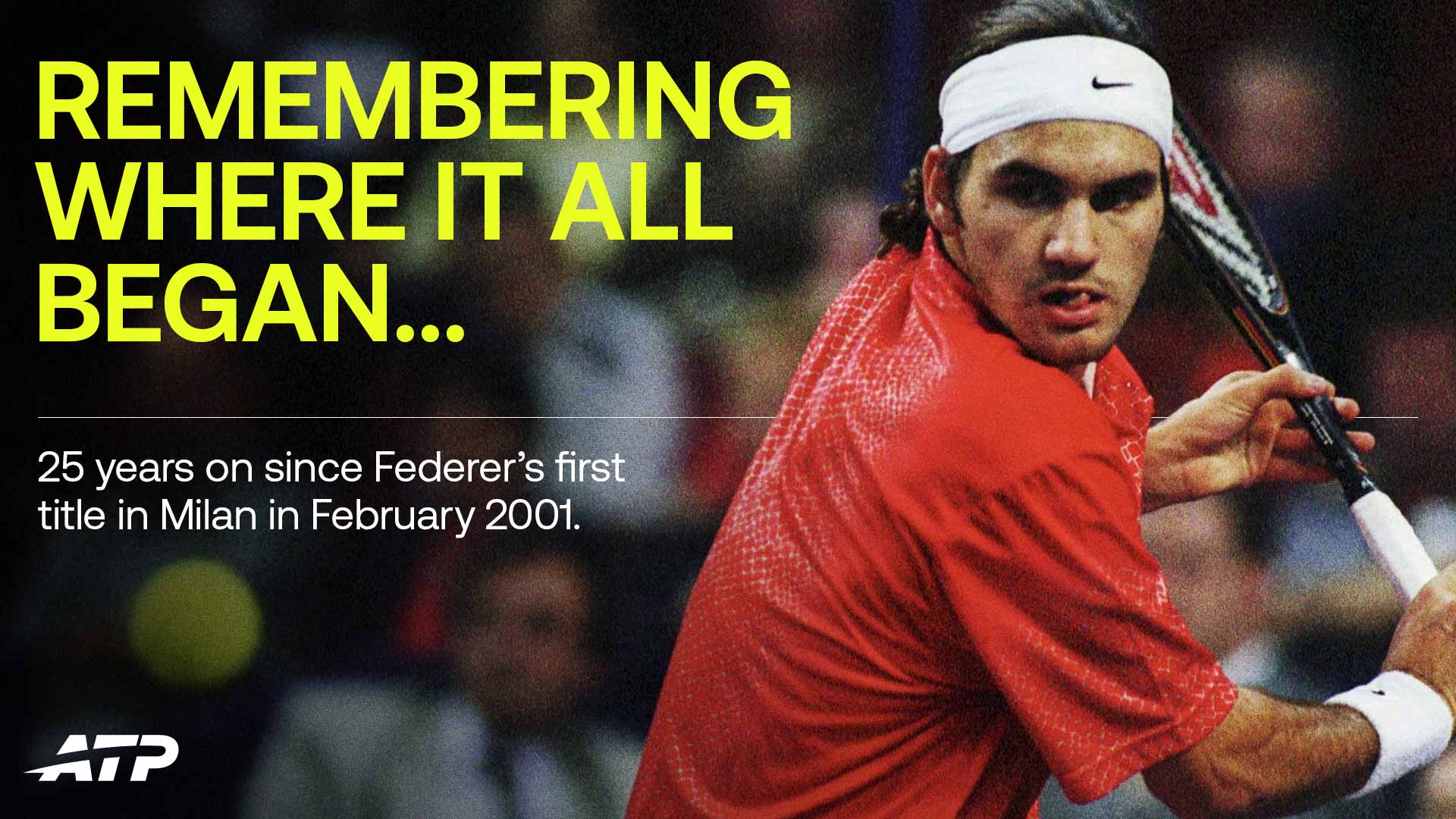
Twenty-five years ago this February, under the swift indoor hard-court bounce in Milan, a 19-year-old Roger Federer finally claimed his first ATP Tour trophy. The air crackled with expectation for a player who’d reached finals in Marseille and Basel the previous season but come up empty each time. Ranked inside the Top 30, he arrived not as a raw prospect but as one on the verge, the Milan draw a gauntlet that would test his blend of fluid strokes and fragile nerves.
The path started solidly against Rainer Schuettler and Cyril Saulnier, where Federer used heavy topspin forehands to dictate from the baseline, pinning opponents deep and converting breaks with crosscourt precision. But the quarterfinal against Goran Ivanisevic ramped up the intensity—the Croat’s lefty serves and slice backhands exploited the fast surface, forcing the young Swiss to sharpen his footwork and return deeper. He took it in straight sets, each winner building quiet confidence, even as Ivanisevic headed toward his Wimbledon glory months later.
“Out of the four guys in the semis, I felt the title was in my hands,” Yevgeny Kafelnikov told ATPTour.com.
Turning the tide on a seasoned rival
In the semifinals, Federer faced Kafelnikov, the No. 7 seed and former World No. 1 who’d won their three prior meetings, his flat groundstrokes thriving on the indoor speed. The Swiss opened aggressively with inside-out forehands to stretch the Russian wide, clashing topspin against power in a match that tilted his way 6-2, 6-7(4), 6-3. A mid-second-set reset saw him mix one–two serves with down-the-line backhands, breaking through when Kafelnikov’s movement faltered on the slick court.
Kafelnikov had sensed the potential early, recalling their first clash in Rotterdam when Federer was 18 and nearly upset him in three sets. The veteran noted the teenager’s distractions—fiddling with PlayStation alongside his coach—but foresaw the focus that would sharpen around age 22, unlocking a game destined for the top.
“We all knew that Roger was the best junior at the time,” Kafelnikov said. “I remember playing him for the first time in Rotterdam when he was still 18. It took me three sets to get past him. I knew all he needed at that time was someone who could lock him up in the frame of mind when he could be really focused on his tennis. [He was] playing the PlayStation with the coach. He was not so focused compared to when he turned 22, when he started to really believe that he could be No. 1. He had the game to be the best player in the world, we all knew that.”
This win marked Federer’s first over an ATP No. 1 Club member, propelling him into his third tour final against Julien Boutter, who’d edged Greg Rusedski in the other semi. The crowd’s murmurs grew as the championship match unfolded, the pressure of being the favorite weighing on the 19-year-old against Boutter’s big serving.
Steadying for the title-clinching reset
Federer pocketed the opening set 6-4 with precise returns that jammed Boutter’s swing, high-bouncing topspin to the body disrupting the Frenchman’s rhythm on the low-bouncing hard court. The second set dragged into a tiebreak, where Boutter’s aces edged it 9-7, echoing the heartbreaks of prior finals and testing the Swiss’s resolve. He exhaled, refocused on serve-and-volley approaches, and sealed the decider 6-4 with inside-in forehands that cut off angles, wrapping the 6-4, 6-7(7), 6-4 victory.
The triumph brought immediate relief, the trophy lift a release after three years since his debut ATP win in Toulouse in 1998. Boutter later reflected on his place in the story, humbly noting he was the first to fall in a final to Federer, though far from the last.
“I really wanted to win my first ATP Tour title,” Federer once told the ATP. “That was a big week, beating Boutter in the final. It felt like I had pressure because maybe I went into that final a little bit as the favourite. But it was fast indoors and Boutter was a big server, so you never knew what was going on. I think it was more of a relief rather than joy or happiness. I think that kicked in 24 hours later. I remember I thought, ‘At least I have one’.”
“I am a really small space in the career of Federer,” Boutter said. “I am the first one to lose in a final against him, but many guys did the same as me.”
Looking back, Milan’s indoor hard-court breakthrough in 2001 laid the foundation for Federer’s ascent, blending tactical smarts with mental steel to fuel 103 titles, including 20 Grand Slams, his last arriving in Basel in 2019. That week taught him to channel hype into drive, the echoes of tiebreak tension and veteran battles rippling through a career that redefined the sport. As the confetti fell, the horizon stretched wide, his game now armored by lessons etched in Milan.
Read more: https://www.atptour.com/en/news/federer-milan-2001-title-25-years-on