Basavareddy Leans on Cervara for Jeddah Breakthrough

With a semifinal on the line against Justin Engel at the Next Gen ATP Finals, Nishesh Basavareddy draws strength from his new coach Gilles Cervara’s high-stakes experience to steady his rising game.
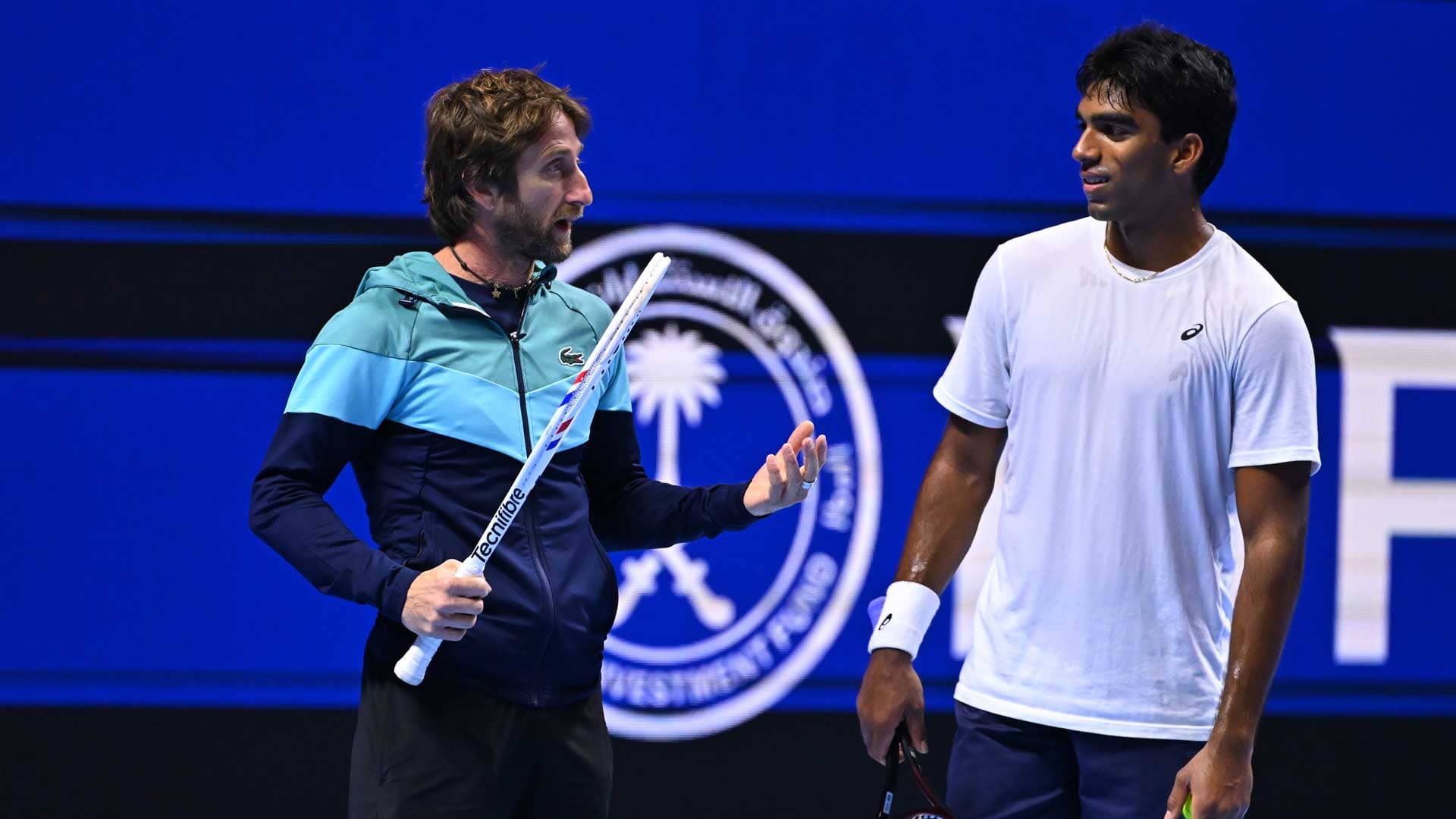
In Jeddah’s buzzing arena, where the Next Gen ATP Finals crackle with the urgency of young talents forging their legacies, Nishesh Basavareddy approaches Friday’s must-win against Justin Engel with renewed clarity. The 20-year-old American has split his round-robin matches, each outcome sharpening the focus on what a victory could mean—a semifinal spot that builds on his breakout flashes from a turbulent first full tour season. Now, with Gilles Cervara in his corner for the first time at a tournament, Basavareddy carries the weight of expectation tempered by expert guidance.
Cervara, who steered Daniil Medvedev to the 2021 US Open title and the world No. 1 ranking in 2022, joined Basavareddy in December after parting ways with the Russian in August. The partnership emerged quickly, as the American’s team sensed a match in experience and approach that could stabilize his path. Early talks have centered on refining his baseline power and physical edges, turning seasonal inconsistencies into sustainable strengths.
“My team reached out to his team after we heard about his split with Daniil,” Basavareddy told ATPTour.com in Jeddah. “We just thought it’d be a great fit with all his experience and his mindset. I’m really glad it worked out.”
Forging core strengths in December
The duo’s initial sessions drilled into the essentials: game patterns, body resilience, and serve mechanics to withstand the tour’s demands. Basavareddy has targeted his delivery, adding placement and spin to counter aggressive returns on fast hard courts like those in Jeddah. These adjustments address the energy dips that plagued his 2025 results, where heavy topspin forehands shone in bursts but faded under prolonged rallies.
His season blended highs, like the ATP 250 semifinal in Auckland and a set taken from Novak Djokovic at the Australian Open via probing inside-out shots, with tougher stretches on varied surfaces—from Cincinnati’s hard courts to Los Cabos, Winston-Salem, and Hangzhou. Cervara’s input layers defensive variety, such as underspin backhands to disrupt opponents’ rhythm in crosscourt exchanges. With a support team bolstering conditioning, Basavareddy aims to maintain that baseline dominance longer, especially in the short-court format here that rewards quick 1–2 combinations.
“The game is a huge, huge aspect,” Basavareddy said on what they have been working on in December. “Physically, that’s also a big area I can continue to improve in. We’re trying to build the right team around us to improve that side. I’ve also put a lot of work into my serve.”
Channeling experience against the pressure
Last year’s 1-2 record at this event left Basavareddy wide-eyed amid the debut intensity, but a full tour campaign has grounded him, turning the electric crowd noise into familiar fuel. Ranked No. 167 in the PIF ATP Rankings, he enters this decider more attuned to the indoor hard’s low bounce, where down-the-line passes can punish lapses. Cervara’s presence, marked by his 2019 ATP Coach of the Year award and Medvedev’s haul of two ATP Masters 1000 titles that year plus the 2020 Nitto ATP Finals, offers a roadmap through the mental fog of high-stakes play.
The American values that proven navigation, reflecting on a year of hard-won lessons from travel isolation and narrow defeats. Against Engel’s steady baseline game, he plans to deploy sharper transitions, following deep crosscourt returns with inside-in forehands to seize control early. This familiarity with Jeddah’s tempo, amplified by no-let serves and compact dimensions, positions him to convert break chances more efficiently than his season norm.
“It’s huge,” Basavareddy said. “This first year on Tour I’ve learned a lot. There are definitely things I could have done differently. So going forward, it’s nice to have someone who knows the path to get to the top. I think that’ll help me a lot.”
Mapping ambitions beyond the semis
Short-term focus locks on health and 2026 preparation, but the horizon stretches toward ranking climbs and all-court mastery, free from direct Medvedev shadows. Basavareddy, a two-time ATP Challenger Tour champion, emphasizes their stylistic differences—his power versus the counterpuncher’s finesse—while embracing the belief that drives progress. Cervara’s return to developing talent injects tactical nuance, like varying slice approaches to open angles in defensive scrambles.
In the arena’s rising hum, where every point echoes with semifinal implications, this pairing transforms past scars into forward momentum. Basavareddy eyes a strong 2025 close, channeling matured insight into purposeful aggression against Engel.
“Initially it’s to try to get healthy, try to get ready for the new season and then moving forward, just try to become the best player I can be and see how far, how far we can go up the rankings.”
“It’s tough to say because we’re completely different players,” he added on comparisons. “But I’m glad he believes in me and I believe in myself. Hopefully we can see how far I can go.”
“Last year here I was wide-eyed, it was my first big tournament,” Basavareddy said. “This year it feels a little more normal. I’m still really excited. It’s one of the biggest events we have.”
“I gained a lot of valuable insight and experience,” he said. “I definitely feel much more experienced than last year. Let’s hope to end 2025 with some success.”
As the match unfolds, Cervara’s steady gaze from the sidelines could tip the scales, turning Basavareddy’s raw potential into the precision needed for deeper runs and a brighter 2026.