NextGenATP Trio Sparks 2025 Fireworks

Jakub Mensik, Joao Fonseca, and Learner Tien turned early promise into a year of bold breakthroughs, conquering surfaces and scalps while the tour watched a new generation ignite.

In the blistering December heat of Jeddah, the Next Gen ATP Finals presented by PIF set the stage for 2025’s breakout stars. Jakub Mensik, Joao Fonseca, and Learner Tien arrived as prospects, leaving as harbingers of change—Fonseca claiming the title over Tien in a final that crackled with youthful intensity. Weeks later, they hit Melbourne’s hard courts, ready to prove their mettle against the ATP’s elite.
Tien’s lefty spin carved through the Australian Open draw, his heavy topspin forehands forcing unforced errors in grueling rallies, landing him in the fourth round as the youngest there since Rafael Nadal in 2005. Fonseca unleashed inside-out winners to upset Andrey Rublev, while Mensik’s precise down-the-line backhands dismantled Casper Ruud, each Top 10 victory a jolt that sent their rankings surging and whispers turning to roars in the stands.
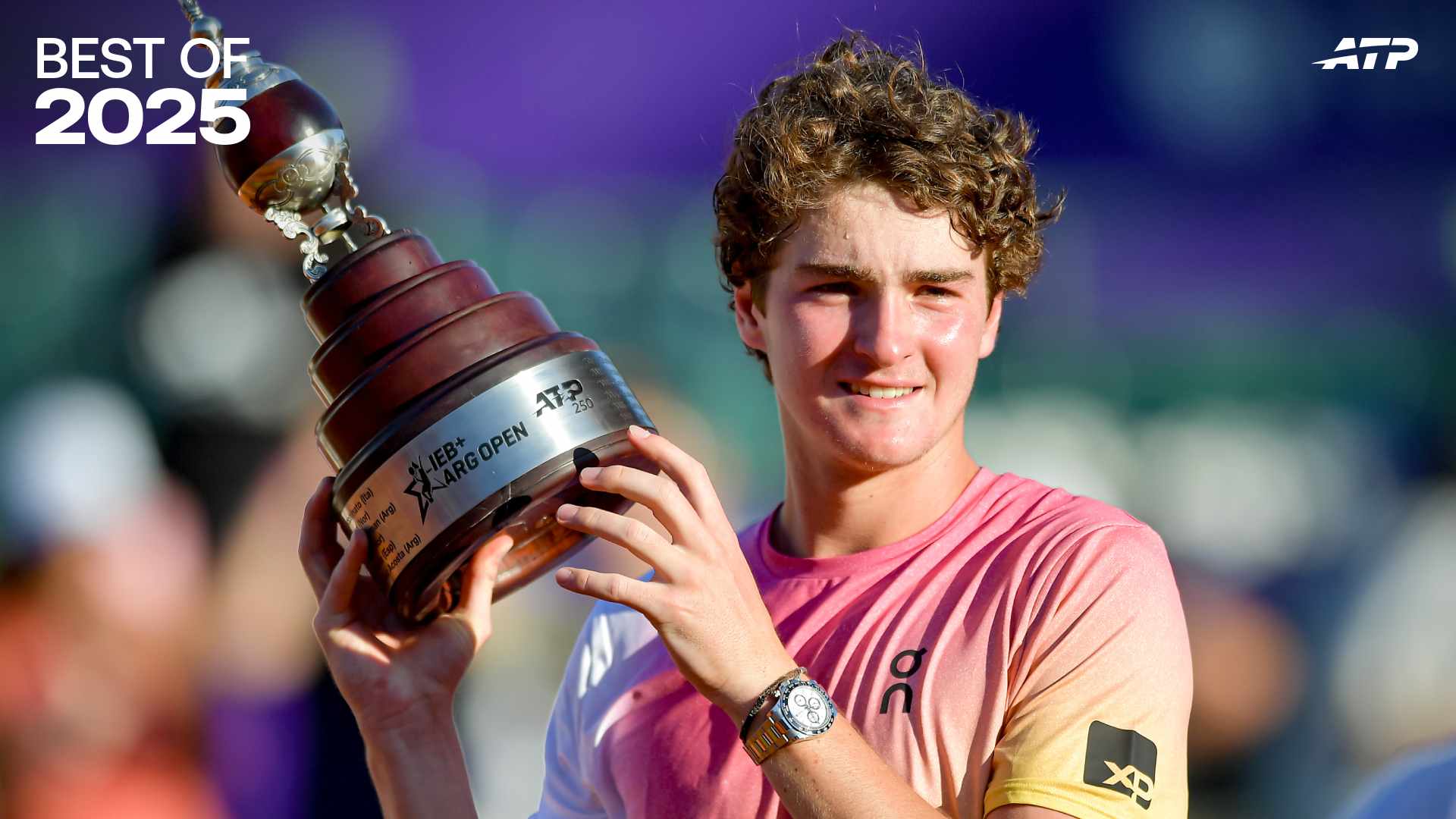
“Unbelievable week, even in Argentina, there are some Brazilians cheering for me,” an emotional Fonseca said following his final victory against Francisco Cerundolo. “That’s just amazing. Every Brazilian, everyone from their country wants this support from your own country. For me, this [moment] that I’m living is just unbelievable.”
Clay courts forge early triumphs
February’s red dust in Buenos Aires suited Fonseca’s grinding style perfectly. The 18-year-old Brazilian slid into points with deep crosscourt groundstrokes and low slices, capturing his maiden ATP Tour title at the 250 event—the youngest South American champion since 1990. That victory, sealed against Cerundolo amid chants from unexpected supporters, bridged his prodigy status to proven contender.
March’s Masters 1000 circuit amplified the pace. Fonseca notched his second win at Indian Wells, battling through baseline exchanges that tested his retrieval on the hard courts. Then Mensik exploded in Miami, his 19-year-old game peaking with a stunning final over Novak Djokovic, powered by flat serves to the body and inside-in forehands that neutralized the Serb’s returns.
Along the way, he outmaneuvered Jack Draper with varied depth, wore down Arthur Fils in a topspin battle, and edged Taylor Fritz via sharp passing shots—the second-youngest titlist there behind Carlos Alcaraz, and the first Czech since Tomas Berdych in Paris 2005. The crowd’s eruption echoed the shift: these kids weren’t just surviving; they were dictating.
“It feels incredible,“ Mensik said in his on-court interview after becoming the ninth-youngest Masters 1000 champion in history. ”It was probably the biggest day of my life and I did super, which I’m really glad [about], to show the performance and keep the nerves outside of the court before the match. I feel just super happy and I think that the feelings will come later.“
Surfaces shift, momentum holds
Mensik carried that fire into spring clay, reaching Madrid’s quarterfinals with improved net approaches and Rome’s fourth round by layering underspin to disrupt rhythms on the slower bounce. Fonseca built on his dirt affinity, pushing to Roland Garros‘s third round where high-bouncing forehands kept foes at bay, absorbing the tournament’s weight with quiet resolve.
Grass season flipped the tempo at Wimbledon, where Mensik and Fonseca both hit the third round—the Czech shortening points with serve-volley rushes, the Brazilian relying on one-two serve-forehand combos to counter the slip. Tien, meanwhile, sliced to a quarterfinal in Mallorca, his low-bouncing backhands skimming the turf in a second deep run that hinted at his all-surface potential.
North America’s hard-court grind brought fresh tests. Tien strung three straight-set wins in Toronto, his crosscourt angles pinpoint before a fourth-round loss to friend Alex Michelsen exposed patterns but sparked sharper adjustments. Fonseca impressed in Cincinnati, upsetting Alejandro Davidovich Fokina through patient rallies that turned power back on its owner, reaching the third round as fatigue loomed.
Late surges crown the year
Autumn delivered the crescendo. Tien charged Beijing’s ATP 500 final, upsetting Francisco Cerundolo with serve variety, outlasting Flavio Cobolli via topspin loops, cracking Lorenzo Musetti‘s one-hander with high kicks, and pressuring Daniil Medvedev deep with down-the-line strikes. Shanghai’s fourth round followed, but Metz in November sealed his breakthrough—his first ATP Tour title as the first American teenager since Andy Roddick in 2002, indoor hard amplifying his 1–2 patterns into overwhelming force.
”I never take it for granted, just coming out here and competing. So, holding this trophy just means the world to me. And I’m just really grateful,” Tien said during the trophy ceremony. “I want to thank my team, the ones that are here, the ones that are at home, for all the support, for everything this whole year and always, it means the world to me.”
Fonseca’s October peak in Basel added another layer, the 19-year-old claiming the ATP 500 crown—the first Brazilian above 250 level since Gustavo Kuerten in 2001, and third-youngest in the series—with forehand winners piercing the air. Mensik closed at a career-high No. 16, Fonseca at No. 24, Tien at No. 28, their climbs a map of calculated risks and unyielding drive.
Other NextGenATP talents like Alexander Blockx, Dino Prizmic, Martin Landaluce, Nicolai Budkov Kjaer, Nishesh Basavareddy, and Rafael Jodar prepare for Jeddah, with Budkov Kjaer securing four ATP Challenger titles, Jodar three, Blockx and Prizmic two, Landaluce one, and Basavareddy hitting Auckland’s semifinals. As 2025’s echoes fade, this trio’s blueprint—adapting spin and strategy across every shift—promises more upsets, signaling a tour where youth redefines the baseline.