Dimitrov’s Lifetime Craft Turns Nets into Traps

Grigor Dimitrov spent 2025 punishing every bold lunge to the net, his passes carving through defenses with a precision born from decades of outmaneuvering taller foes. Leading the ATP Tour at 40.6 percent points won against net-rushers, the Bulgarian’s game blended artistry and ice-cold reads, turning aggression into his greatest ally.
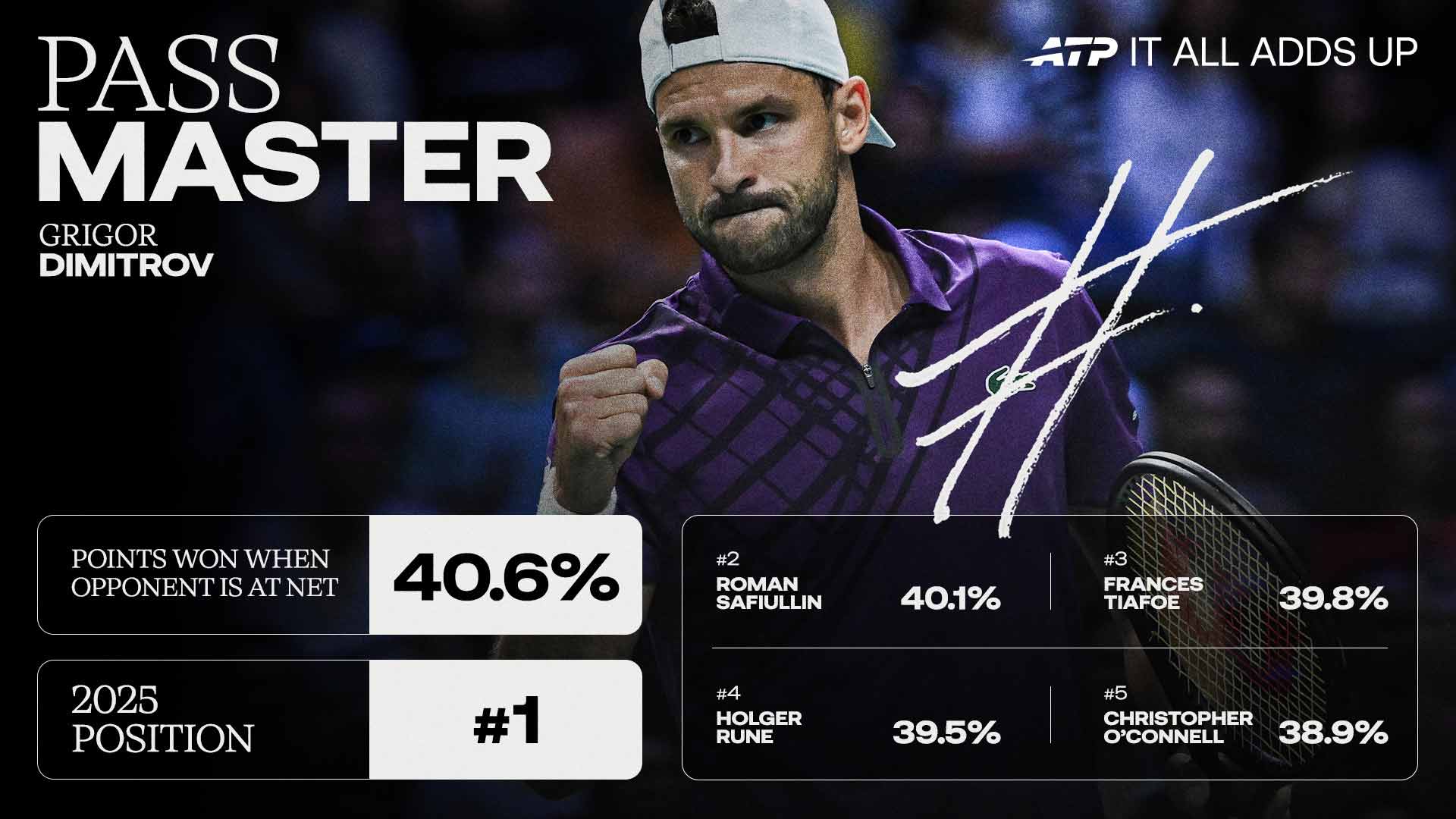
Grigor Dimitrov‘s 2025 unfolded as a clinic in calculated disruption, where opponents’ forward charges met swift, angled retribution. Leading the ATP Tour with a 40.6 percent success rate on points when rivals approached the net, he transformed vulnerability into dominance across surfaces. This edge stemmed from a career forged against relentless aggression, his one-handed backhand dipping low or firing crosscourt to exploit every overreach.
“When I was a junior, I was always playing against the older guys and [those] taller than me,” Dimitrov explained. “I was not that tall when I was younger, and a lot of them were coming to the net a lot, especially some of the American players when I played as they were always playing serve and volley or attacking me. So I always liked to have targets. I loved when some of it was coming through because I was fairly agile to move around the court and [could] predict some of the shots in advance, knowing where I’m going to position the ball in order to get [an easier] next ball coming back at me.”
His returns carried heavy topspin on hard courts, accelerating off the bounce to force hurried volleys into errors. Against Roman Safiullin early in the year, Dimitrov anticipated serve-and-volley rushes, countering with down-the-line passes that stranded the Russian mid-court. These moments built his rhythm, conserving energy for deeper runs while stacking wins that propelled his ranking climb.
Backhand angles wrong-foot the bold
Dimitrov’s passing thrived on split-second reads, often unleashing an inside-out backhand to pull volleys wide or a slice that skidded low past outstretched rackets. In Miami’s humid grind, he faced Frances Tiafoe in the semis, using crosscourt angles to draw the American forward prematurely, then threading needles with precision that turned explosive serves into passable setups. The crowd’s murmurs swelled with each successful lob evasion, his composure amid the baseline bombardments underscoring a tactical depth that outlasted raw power.
Adaptations varied by surface; on clay’s deliberate pace, he extended rallies to lure net forays, rewarding patience with one–two patterns that opened lanes. Holger Rune felt this shift during extended exchanges, where Dimitrov’s footwork allowed unexpected inside-in forehands to disrupt transitions from baseline to net. Each matchup layered resilience, his 40.6 percent efficiency translating to breaks that fueled a surge toward the top three in the PIF ATP Rankings.
Split decisions fuel high-stakes calm
In the rally’s heat, Dimitrov balanced outright winners against safer setups, his focus locked on the ball’s spin and trajectory for guidance. “it’s very difficult to know what you’re going to do, because you just don’t know,” he said. “You have a split second to make a decision… So for me, I’ve always focussed most on the ball, because the ball gives me the information, and then hopefully I can make the right decision.”
This mental anchor shone against Christopher O’Connell on Australian hard courts, where crosscourt backhands lured aggressive advances only to evade them with sharp down-the-line replies. The physical toll of a grueling schedule tested his timing, yet he absorbed pressure, using crowd energy on big points to sharpen his edge. Victories like these, blending agility and anticipation, marked his path to the Nitto ATP Finals title and a former No. 3 perch.
Grass demands peak passing poise
At Wimbledon, low-bouncing grass amplified his backhand’s skid, turning net play into a high-risk gamble for opponents. Dimitrov dismantled approaches with angles that clipped shoelaces or fired inside-in to the baseline, his efficiency peaking amid the All England Club’s charged air. In the fourth round against eventual champion Jannik Sinner, he carved a two-sets-to-love lead, neutralizing the Italian’s forays with passes that threaded past desperate reaches, the stands buzzing with each escalating exchange.
Injury cut the drama short—a pectoral tear forcing retirement—but not before his display echoed junior battles won through prediction and poise. Earlier on those lawns, Rune’s net transitions faltered against similar counters, Dimitrov’s flat trajectories exploiting the surface’s speed to build momentum. This grass-court mastery, woven into a season of deep runs like Miami’s Masters 1000 semis, hinted at enduring flair amid the Tour’s elite pressures.
Throughout 2025, Dimitrov’s passing wove through diverse foes and conditions, from hard-court endurance to grass’s urgency, each angle reinforcing his resurgence. The 40.6 percent mark stood as proof of focus honed over years, setting the stage for 2026 battles where net aggression will face an even sharper counter.
Points Won When Opponent At Net (2025)
See all stories in this series
Visit our ATP Stats section for more insights.