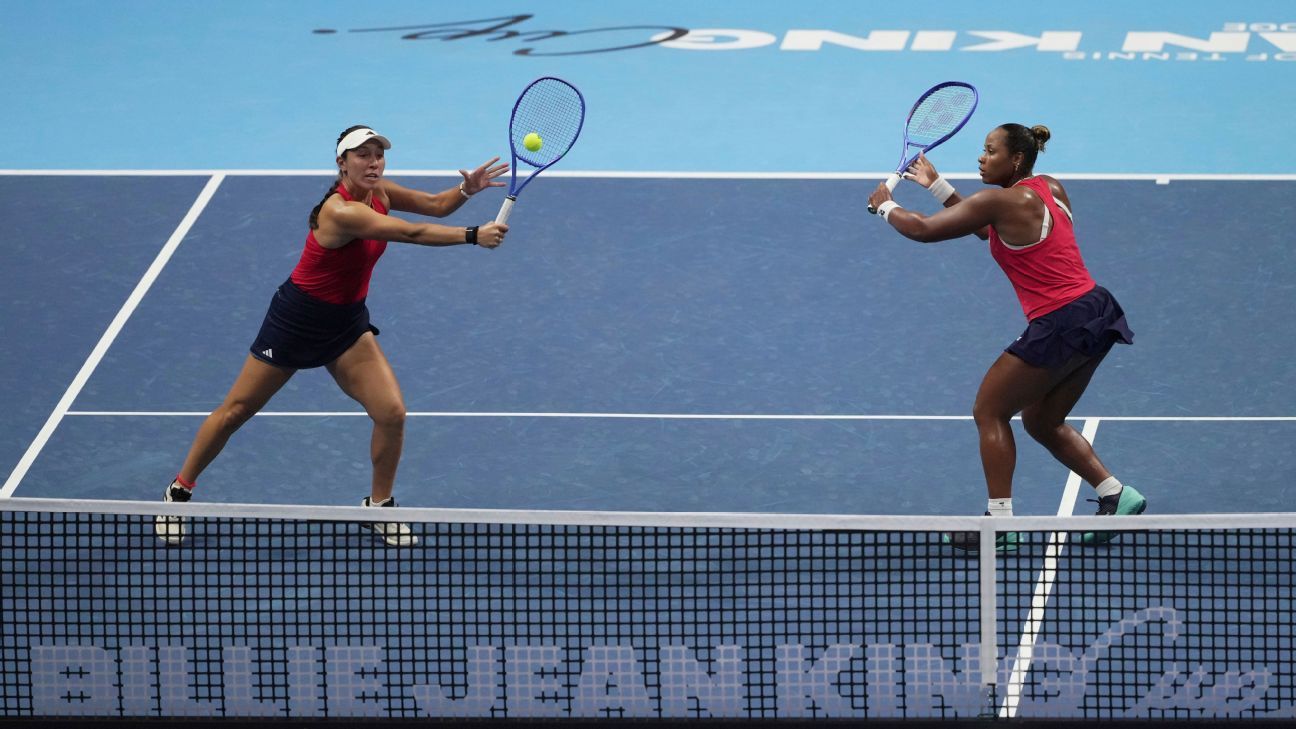
The humid buzz of Shenzhen’s arena pulsed with the intensity of a Billie Jean King Cup quarterfinal, where the United States edged Kazakhstan 2-1 to reach the semifinals for the first time since 2021.
Jessica Pegula and
Taylor Townsend delivered the decisive blow in doubles, their victory a cathartic release after a tie that tested nerves and tactics on the medium-paced hard courts. This advance, carrying the weight of America’s 18 titles—the last in 2017—sets up a Saturday showdown with Britain, where every rally will echo the pressure of unfinished legacy.
Navarro’s clutch escape from the brink
Emma Navarro‘s battle against
Yulia Putintseva stretched into a 2½-hour grind, the American’s flat groundstrokes redirecting pace in crosscourt exchanges that kept the Kazakh off-balance. Putintseva grabbed a 6-4 lead in the tiebreak, converting breaks earlier to push Navarro to two match points, but the U.S. player unleashed inside-out forehands for the final four points, securing 7-5, 2-6, 7-6 (6) amid rising crowd murmurs. This stunning turnaround, born from Navarro’s season of hard-court inconsistencies, handed America an early lead and infused the bench with defiant energy, the surface’s true bounce amplifying her down-the-line winners in the decider.
“I wanted to kind of redeem myself a little bit out there against her [Rybakina], try and help my team get a win,” Pegula said.
Rybakina’s baseline dominance levels the tie
Elena Rybakina, the former Wimbledon champion, imposed her towering serve and penetrating groundstrokes to dismiss Pegula 6-4, 6-1, pinning the American deep with flat bombs that limited return angles. In their first hard-court clash in 2½ years, Rybakina’s 80% first-serve accuracy neutralized Pegula’s one–two patterns, the second set unraveling in under 30 minutes as inside-in approaches found the net. Pegula’s top-10 steadiness cracked under the Kazakh’s depth, yet this reversal sharpened focus for the decider, the arena’s lights casting long shadows over a tie now hanging in doubles balance.
Townsend, the world doubles No. 1 and two-time major champion, who
later apologized for comments about Chinese food, brought explosive net rushes to pair with Pegula, dominating the first set 6-2 through sharp poaches off crosscourt lobs. The Kazakh duo fought back, but the U.S. pair’s volleys pierced resistance in the tiebreak, clinching 7-6 (1) on Rybakina’s double fault—a moment of poetic justice that blended Townsend’s flair with Pegula’s resolve. This rebound, exploiting gaps in the opponents’ positioning, turned personal frustration into team propulsion, the hard court’s speed favoring their aggressive 1–2 combinations.
Semifinal stakes rise across the draw
Britain’s path mirrored tactical grit, sweeping Japan in straight sets as
Sonay Kartal outlasted
Ena Shibahara 6-3, 7-6 (4), fending off a break point at 5-4 and rallying from 3-1 down in the tiebreak with deep returns that forced errors.
Katie Boulter sealed the quarterfinal by overpowering
Moyuka Uchijima 6-2, 6-1 in their debut, her big serve overwhelming baseline rallies and injecting momentum into a squad poised for breakthroughs. Facing the U.S. on Saturday, Britain’s efficient singles could clash with America’s doubles depth, promising a chess match of adjustments on the same unforgiving surface.
In the other bracket, Ukraine advanced to Friday’s semifinal against defending champion Italy, where
Marta Kostyuk and
Elina Svitolina secured singles wins over
Jessica Bouzas Maneiro and
Paula Badosa, respectively, their variety disrupting rhythms to topple Spain while Italy dispatched host China. For the Americans, this BJK Cup journey—evolving from the Fed Cup era—pulses with historical echoes, Navarro’s tiebreak tenacity and Townsend’s net dominance fueling a quest to shed recent disappointments. As Shenzhen’s energy lingers, the real drama builds, with Britain’s resilience testing whether U.S. resolve can carry them toward a 19th crown.