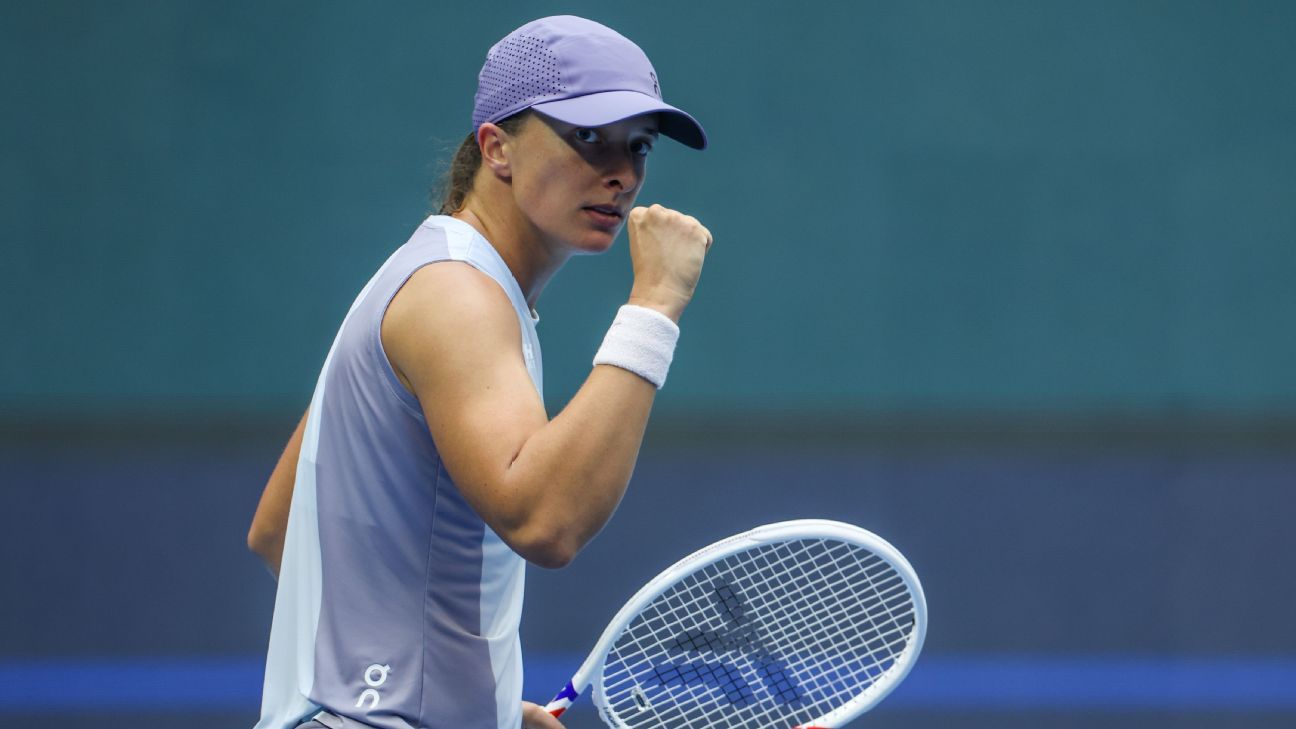
Beijing’s outdoor arenas carried a bite in the air as Iga Swiatek dismantled Yuan Yue 6-0, 6-3, her forehand’s heavy spin carving through the home crowd’s hopes like a late-season reminder of unyielding command. Fresh from clinching the Korea Open, the top seed advanced to the third round, her game a blend of baseline precision and mental steel that turned potential fatigue into fluid execution. This victory not only propelled her deeper but etched a milestone: the first to amass 25 or more wins at WTA 1000 events over three straight seasons, a feat the WTA highlights as testament to her sustained brilliance amid six Grand Slam titles, including four French Opens, one US Open, and Wimbledon’s green triumph.
Adapting patterns to hard-court demands
Swiatek’s crosscourt forehands pinned Yue deep from the outset, forcing errors in the first set’s swift 6-0 surrender, where the Chinese player’s serves faltered under probing returns. In the second, she mixed inside-out angles to exploit backhand weaknesses, sealing 6-3 with a one–two rhythm that preserved energy on the grippy plexicushion. This adaptability, honed from clay’s endurance to hard’s quicker tempo, underscores her edge as Beijing’s lower bounce amplifies her topspin kicks, turning the autumn grind into a platform for deeper runs and year-end supremacy.
The crowd’s initial cheers for Yue faded into murmurs of respect, mirroring Swiatek’s psychological hold—each point a step away from the isolation of the chase, toward the quiet confidence of the pursued. Her path here, layered with expectations from grass breakthroughs to hard-court hauls, reveals a player who channels pressure into patterned inevitability, eyes fixed on converting consistency into another title echo.
Young guns and upsets stir the draw
Earlier, fourth-seeded Mirra Andreeva overwhelmed Zhu Lin 6-2, 6-2, her underspin backhands disrupting the home favorite’s high-kicking serves with low bounces that bent rallies her way on the fast surface. American Emma Navarro grinded out a 6-3, 7-6 (0) win over Elena-Gabriela Ruse, saving set points in the tiebreak via flat crosscourt backhands that exposed the Romanian’s movement under pressure. These advances inject youth into a field thick with late-season tension, where tactical tweaks like Andreeva’s slice variations highlight how hard-court speed rewards aggressive baselines and reshapes the points chase.
Naomi Osaka powered through the opener 6-1 against Aliaksandra Sasnovich, her booming serves echoing across the courts, yet the Belarusian rallied 6-4, 6-2 by targeting second-serve lapses with deep returns that flipped the mental script. Emma Raducanu, meanwhile, steadied with a 6-3, 6-3 defeat of Cristina Bucsa, employing crosscourt lobs to counter net approaches and disrupt rhythm on the quicker deck. Such swings capture the women’s draw’s pulse—power falters without variety, upsets bloom from lapses—setting up third-round clashes that could cascade through rankings as exhaustion tests resolve.
Sinner rebuilds with focused intensity
Across the nets in the concurrent ATP 500, Jannik Sinner steadied against Terence Atmane 6-4, 5-7, 6-0, his flat groundstrokes regaining range after a mid-match dip, culminating in a third-set shutout as the Frenchman wilted. Still raw from the US Open final loss to Carlos Alcaraz three weeks back, the Italian had earlier dispatched Marin Cilic, conceding just four games through varied serve depths that exploited the veteran’s fading mobility. Beijing’s hard courts favor his efficiency, where minimal errors and explosive transitions—like down-the-line backhands—rebuild confidence shot by shot in the fall swing’s haze.
The atmosphere thickened with Sinner’s resolve, each winner a pivot from frustration to focus, the crowd sensing his hunger to convert near-misses into triumphs. As quarterfinals approach, both he and Swiatek embody the tour’s turning point, where mental fortitude forges paths through fatigue, promising tactical fireworks that bridge seasons with renewed promise.