Sinner threads lines past Rublev to top Djokovic streak

Two wins from history on home clay, the world number one mixes early breaks with line precision while fatigue and the French Open loom ten days out.
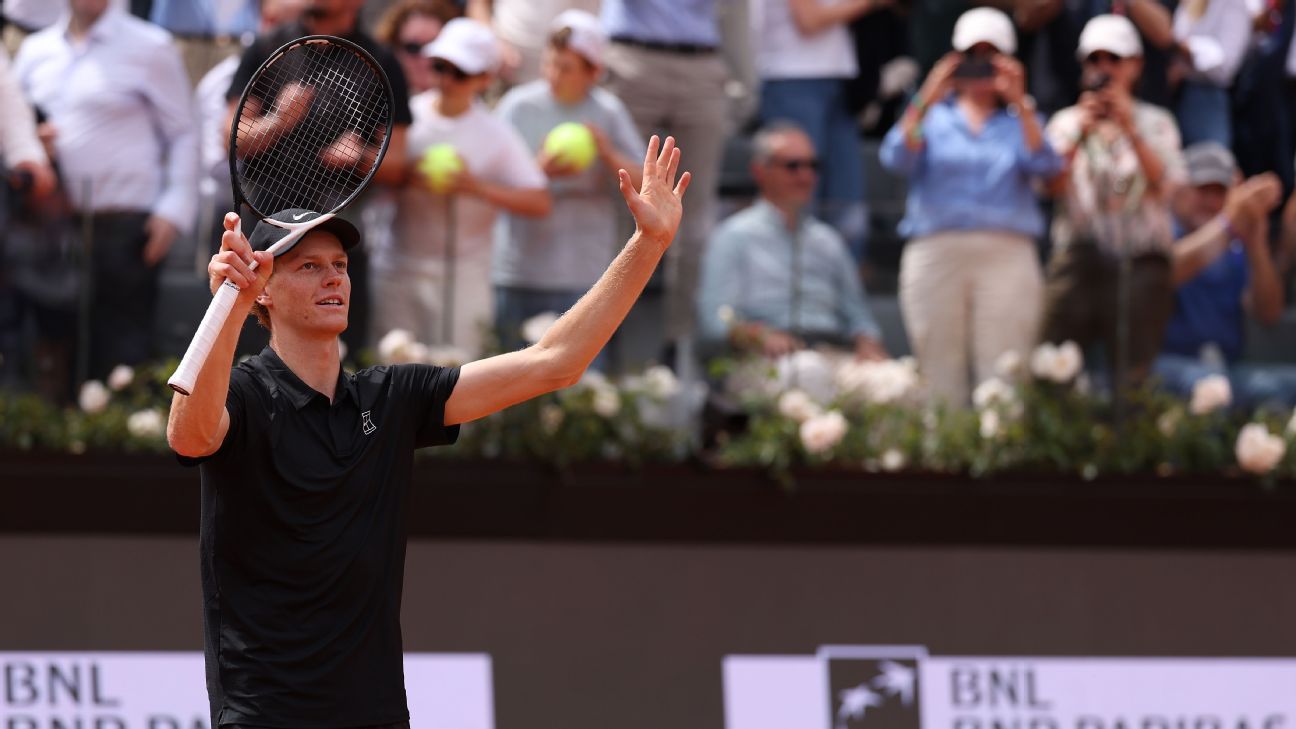
Jannik Sinner is two victories away from becoming the first home male player to win the Italian Open in half a century. And it doesn’t seem like anybody can stop him -- either in Rome or at the French Open that starts in 10 days.
Line calls and early breaks set clay rhythm
The top-ranked Sinner landed shots on the lines repeatedly in a 6-2, 6-4 triumph over Andrey Rublev to reach the semifinals Thursday and move past Novak Djokovic with a record 32nd consecutive victory in Masters 1000 events -- the biggest tournaments outside the Grand Slams. Sinner broke serve in the opening game for a third straight match and never lost control against the former top-five player.
Red clay at the Foro Italico rewards heavy topspin crosscourt exchanges and inside-out forehands that pull opponents wide. Sinner executed those patterns with minimal errors despite occasional wind gusts that tested footwork late in rallies. “I don’t play for records. I play just for my own story. And obviously at the same time it means a lot to me,” Sinner said.
I don’t play for records. I play just for my own story. And obviously at the same time it means a lot to me.
One brief lapse arrived when Andrey Rublev broke late in the second set. “It was a bit breezy, a bit windy, so it was very tough conditions,” Sinner said. “I felt we both didn’t play at our best today.”
Semifinal math tests surface adjustments
Sinner’s semifinal opponent will be 2023 Rome champion Daniil Medvedev, who came back to beat Spanish qualifier Martin Landaluce 1-6, 6-4, 7-5. Medvedev’s flat-ball approach requires Sinner to shorten swing paths and mix slice backhands to disrupt rhythm on slower clay. The other semifinal will feature Casper Ruud of Norway against Luciano Darderi, an Argentine-born Italian, setting up potential path calculations where Sinner could extend his unbeaten Masters run since retiring with cramps against Tallon Griekspoor in Shanghai in October.
Sinner hasn’t been beaten in a Masters event since that match. Djokovic won 31 straight Masters matches in 2011. Including all tournaments, Sinner’s winning streak reached 27 matches. He was last beaten by Jakub Mensik in the Qatar Open quarterfinals on Feb. 19 -- and he hasn’t even dropped a set since his opening match of his previous tournament, the Madrid Open. Sinner is also aiming to become the second man after Novak Djokovic to triumph at all nine Masters events. The Italian Open is the only Masters event that Sinner hasn’t won.
Sinner lost last year’s final in Rome to Carlos Alcaraz, who is now sidelined due to a right wrist injury, while Jasmine Paolini in 2025 became the first Italian woman to raise the trophy in 40 years. The partisan energy inside the 10,500-seat Campo Centrale added another layer, fans waving signs that read “Sinner, Facce Sogna” while urging the leader to stay composed under lengthening days. Andrey Rublev noticed the precision up close, observing that many points landed on or inside the lines and that forcing errors requires sustained concentration against the number one.
Women’s final paths reveal parallel tactics
In the women’s tournament, Coco Gauff beat 36-year-old Sorana Cirstea 6-4, 6-3 to reach the final for a second straight year. Gauff will face two-time Rome champion Elina Svitolina in the final after the Ukrainian beat three-time champion Iga Swiatek 6-2, 4-6, 6-2. Gauff saved a match point in a three-set victory over Iva Jovic in the fourth round and then came back from a set down to defeat Mirra Andreeva in the quarterfinals.
Against Sorana Cirstea, Gauff got 78% of her first serves in and had only one double fault. “I’m just happy to be through in straight sets today,” Gauff said. “it’s been a marathon week.” Gauff was beaten by Jasmine Paolini in the 2025 Rome final, then went on to win the French Open. Elina Svitolina won Rome in 2017 and 2018. Sinner said he felt fatigued toward the end yet expected recovery before deeper runs on the same surface.