Rybakina steels herself through Pegula’s surge

Elena Rybakina turned back a fierce late rally from Jessica Pegula in the Australian Open semifinals, advancing to a high-stakes rematch with Aryna Sabalenka amid echoes of past heartbreaks.
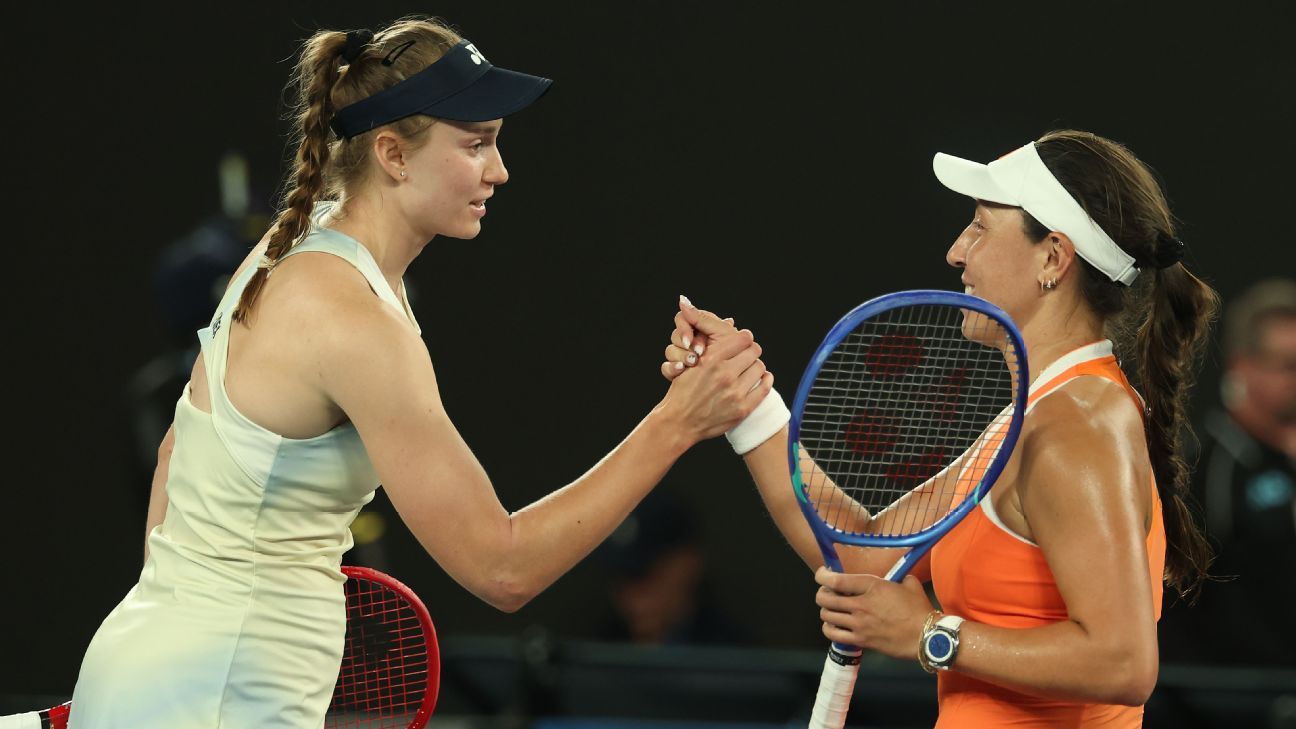
Elena Rybakina powered into the Australian Open final with a 6-3, 7-6 (7) win over Jessica Pegula, her baseline bombs dominating early on Rod Laver Arena’s hard courts. The No. 5 seed’s heavy topspin forehands pinned Pegula deep, forcing errors in crosscourt exchanges and securing the first set with clinical efficiency. But as the second set unfolded, the match tilted into a pressure cooker, Rybakina’s serve wobbling under the weight of three squandered match points on her rival’s delivery.
Pegula clawed back momentum, breaking Rybakina twice as she served for the match, her sharp returns and flat backhands slicing through the humid air. The American’s one–two combinations—serve followed by inside-in forehands—disrupted Rybakina’s rhythm, drawing the crowd into a frenzy of cheers. Rybakina’s footwork held firm, but the tension mounted, her mind flashing to prior collapses on these courts.
“Really, really stressful,” Rybakina said, admitting she had flashbacks from the 2024 Australian Open when she lost the longest women’s tiebreaker ever at a Grand Slam to Anna Blinkova 22-20 in a three-set defeat.
Flashbacks sharpen her resolve
Those 2024 memories—of a grueling 22-20 tiebreaker loss—fueled Rybakina’s fight, her deep breaths steadying her as Pegula pressed. She varied her backhand slice to pull Pegula forward, opening angles for down-the-line winners that kept the set alive. The Kazakh’s composure, forged through a season of tight losses, turned potential defeat into defiance, the arena’s lights casting long shadows over her determined strides.
In the tiebreaker, Pegula grabbed two set points with aggressive crosscourt returns, but Rybakina erased them: an inside-out forehand on the first, a volley on the second. The drama stretched 29 minutes from her initial match point, Pegula’s resilience testing every nerve. Yet Rybakina’s adjustments—shortening her swing on second serves—regained control, her final point landing with a thud that silenced the roars.
“I’m proud no matter the situation. It got very tight. I stayed there,” Rybakina said of the win over Pegula. “I was fighting for each point.”
Tiebreaker grit cements survival
Rybakina’s tiebreaker escape highlighted her growth in high-stakes moments, blending power with tactical patience on Melbourne’s medium-fast surface. Pegula’s flat shots skidded low, but couldn’t overcome the Kazakh’s depth and spin variations that disrupted her baseline flow. This semifinal grind, echoing their head-to-head battles, showcased Rybakina’s edge in absorbing pace and redirecting it with precision.
The win propels her toward redemption, her serve—key to big matches—needing sharpening after today’s lapses. Crowd energy surged with each point, the humidity amplifying every grunt and footstep. Rybakina’s mental reset positions her to challenge the top seed, turning scars into strength.
Sabalenka rematch promises fireworks
Rybakina now faces top-ranked Aryna Sabalenka in a 2023 Australian Open final rematch, where the Belarusian staged a 4-6, 6-3, 6-4 comeback. Sabalenka advanced by overpowering Elina Svitolina 6-2, 6-3, her 1–2 patterns overwhelming the Ukrainian with raw power. For Rybakina, this clash revives a rivalry defined by baseline wars, her inside-out forehands poised to test Sabalenka’s dominance Down Under.
“It was a great battle,” Rybakina said of the 2023 final. “In the end, she played a bit better and it was well deserved. I want to enjoy the final, and hopefully I can serve better than today.” As Melbourne’s night falls, Rybakina’s journey—from semifinal survival to title shot—sets up a final where mental fortitude could flip the script, her heavy balls ready to clash against Sabalenka’s thunder.
The Associated Press contributed to this report.