Nadal’s Lessons from Baseline to Lecture Hall

Rafael Nadal, the relentless force behind 22 major titles, steps into academia’s spotlight at Spain’s oldest university, where his career’s mental grit earns an honorary doctorate and reframes sport as society’s enduring teacher.
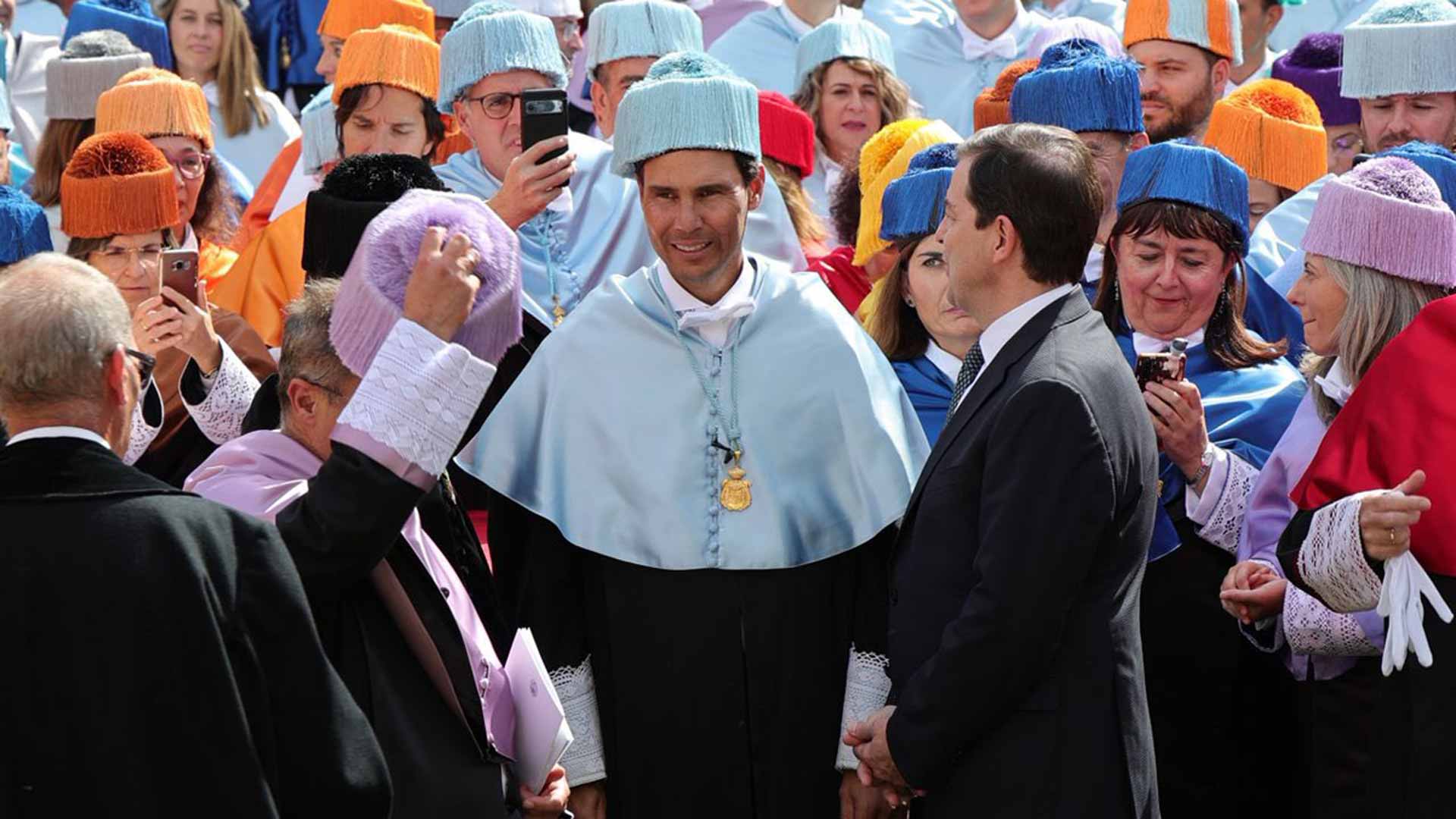
In the echoing chambers of the University of Salamanca, Rafael Nadal traded the thunder of clay-court rallies for the measured rhythm of an academic ceremony. After more than 20 seasons dominating the ATP Tour with unyielding baseline exchanges and tactical recoveries, the 22-time major champion received an honorary doctorate on Friday, becoming the first athlete to claim such distinction from this 13th-century institution. The event, alive with the quiet hum of history, captured the psychological resilience that defined his reign—from grinding crosscourt patterns on slow surfaces to resetting after down-the-line errors under stadium lights.
Embracing sport’s unyielding classroom
Wearing a blue mortarboard, Nadal recited his oath before the university senate and accepted the medal that welcomed him into their doctoral fold. His wife Mery Perello, parents Sebastian and Ana Maria, and sister Maribel sat among the assembly, their support a steady backdrop to the proceedings. He addressed the hall with the poise of a player eyeing a break point, linking his global tennis travels to broader human values.
“It makes me so proud and grateful to receive the title of Honoris Causa from the oldest University in Spain and one of the oldest in the world; a place where, since the eighteenth century, humanism, critical thinking and intellectual freedom have illuminated the whole of humanity,” he said. Nadal highlighted his path diverging from traditional studies, shaped instead by tournaments across five continents where every match honed focus amid jet-lagged fatigue and surface shifts.
“My life was played out at tournaments and on tennis courts, travelling the five continents, competing and learning from the sport and from the experiences that came with all of that. Therefore, this recognition is not only a privilege for me, it is also a demonstration of respect for sport and what it represents to society.”
The former world No. 1 always blended fierce competition with off-court integrity, qualities that sustained him through injury comebacks and five-set marathons. He portrayed sport as his personal university, where discipline emerged from daily drills—meticulous footwork on grass to counter slips, or patient one–two combinations to dismantle aggressive returns.
Instilling discipline and quiet humility
Nadal delved into the game’s core teachings, emphasizing how it curbed ego amid triumphs. Losses, like a mistimed slice inviting a lob, reminded him that no one dominates every exchange, a mindset that fueled comebacks from set deficits in high-stakes finals. This humility extended beyond the lines, drawing admiration from fans who lined Salamanca’s streets from dawn, their early vigil mirroring queues for Wimbledon finals.
“Ever since I was a boy, sport has been my own college and, in some ways, my own university. What I learned on the courts has always been with me, both in tennis and away from it. Sport taught me the value of discipline. You get nothing without daily hard work, without commitment and without taking care of the smaller details,” he explained. Those details—adjusting topspin on high-bouncing hard courts or using inside-in forehands to exploit weak backhands—built the endurance for 20-plus years of elite play.
“Sport also taught me not to feel that I am better than anyone, because in competitions and in tournaments, as in life, nobody wins every time.“ His words resonated in the hall’s warm light, evoking the post-match calm after outlasting rivals on Philippe-Chatrier’s red dust.
Balancing ambition with foundational values
Turning to a formative crossroads, Nadal recounted a 2002 decision that tested his budding resolve. At 15, he eagerly anticipated his junior debut at Roland Garros, already holding ATP points from international circuits and dreaming of carving winners down-the-line on Paris clay. The opportunity promised a tactical awakening, yet his parents prioritized exams, denying the trip despite his protests.
The setback stung like an unforced error in a deciding tiebreak, but time revealed its wisdom. “However, my parents told me I could not play, because it was during exam season. For me, at 15, it was very difficult to understand. Despite my disappointment, my parents were not to be moved and in the end, I didn’t play in the tournament. With time, I learned that the decision was a great lesson and now I thank them because they helped me finish my compulsory education and they taught me that no goal comes before values and education,” he reflected. This choice anchored him, blending sport’s intensity with education’s steadiness, much like opting for safe crosscourt rallies to build pressure rather than risky inside-out shots.
The Salamanca honor builds on prior accolades, including the 2008 Prince of Asturias Award for Sport, the Royal Order of Sports Merit, the Medal of Merit in Labour, and repeated National Sports Awards. Each recognizes the mental framework that turned early promise into a dynasty, from underspin defenses on fast grass to resilient forehands in New York night sessions. As crowds cheered outside the ancient walls, Nadal’s narrative invites emerging players to view tennis not just as competition, but as a forge for enduring character, pointing toward legacies that outlast any trophy shelf. Editor’s Note: This story was translated from ATPTour.com/es.