Kostyuk meets Noskova in first-time Wimbledon semifinal

Momentum meets first-time nerves on Centre Court as two players with long grass streaks chase a maiden final berth.
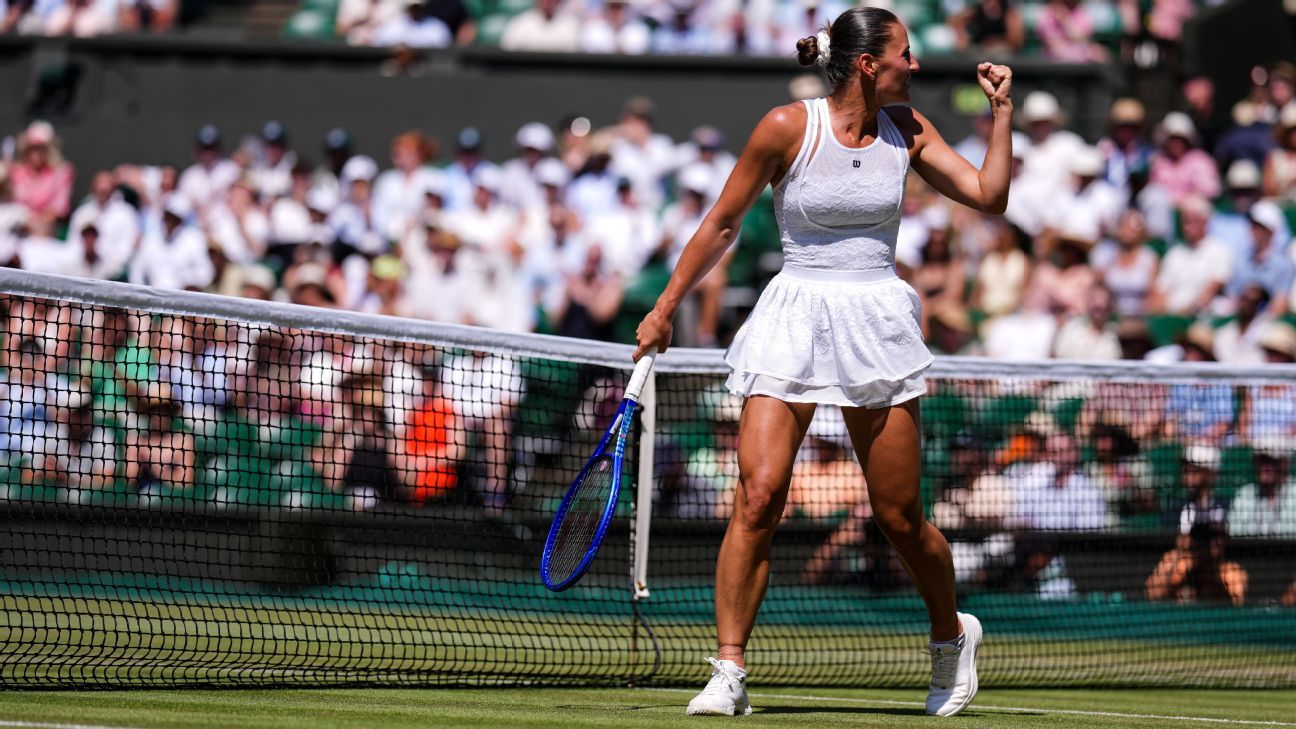
Marta Kostyuk made a big impression in her Centre Court debut by beating Jasmine Paolini 6-3, 6-2 to reach her first Wimbledon semifinal on Wednesday. The 24-year-old Ukrainian also reached the last four at the French Open, losing to Russian teenager Mirra Andreeva, the eventual champion in Paris. Kostyuk raised her hands and dropped to her knees after Paolini scuffed a shot on her second match point. After shaking hands with the Italian, Kostyuk did a pirouette on court.
The 12th-seeded Kostyuk had a sneak peek at Centre Court on Tuesday so that she wasn’t overwhelmed for the match. She later described the entrance as overwhelming, recalling a spectator visit nine years earlier to watch Roger Federer. That single day of preparation proved enough to keep her mind clear during a 6-3, 6-2 victory that extended her grass surge.
I was flabbergasted by this entrance and everything inside. I was like, ‘Wow,' I need one day to recover from what I saw.
Kostyuk will be back on Centre Court on Thursday to face ninth-seeded Linda Noskova for a spot in Saturday’s final. Noskova beat No. 25 Elise Mertens 6-3, 7-5 on No. 1 Court. The 21-year-old improved to 10-1 on grass this season after a Berlin Open final win over Jessica Pegula.
Season streak shapes inner resolve
Kostyuk arrived carrying the burden of 21 wins from her past 22 matches, the longest active streak on tour since mid-April. That run included a French Open semifinal loss yet the Ukrainian has refused to let prior heartbreak dictate her grass-court approach. She used a Tuesday walk-through to steady her breathing before facing Paolini, whose 26 unforced errors exposed the cost of rushed decisions under pressure.
Noskova has shouldered her own expectations after a 10-1 grass record this season and 18 match wins across the past two years on the surface. She spoke openly about pre-match nerves before dispatching Mertens, noting that the moments carrying the most weight often produce her cleanest tennis. Holding all 11 service games without facing a break underscored how composure under load translated into first-serve dominance at 79 percent.
Serve precision steers semifinal routes
Kostyuk dismantled Paolini with a steady diet of crosscourt heavy topspin that forced the Italian wide, then finished points inside-out when Paolini overcompensated. That same pattern now collides with Noskova, who has won 18 grass-court matches across the past two seasons and dropped just one service game through five rounds. Noskova reached the final in Berlin by beating Pegula on a similar surface, using a high first-serve percentage and immediate inside-in transitions that left returners pinned behind the baseline.
Against Mertens she won 79 percent of first-serve points and never faced a break, a level of control that will test Kostyuk’s return positioning on Thursday. Kostyuk’s 1–2 combination against Paolini relied on a flat first serve out wide followed by a heavy crosscourt forehand that exploited the Italian’s tendency to lean toward her backhand side. Paolini finished with only eight winners and 26 unforced errors, many of them on attempted down-the-line passes that landed long once the ball stayed low.
Noskova has shown she can absorb that same wide serve and redirect with slice backhands that skid even lower on grass, turning defense into sudden inside-out attacks. Kostyuk must decide whether to stand two steps closer on second serves or stay back and use underspin slices to blunt Noskova’s transition speed.
Youth wave meets historic pairing
The opposite semifinal pits Coco Gauff against Karolina Muchova, creating the first Czech semifinal pairing at a major since the 2019 Australian Open featuring Karolina Pliskova and Petra Kvitova. Three of the four semifinalists remain under 25, matching the youngest group since 2014 when Eugenie Bouchard, Simona Halep and Kvitova reached the final four.
That concentration of youth amplifies the mental narrative, because each player must manage the external story of a wide-open draw while executing patterns that have already carried them this far. Kostyuk’s inside-out forehand pressure and Noskova’s improved first-serve percentages both reflect adjustments born from earlier setbacks. The Thursday encounter therefore becomes less about surface adaptation and more about who sustains clarity when the crowd noise and personal expectations peak together.