The Cruel Art of Tennis Runner-Up Speeches

In the shadow of Grand Slam glory, defeat demands one last performance: a speech that bares the soul while the sting is fresh. As the Australian Open approaches, players revisit the mental toll of this singular tradition.
Five years ago, on the night before the biggest match of her life, Jennifer Brady sat in her hotel room in Melbourne anxiously writing in the Notes app on her phone. After an unexpected run at the Australian Open, she had advanced to the first major final of her career and was slated to play Naomi Osaka the next day on Rod Laver Arena. She knew the challenge ahead to achieve a lifelong dream as the world watched on, but that wasn’t what she was thinking about at that moment.
Brady meticulously wrote down everyone she wanted to thank, wracking her brain for all of the people who had helped her along her journey. She didn’t want to blank while addressing the crowd and knew how harshly she could be judged if it didn’t go well. The weight of those words felt heavier than any baseline rally she might face.
“I was so worried about my speech and all of the things I would say after,” Brady told ESPN this month. “I was so stressed about having nothing to say -- win or lose -- or about messing up.”
Brady went on to lose to Osaka the following day 6-4, 6-3, and despite her obvious disappointment, she gave a gracious and upbeat speech. During her address lasting two minutes and 22 seconds, she managed to congratulate Osaka and her team, as well as everyone involved in the tournament, and thanked her own support staff. She even drew laughter as she mentioned her mom back home, “watching right now in front of the TV, probably crying.”
Building to the breaking point
The path to a major final layers pressure like successive topspin loops, each round tightening the grip on composure. For Brady, that 2021 Australian Open run meant adapting her flat forehand to Melbourne’s bouncy hard courts, where Osaka’s 1–2 pattern of serve and inside-out forehand proved decisive in straight sets. Yet the real test came post-match, as the arena’s echoes faded and she stepped to the mic, her voice steady despite the fresh ache of unforced errors in key games.
Current ATP No. 6 Alex de Minaur has never reached a major final, but he has had to give his fair share of runner-up speeches, including at the Masters 1000-level Canadian Open in 2023 -- and he calls it one of the hardest things to do in the sport. Those moments force an instant pivot from frustration to perspective, much like shifting from aggressive net approaches to defensive lobs under pressure. De Minaur’s experiences on North American hard courts, with their faster pace demanding quicker decisions, mirror the tour’s relentless build toward high-stakes ceremonies.
Brady said she doesn’t remember a lot about what she said (although does have a better recollection of what Osaka said). But all this time later, and with just days to go before two more singles players have to craft a runner-up speech after a potentially crushing defeat, Brady does vividly remember how agonizing it was in the moment. The formula—congratulate the opponent, thank the tournament staff from officials to ball kids, then nod to personal supporters—offers structure, but delivering it live tests the raw edges of defeat.
“You’re in the finals of a Grand Slam, obviously you want to win, and it’s something that you’ve worked for and trained for your entire life,” she said. “And then within five minutes of losing maybe the biggest match of your career, you have to go up on a stage and thank everyone for making the tournament possible and congratulate your opponent for beating you.” That immediacy, amid the crowd’s lingering cheers and the court’s cooling surface, amplifies the psychological shift from competitor to commentator.
Exposing raw edges on court
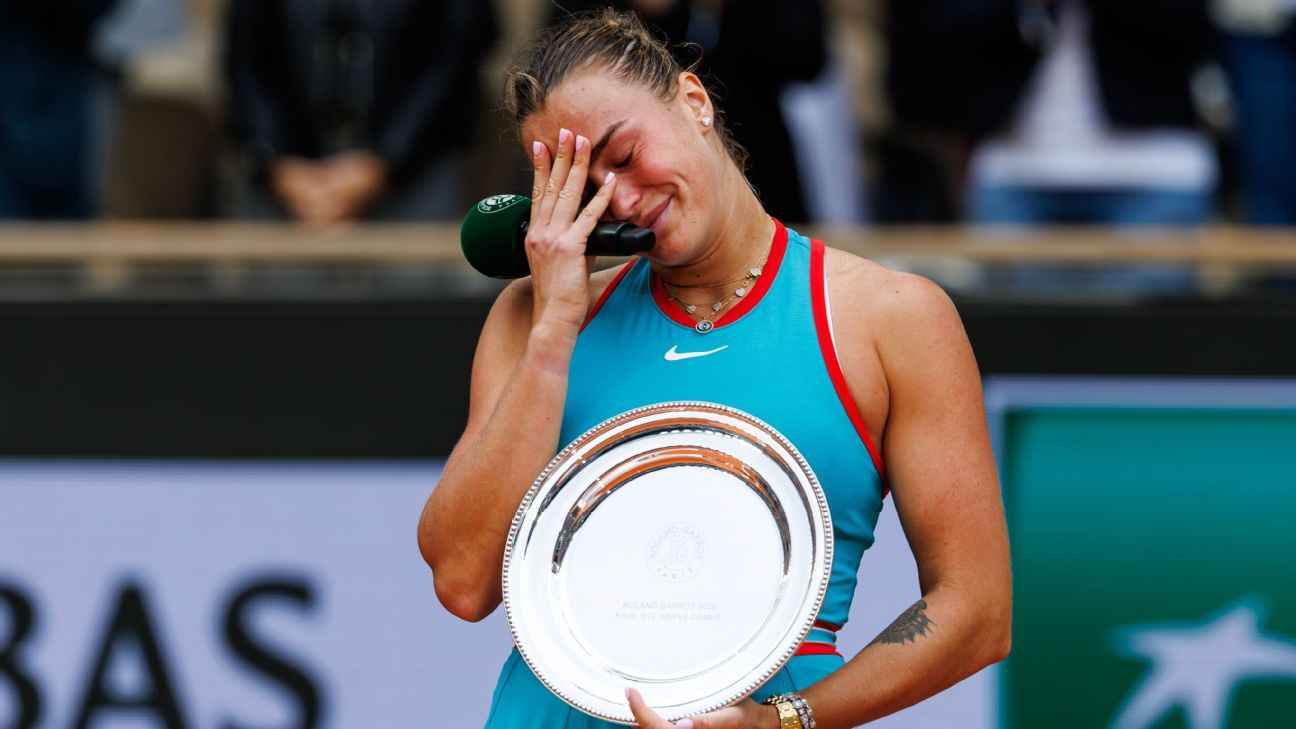
After losing to Coco Gauff for the French Open title in June, world No. 1 Aryna Sabalenka made headlines after what many interpreted as disrespectful comments during her speech and in her news conference hours later. The clay’s grinding rallies, where Sabalenka’s heavy topspin forehands clashed against Gauff’s speed and crosscourt angles, had built to a final of unforced errors and emotional overflow. Her words on Philippe-Chatrier, tears streaming, captured the toll of two weeks sliding through red dust and baseline exchanges.
“Honestly guys, this one hurts so much, especially after such a tough two weeks of playing great tennis,” Sabalenka said to the crowd as the tears rolled down her face. “And in these terrible conditions [to] show such terrible tennis in the final, [it] really hurt.” She later doubled down when speaking to reporters and called it the worst final she had ever played, and said Gauff only won because she had made so many mistakes, before regretting her words as completely unprofessional.
Some five weeks later at Wimbledon, and two days after defeating Sabalenka in a thrilling three-set match in the semifinals, it was Amanda Anisimova’s turn to address the crowd. After a staggering final, in which Iga Swiatek handed her a 6-0, 6-0 defeat in just 57 minutes, Anisimova was visibly distraught as she walked up to accept her trophy from the Princess of Wales. The grass’s low bounce had favored Swiatek’s down-the-line precision and slice backhands, dismantling Anisimova’s aggressive returns in a blur of quick points.
No one knew what to expect when she took the microphone moments later on Centre Court. She wiped the tears away as the crowd began to cheer in support. She praised Swiatek, calling her “an inspiration” and “an unbelievable athlete.”
Her voice continued to get stronger as she spoke, and she smiled as she acknowledged those seated in her player box. But when she spoke of her mom, who had flown in that morning, she broke down in tears again. “My mom’s put in more work than I have honestly,” Anisimova said as her voice broke and she covered her eyes with her hand before apologizing. “I’m so sorry. A few more words, I’m sorry.”
“My mom is the most selfless person I know. She’s done everything to get me to this point in my life. So thank you for being here and breaking the superstition of flying in. I mean, it’s definitely not why I lost today.” Ultimately Anisimova spoke for over five minutes, blending in raw emotion and humor, and fully enamoring herself to the crowd and those watching around the world with her candor.
“I think I was just trying to hold it together, honestly,” Anisimova said to reporters later. “It was such a big moment. I was trying to remind myself, like, this is an incredible moment, to not try and let that go and get overwhelmed by all the feelings I was feeling. So I tried to keep it together and swallow all the tears and just speak from the heart really.”
The speech went viral and Anisimova drew praise from around the tennis world and beyond. Amy Edmondson, a professor of leadership and management at Harvard Business School, called it a master class in failure in an interview with The Athletic. That blend of vulnerability and generosity turned a devastating bagel set into a moment of connection, her words rising over the Centre Court hush like a well-placed lob.
Challenging the courtside tradition
“I don’t think [the losing player] should have to talk,” said Andy Roddick, the 2003 US Open champion and four-time major runner-up, on a recent episode of his “Served” podcast. “it’s cruel, it’s hard, and it doesn’t exist in any other sport where you have to talk about it immediately afterward and come up with your own speech.” Roddick’s own finals, marked by serve-volley battles on fast grass and hard courts, left him exposed in ways no post-match presser could match.
Sabalenka, who has now given three consolation speeches at majors, agrees. “I don’t understand [why] they keep the runner-up on court for all of that ceremony because it is the worst moment,” Sabalenka told Melbourne-based newspaper The Age ahead of the Australian Open. “Of course, I would love to go out there to thank my opponent, to thank my team, say thank you to everyone, and just leave the court. I don’t want to be there. I need my time to cool down, to kind of switch off from what happened.”
The task can be made even harder for those who aren’t native English speakers. While tournaments are played around the globe, English is traditionally the default language spoken. “Having to do that in another language? Yeah, no thank you on that,” Brady said.
But as hard as it may be, even for someone without a language barrier, De Minaur has found a silver lining in the practice. He vividly remembers losing his first ATP final at the Sydney International in 2018 in front of a hometown crowd, which included family members and friends. After falling to Daniil Medvedev, De Minaur was devastated as he accepted his runner-up trophy.
But having to speak just moments later made him process the defeat and his emotions in real time. “I was extremely frustrated for not being able to get the win but at the same time, I had to start seeing the perspective right then,” De Minaur said. “I had a great week, I had made the final, I was fully close [to winning] and I had enjoyed every second of the week. Of course there was nothing I wanted to do more than win that match in Sydney but hey, I told myself, and the crowd, that I would find another chance to do it -- and I was able to come back the following year and redeem myself.”
He won the tournament in 2019 and got to give the first victory speech of his career in front of the same crowd. “I was very proud of that,” he added. That hard-court swing in Australia’s summer, with its coastal winds affecting ball trajectories, had tested his one–two punch, turning loss into a launch for the next season’s majors.
Brady, who has been mostly sidelined since 2021 because of a string of debilitating injuries and has played in just two major tournaments since her final appearance in Melbourne, enjoys watching speeches, even if she doesn’t always want to give them, and thinks they should be optional for the runner-up. She knows how challenging they can be but appreciates when “personalities come out” and they don’t stick to the script. While the now 30-year-old, who returned to action this week at an ITF event in San Diego, admits she “kind of blanked” as soon as she stood in front of the microphone, the trophy ceremony from that day remains something that she is known for and a clip that gets sent to her countless times every year during the Australian Open.
While her speech was without controversy, what happened next did go viral. When Osaka started her victory speech, she asked Brady if she would prefer to be called Jenny or Jennifer, to which Brady responded, “Jenny.” Osaka then proceeded to congratulate “Jennifer.” It was an awkward moment, punctuated by a bewildered expression on Brady’s face, and it spread across the internet like wildfire.
A true queen 👑@naomiosaka took time to praise and congratulate @jennifurbrady95 and her team after winning the #AusOpen pic.twitter.com/l7K6Yycn0C
— espnW (@espnW) February 20, 2021
For Brady, it was a reminder of how nerve-wracking the experience of addressing the crowd can be. Even for someone who had just won her fourth major title. “I was very nervous when I started my speech, and I think she was too,” Brady said. “I think maybe she just wanted to break the ice for herself when she asked me that, but then just wasn’t even fully listening in the moment. I couldn’t really hear that well with the speakers in the stadium and the echo and all that, but when it sounded like she said ‘Jennifer,' I remember being like, ‘Oh no.' When I got off the court, my phone was just blowing up about it.”
“I remember the ‘Jenny or Jennifer?' moment more than my own speech. It still gets brought up a lot, more than you would expect. And it always resurfaces on the internet this time of year.” As the 2026 Australian Open unfolds under Melbourne’s lights, with its dawn sessions and night-time intensity on Rod Laver Arena, the runner-up’s words will again probe the sport’s emotional core. Players like Sabalenka advocate for brevity or opt-outs, yet the ritual endures, revealing character in the quiet after the last point falls. In tennis’s cycles of surfaces and slumps, these speeches might evolve, offering space for healing before the next draw begins.