Rome Mourns Pietrangeli’s Clay-Court Legacy

Hundreds fill the Stadio Pietrangeli to honor a pioneer whose Grand Slam breakthroughs and Davis Cup grit still shape Italy’s tennis ambitions, even as new pressures test the next wave of stars.
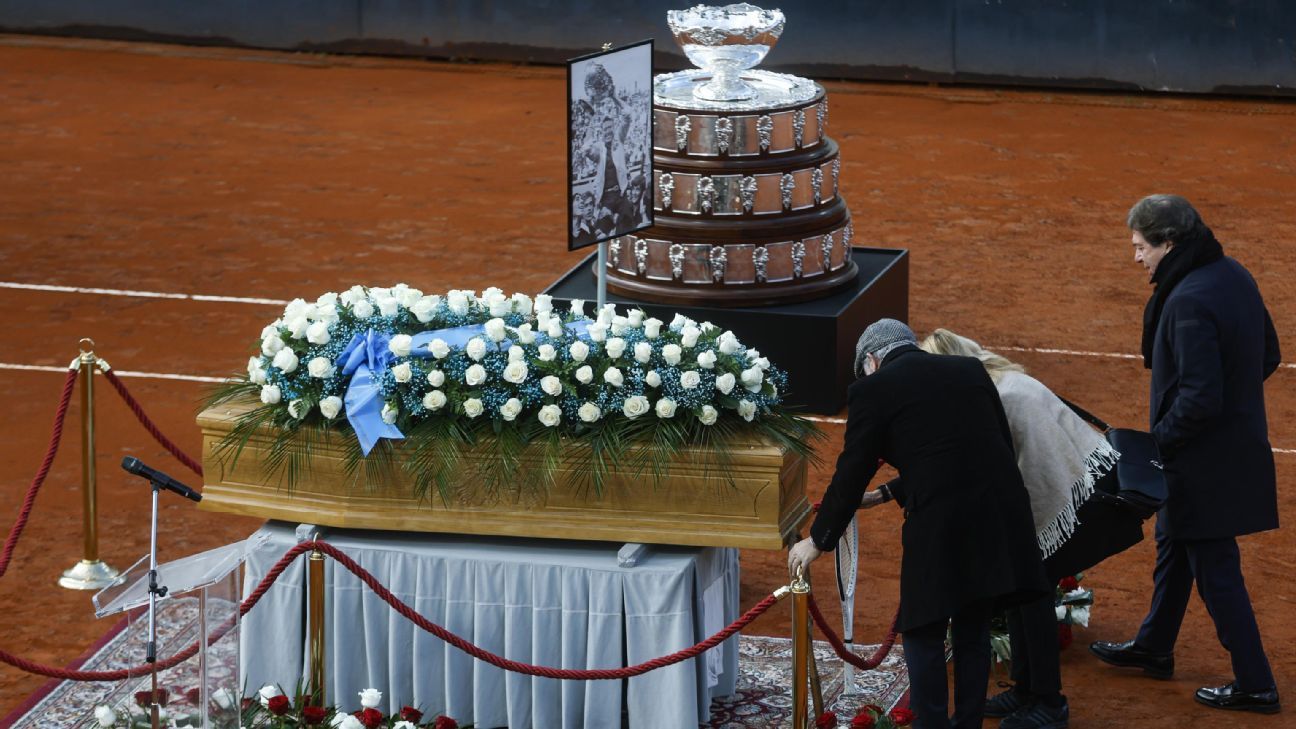
In Rome’s Foro Italico, hundreds gathered under a crisp December sky to bid farewell to Nicola Pietrangeli, the tennis great who died at 92. The Stadio Pietrangeli, renamed in 2006 to celebrate his triumphs, hosted the public viewing on its statue-lined court, a place where his baseline mastery once turned matches into enduring legends. Mourners filled the stands, their silence broken only by the soft echoes of a career that put Italy on the global map.
Court captures his tactical triumphs
The coffin rested at center court, surrounded by blue and white flowers that evoked the Italian flag and his love for the game. Two tennis rackets lay beside it, alongside the Davis Cup from Italy’s 1976 victory under his captaincy as player-captain. A large screen played highlights of his path, from the first Grand Slam singles titles for an Italian at the French Championships in 1959 and 1960, set to Charles Aznavour’s melodies, one of Pietrangeli’s favorites.
His Davis Cup record stood unmatched, with 66 ties from 1954 to 1972, including 78 singles wins against 32 losses and 42 doubles victories over 12 defeats. Attendees recalled how he used underspin slices to disrupt rhythms on clay, following with inside-out forehands that pulled opponents wide. The setup honored a man whose one–two combinations in doubles built unbreakable team resolve.
“Everything just as he wanted, the place and the music,” his son Marco said.
Friends bridge eras of ambition
As Frank Sinatra’s “My Way” played, the coffin moved toward the Chiesa della Gran Madre di Dio for the private funeral, a procession that mirrored Pietrangeli’s unyielding style. Prominent Italian sports figures attended, from former and current presidents of the National Olympic Committee to the head of the Italian Tennis Federation. Adriano Panatta and Tonino Zugarelli, who clinched the 1976 Davis Cup with him, stood in quiet tribute, their shared history evoking the pressure of those crosscourt defenses and net approaches.
Other former players joined, including Fabio Fognini, who retired earlier this year. Prince Albert II of Monaco, a longtime friend, arrived to offer condolences, his presence highlighting Pietrangeli’s bonds beyond the tour. The gathering blended grief with reflections on how his down-the-line winners and mental adjustments inspired generations to navigate clay’s slow tempo.
“I knew him for many years,” he reflected. “He was a splendid man. I really wanted to be here also for his family; I am very emotional. He was always there in the most important moments of my life.”
Absence underscores modern strains
Yet current Italian players stayed away, especially Jannik Sinner, whose recent successes have fueled hopes of reviving Pietrangeli’s glory. This gap pointed to the tour’s demands, where schedules leave little room for pause amid training and matches. Pietrangeli’s legacy adds emotional weight, turning every inside-in approach or serve-and-volley into a test of endurance on surfaces he once owned.
For rising stars, his example of varying slice depths to control points offers tactical lessons in handling pressure. The memorial left a sense of continuity, as Italy’s players carry forward his resolve, blending reverence with the drive to forge new paths on the circuit. As the crowd dispersed, the court seemed poised for fresh battles, echoing a pioneer’s influence in every future rally.