Sinner regains command with repeat Wimbledon triumph

After months of physical tests and major disappointments, precise adjustments on grass carried the world number one through early nerves to a composed victory that restored his standing at the top.
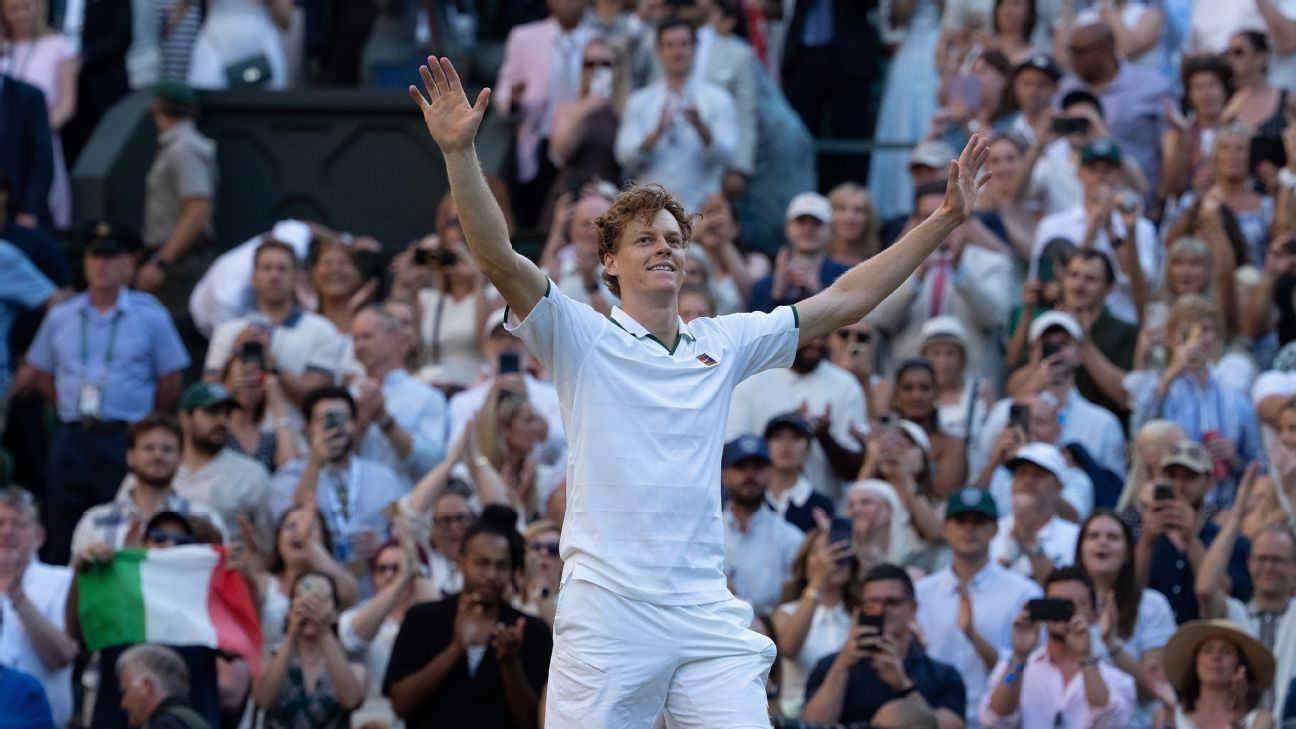
Forty-five days after his stunning upset loss in the second round of the French Open, and 163 days after seeing his quest for a three-peat at the Australian Open spoiled in the semifinals, Jannik Sinner found himself back atop the tennis world Sunday.
With a 6-7 (7), 7-6 (2), 6-3, 6-4 victory over world No. 2 Alexander Zverev, the man who ultimately took the crown in Paris, Sinner rallied to become the Wimbledon champion for the second consecutive year. After hitting a forehand winner to clinch the trophy following a tense three hours and 46 minutes, he fell onto the ground and covered his eyes with his hands in what appeared to be sheer relief.
It had been one year since he had last hoisted a major trophy, and it seemed as if all of the emotions had caught up with him in one ever-so-brief instant. But then he sat back up, quickly gathered himself and shared a hug with Zverev. Suddenly, everything looked familiar again, and he was back in a place and a position in which he knew he belonged. Sinner, 24, was a Grand Slam champion for the fifth time.
Extra preparation time sharpens grass patterns
As he thanked the crowd during the trophy ceremony, he explained that a player never knows how many times they might have the opportunity to play on Centre Court on Championship Sunday and how special it was. “I never take things for granted,” he added. But after his staggering comeback victory, he made it clear he should remain a favorite nearly anywhere he plays -- one capable of countless finals and trophies -- and silenced all of those who had begun to doubt his greatness. And after such an up-and-down year, this one meant everything.
“We got here 12 days early, didn’t play a lead-in tournament, so we knew the first couple matches were going to be really difficult for him to get through,” Darren Cahill, one of Sinner’s coaches, said after the match. “He just puts his head down and goes to work. He’s had a great attitude throughout this entire tournament. He’s going to have a long, distinguished career. He’s going to put himself in a position to win more of these majors. I don’t think this one was any more important than any of the others that he’s played, but it felt damn special, that’s for sure.”
The expectations couldn’t have been higher for Sinner at the start of Roland Garros. After his disappointing Australian Open exit to Novak Djokovic in five sets, he had recorded one of the most impressive streaks in recent memory by winning all five Masters 1000-level events in the spring, starting on hard court at Indian Wells and concluding on clay at the Italian Open. With the absence of his fierce rival Carlos Alcaraz due to a prolonged wrist injury, he was the overwhelming favorite to claim the titles at both the French Open and Wimbledon. A victory in Paris would have completed the career Grand Slam, a rarified feat in tennis and something he could have achieved at just 24 years of age.
After his routine first-round win, he had a 30-match win streak. And against Juan Manuel Cerundolo, ranked No. 56 in the world, he had a 6-3, 6-2, 5-1 lead and was just one game away from advancing. But on a sweltering day of a Parisian heat wave, Sinner wilted in the sunshine. What happened next is well known and already part of his lore. While serving for the match at 5-4, 0-40, he was struck by cramps and walked back to his chair. He then left the court for several minutes to receive medical treatment. Sinner returned but never could fully recover. He lost 18 straight points and seven consecutive games, stretching into a fourth set. And then he found himself in a once-unthinkable deciding set. It ultimately ended with a shocking 3-6, 2-6, 7-5, 6-1, 6-1 score and Sinner became the first top-seeded man to lose at the tournament since 2000. In front of a packed-to-the-walls room of reporters, he explained he hadn’t been feeling well but didn’t blame the heat.
“I don’t remember the last time I felt this weak,” Sinner said. “But yeah, look, it is what it is. I tried to stay there with all I had today, and this was the maximum I had. Of course, [it’s] a pity because I was playing really well the first couple of sets, and also the third set was playing really well. Yeah, that’s the sport.” But now with unexpected extra time to prepare for Wimbledon, he vowed he could turn it around. “I just need my time now to process what went wrong here, and [I’m] positive also that we can put in good practice weeks before Wimby,” he said. “... There are still plenty [of tournaments left] to play this year.”
Before play got underway at the All England Club, just two weeks ago, Sinner spoke to the media again. This time he was more candid about the impact of the heat. He said he and his team had emphasized playing in hot conditions during their grass-court training, although he made no promises for instant results. “We are happy at the moment with what we are doing,” he said. “The result we’re not going to see here. it’s a long process. There’s no magic behind [it].” But playing in the first match of the tournament on Centre Court, a distinction reserved for the reigning men’s champion, Sinner did not immediately look to be the formerly unbeatable force that he had been throughout the spring. He lost the first set against Miomir Kecmanovic, the world No. 50, and it looked as if yet another upset might be brewing. Somehow, after five sets, three-and-a-half hours, 52 unforced errors, a hard fall on the grass and even a sneaker marked with blood from his toenail, Sinner escaped with the victory. But it wasn’t the most convincing of efforts, and it put his favorite status in jeopardy yet again.
He later attributed his slow start to nerves, and Sinner found a way to quickly alleviate the doubters. While he needed two tiebreaks in his second-round match against Nuno Borges, he didn’t drop a set again on his way to the final. Against Djokovic in the semifinals, meeting for the first time since the Australian Open, Sinner was the epitome of clinical efficiency. He was masterful in a 6-4, 6-4, 6-4 takedown that Djokovic described as simply a “good old blowout.” “I don’t think I [did] too much wrong,” a dejected Djokovic said after the match. “I was just a level or two worse than he is. I mean, he was playing so solid from all ends. ... [it’s] very difficult to read his serve, [what an] incredible weapon [it] has become [over the] last couple [of] years since he changed his technique. Of course, he’s as solid as anyone really from back of the court. That’s it.” Sinner faced just one break point the entire match. He saved it with an ace. It marked just the third time in Djokovic’s esteemed major career in which he failed to break serve in a completed match.
Final tiebreaks expose Zverev limits
Entering Sunday’s final against Zverev, Sinner was heavily favored for the victory, in large part because of his recent dominance over the German. Sinner had a 10-4 career head-to-head record against Zverev and had won their last nine meetings -- a streak dating back to 2023. Perhaps more astoundingly, Sinner hadn’t lost a set or a service game to Zverev in their last seven matches. In their lone previous Slam final meeting, in Melbourne last year, Sinner was merciless in a swift 6-3, 7-6 (4), 6-3 rout for the title. “In general, Jannik is better than me at the moment,” Zverev said after. “it’s as simple as that.”
But Sunday was different. It marked the first time the two had played since Zverev had finally become a major champion -- having seized the moment in Paris without Sinner or Alcaraz to stop him -- and he had a different level of confidence. Zverev was relentless with his attack from the start and what resulted was two fiercely battled opening sets, which saw neither break serve and both sets end in tiebreaks. The crowd, keenly aware of Zverev’s underdog status and his history against Sinner, appeared to be able to sense a potential upset. It was all even at the start of the third set. But momentum began to shift. Zverev slipped and took a hard fall in the seventh game, wincing in agony with right knee pain. Sinner helped him off the ground, and Zverev was able to continue playing. Sinner then closed out the game with the next two points to stay on serve. But in the next game, Sinner finally got the break and he was suddenly firmly in control of his own destiny. He clinched the set moments later. Zverev slammed his racket to the ground in frustration.
Sinner, in a stark contrast, showed few signs of emotions throughout, and instead continued to show his steady calm and undeniable resolve. In the fourth set, after the two traded serves for the first six games, Sinner broke through yet again with a break behind a forehand winner. Victory now seemed inevitable. Sinner emphatically won the next four points on serve and was now one game away. Zverev responded with a hold of his own but Sinner could not be stopped. “Jannik. I don’t really like you anymore,” Zverev said, jokingly, during his on-court interview. “I lost to you nine times in a row ... He showed once again why he’s the best player in the world.” Sunday made it 10 consecutive losses, but the sentiment remained. When at his best, Sinner is nearly impossible to beat by anyone not named Carlos Alcaraz. But after playing in his first major final since the US Open in September -- in which he lost to Alcaraz -- Sinner said he wasn’t thinking about anything other than trying to enjoy the moment. And it seemed what he had found over the past year, perhaps more than anything, was perspective.
“The only thing I’m very happy [about] is that I’m trying to do my best every day,” Sinner told another packed room full of reporters on Sunday night. “Sometimes you have a tournament with a good outcome, and sometimes you don’t. There’s nothing you can really do about [it]. There is no failure if you don’t win a Grand Slam. it’s very, very rare days. Now I have five in my whole life. We talk about five Grand Slams. But [at the] end of the day, it’s five days of so many other days. You just want to enjoy it. Today was a very tough day. If I lose, it’s still a great day. Playing a Grand Slam final, it’s so rare and so special.” The victory added a fifth major and restored separation at the top of the standings heading into the hard-court swing. Points stayed short on grass allowing the twenty-four-year-old to conserve energy across the fortnight while opponents tired from longer exchanges on slower surfaces earlier in the year. Surface considerations favored the defender who had practiced hot conditions in advance to avoid the cramp issues that surfaced against Juan Manuel Cerundolo on clay. Grass court speed demands serve tweaks. Transitioning from clay where heavy topspin dictated rallies to Wimbledon’s quicker surfaces required flattening trajectories on both wings. Sinner shortened his backswing on the forehand to accelerate through contact points and added more slice on the backhand to keep balls low. These adjustments limited opponent time to set up aggressive returns and created opportunities for inside-out winners that pulled foes wide. Early matches tested the new patterns immediately. Against Miomir Kecmanovic the opening set slipped away amid nerves and 52 unforced errors yet five-set resilience emerged once the serve found rhythm. The 30-match win streak from the spring Masters 1000 events had ended in Paris but grass rewarded patience with shorter points that favored his improved first-strike capability. Rankings math added pressure. Retaining the number one position hinged on reaching the later rounds without a lead-in event so every tiebreak became critical. Two tiebreaks against Nuno Borges in round two confirmed the tactical shift was taking hold as the ball skidded through the court rather than sitting up for counterpunches. Zverev matchup exposes return vulnerabilities. Alexander Zverev arrived with fresh confidence after claiming the Paris crown yet the head-to-head history showed Sinner had not dropped a set to him in seven prior meetings. The final opened with two tiebreaks because both players held serve through clinical patterns that avoided second-serve weaknesses. Zverev attacked crosscourt angles relentlessly but Sinner’s flatter serve placement kept the German stretching and unable to dictate. Sinner rallied to become the Wimbledon champion after breaking in the third set once Zverev slipped on the seventh game. The knee issue briefly halted momentum but the ensuing service hold and immediate break showcased how grass rewarded the one-two combination of wide serve followed by inside-in forehand pressure. Four consecutive holds in the fourth set closed the match in three hours and forty-six minutes without further drama. Novak Djokovic had fallen in straight sets during the semifinals after Sinner saved his lone break point with an ace. The same serve technique that neutralized the Serb’s returns proved decisive against Zverev who managed zero breaks across the final. Carlos Alcaraz remained absent through injury so the draw opened pathways that Sinner exploited with steady resolve. Ten prior victories over Zverev underscored the matchup edge that rankings points alone could not capture. The victory added a fifth major and restored separation at the top of the standings heading into the hard-court swing. Perspective gained over twelve months of fluctuating results framed the victory as one more step rather than a defining redemption. Five major titles now sit in the collection, each earned on different surfaces and against shifting fields, yet the emphasis stayed on daily preparation rather than the rarity of the achievement. Coaches noted the deliberate choice to arrive early and skip warm-up events, accepting that initial matches would test timing and rhythm on the faster surface. Expectations rose sharply after masters dominance. Winning five consecutive Masters 1000 titles on hard and clay courts had positioned Jannik Sinner as the clear favorite for Roland Garros once Carlos Alcaraz withdrew. A Paris victory would have completed the career Grand Slam at age 24 and extended an already remarkable streak. Instead the second-round clash against Juan Manuel Cerundolo exposed physical limits under extreme heat. Serving at 5-4 with three match points, cramps forced a medical timeout; the subsequent collapse of eighteen straight points left the top seed reflecting on rare physical weakness rather than tactical shortcomings. The unexpected fortnight of extra preparation time before Wimbledon allowed focused grass-court sessions that emphasized lower ball trajectories and quicker recovery steps. No promises were made about immediate results, yet the process itself became the priority. The opening Centre Court assignment against Miomir Kecmanovic produced a five-set battle marked by fifty-two unforced errors and a bloodied toenail from a fall. Victory arrived only after tiebreaks and extended rallies that revealed how residual tension from Paris still affected shot selection. Two tiebreaks were again required in the second round versus Nuno Borges, yet from that point forward the draw opened more cleanly. No further sets were dropped until the final, a sign that match rhythm had returned. The semifinal against Novak Djokovic showcased the evolved serve that had become difficult to read after technical adjustments in recent years. Facing only one break point and saving it with an ace, Sinner produced a straight-sets result that left little room for opponent rhythm. Entering the championship match, Alexander Zverev carried fresh confidence from his Paris title. The first two sets stayed on serve until tiebreaks, with the crowd sensing an opportunity for an upset after nine prior consecutive defeats for the German. Sinner rallied to become the Wimbledon champion when a slip by Zverev in the third set shifted momentum. The break that followed came behind an inside-out forehand that pinned the opponent wide, allowing control of the remainder of the match. Throughout the four-set contest the Italian maintained emotional steadiness, breaking again in the fourth set with another forehand winner down the line. Post-match remarks from both players underscored that the gap in consistency remained narrow yet decisive on this surface.
Daily focus shapes long career ahead
Precise serve tweaks and inside-out forehand adjustments on the fast lawns allowed the top seed to overcome early grass rust and dominate the final against a newly confident Zverev. Transitioning from clay where heavy topspin dictated rallies to Wimbledon’s quicker surfaces required flattening trajectories on both wings. Sinner shortened his backswing on the forehand to accelerate through contact points and added more slice on the backhand to keep balls low. These adjustments limited opponent time to set up aggressive returns and created opportunities for inside-out winners that pulled foes wide. Early matches tested the new patterns immediately. Against Miomir Kecmanovic the opening set slipped away amid nerves and 52 unforced errors yet five-set resilience emerged once the serve found rhythm. The 30-match win streak from the spring Masters 1000 events had ended in Paris but grass rewarded patience with shorter points that favored his improved first-strike capability. Rankings math added pressure. Retaining the number one position hinged on reaching the later rounds without a lead-in event so every tiebreak became critical. Two tiebreaks against Nuno Borges in round two confirmed the tactical shift was taking hold as the ball skidded through the court rather than sitting up for counterpunches. Zverev matchup exposes return vulnerabilities. Alexander Zverev arrived with fresh confidence after claiming the Paris crown yet the head-to-head history showed Sinner had not dropped a set to him in seven prior meetings. The final opened with two tiebreaks because both players held serve through clinical patterns that avoided second-serve weaknesses. Zverev attacked crosscourt angles relentlessly but Sinner’s flatter serve placement kept the German stretching and unable to dictate. Sinner rallied to become the Wimbledon champion after breaking in the third set once Zverev slipped on the seventh game. The knee issue briefly halted momentum but the ensuing service hold and immediate break showcased how grass rewarded the one-two combination of wide serve followed by inside-in forehand pressure. Four consecutive holds in the fourth set closed the match in three hours and forty-six minutes without further drama. Novak Djokovic had fallen in straight sets during the semifinals after Sinner saved his lone break point with an ace. The same serve technique that neutralized the Serb’s returns proved decisive against Zverev who managed zero breaks across the final. Surface considerations favored the defender who had practiced hot conditions in advance to avoid the cramp issues that surfaced against Juan Manuel Cerundolo on clay. Carlos Alcaraz remained absent through injury so the draw opened pathways that Sinner exploited with steady resolve. Points stayed short on grass allowing the twenty-four-year-old to conserve energy across the fortnight while opponents tired from longer exchanges on slower surfaces earlier in the year. He just puts his head down and goes to work. He’s had a great attitude throughout this entire tournament. Coaches noted the absence of a warm-up event forced rapid adaptation yet the results validated the extra practice weeks. Ten prior victories over Zverev underscored the matchup edge that rankings points alone could not capture. The victory added a fifth major and restored separation at the top of the standings heading into the hard-court swing. Perspective gained over twelve months of fluctuating results framed the victory as one more step rather than a defining redemption. Five major titles now sit in the collection, each earned on different surfaces and against shifting fields, yet the emphasis stayed on daily preparation rather than the rarity of the achievement. The only thing I’m very happy about is that I’m trying to do my best every day. Sometimes you have a tournament with a good outcome, and sometimes you don’t. There’s nothing you can really do about it. There is no failure if you don’t win a Grand Slam. it’s very, very rare days. Now I have five in my whole life. We talk about five Grand Slams. But at the end of the day, it’s five days of so many other days. You just want to enjoy it. Today was a very tough day. If I lose, it’s still a great day. Playing a Grand Slam final, it’s so rare and so special. The victory added a fifth major and restored separation at the top of the standings heading into the hard-court swing. Grass court speed demands serve tweaks. Transitioning from clay where heavy topspin dictated rallies to Wimbledon’s quicker surfaces required flattening trajectories on both wings. Sinner shortened his backswing on the forehand to accelerate through contact points and added more slice on the backhand to keep balls low. These adjustments limited opponent time to set up aggressive returns and created opportunities for inside-out winners that pulled foes wide. Early matches tested the new patterns immediately. Against Miomir Kecmanovic the opening set slipped away amid nerves and 52 unforced errors yet five-set resilience emerged once the serve found rhythm. The 30-match win streak from the spring Masters 1000 events had ended in Paris but grass rewarded patience with shorter points that favored his improved first-strike capability. Rankings math added pressure. Retaining the number one position hinged on reaching the later rounds without a lead-in event so every tiebreak became critical. Two tiebreaks against Nuno Borges in round two confirmed the tactical shift was taking hold as the ball skidded through the court rather than sitting up for counterpunches. Zverev matchup exposes return vulnerabilities. Alexander Zverev arrived with fresh confidence after claiming the Paris crown yet the head-to-head history showed Sinner had not dropped a set to him in seven prior meetings. The final opened with two tiebreaks because both players held serve through clinical patterns that avoided second-serve weaknesses. Zverev attacked crosscourt angles relentlessly but Sinner’s flatter serve placement kept the German stretching and unable to dictate. Sinner rallied to become the Wimbledon champion after breaking in the third set once Zverev slipped on the seventh game. The knee issue briefly halted momentum but the ensuing service hold and immediate break showcased how grass rewarded the one-two combination of wide serve followed by inside-in forehand pressure. Four consecutive holds in the fourth set closed the match in three hours and forty-six minutes without further drama. Novak Djokovic had fallen in straight sets during the semifinals after Sinner saved his lone break point with an ace. The same serve technique that neutralized the Serb’s returns proved decisive against Zverev who managed zero breaks across the final. Surface considerations favored the defender who had practiced hot conditions in advance to avoid the cramp issues that surfaced against Juan Manuel Cerundolo on clay. Carlos Alcaraz remained absent through injury so the draw opened pathways that Sinner exploited with steady resolve. Points stayed short on grass allowing the twenty-four-year-old to conserve energy across the fortnight while opponents tired from longer exchanges on slower surfaces earlier in the year. He just puts his head down and goes to work. He’s had a great attitude throughout this entire tournament. Coaches noted the absence of a warm-up event forced rapid adaptation yet the results validated the extra practice weeks. Ten prior victories over Zverev underscored the matchup edge that rankings points alone could not capture. The victory added a fifth major and restored separation at the top of the standings heading into the hard-court swing. Perspective gained over twelve months of fluctuating results framed the victory as one more step rather than a defining redemption. Five major titles now sit in the collection, each earned on different surfaces and against shifting fields, yet the emphasis stayed on daily preparation rather than the rarity of the achievement. The only thing I’m very happy about is that I’m trying to do my best every day. Sometimes you have a tournament with a good outcome, and sometimes you don’t. There’s nothing you can really do about it. There is no failure if you don’t win a Grand Slam. it’s very, very rare days. Now I have five in my whole life. We talk about five Grand Slams. But at the end of the day, it’s five days of so many other days. You just want to enjoy it. Today was a very tough day. If I lose, it’s still a great day. Playing a Grand Slam final, it’s so rare and so special. The victory added a fifth major and restored separation at the top of the standings heading into the hard-court swing.