Kyrgios confronts faded glory in Brisbane rout

Nick Kyrgios’s singles return at the Brisbane International crumbles in 66 minutes against Aleksandar Kovacevic, blending tactical rust with a grounded outlook on his post-surgery path.
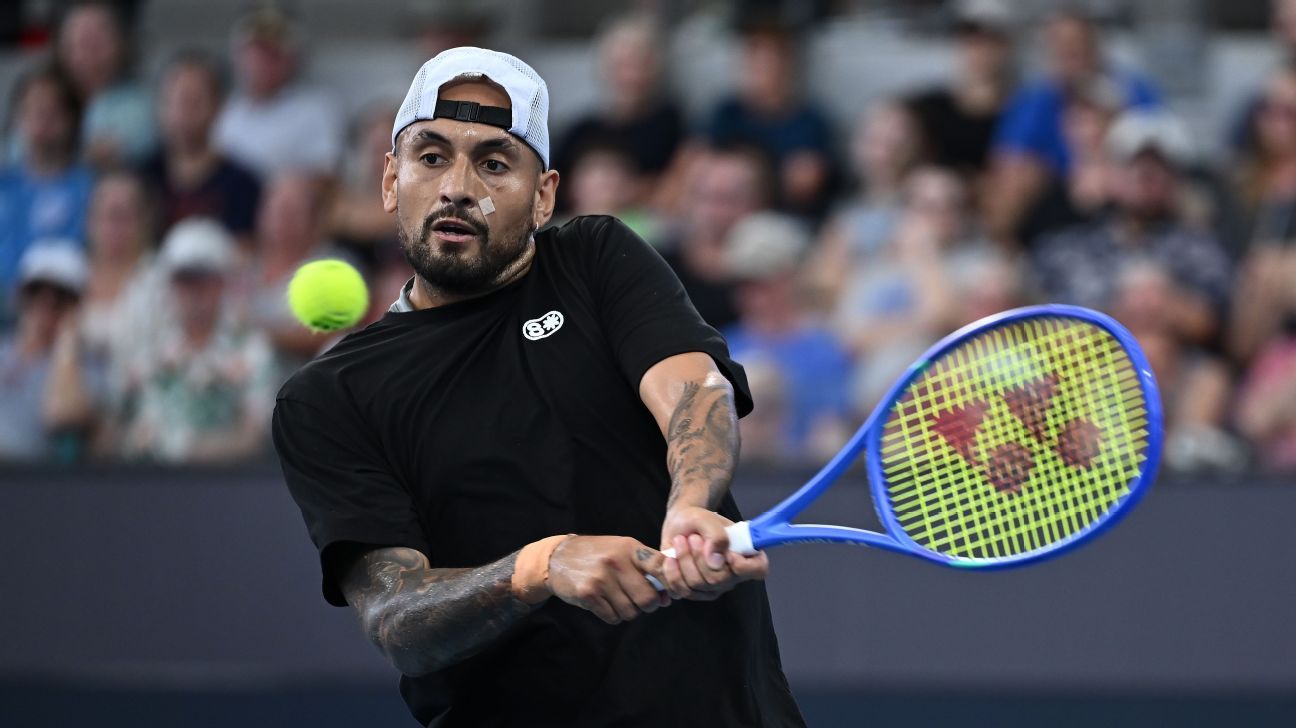
In the humid roar of Pat Rafter Arena, Nick Kyrgios returned to ATP singles action, the crowd pulsing with memories of his 2018 title here. The former world No. 13 faced Aleksandar Kovacevic on these medium-paced hard courts, where the bounce favors steady baseline exchanges. But Kyrgios’s comeback unraveled swiftly, a 6-3, 6-4 defeat in just 66 minutes that highlighted the gap between his 2022 peaks and a current ranking of No. 670.
Kyrgios managed only 10 winners to Kovacevic’s 27, his serve lacking the old pop as loose errors gifted single breaks in each set. He tried an underarm serve early, a spark of mischief, but couldn’t disrupt the American’s rhythm with crosscourt returns or heavy topspin forehands. The surgeries on his wrist and knees since last March have limited him to seven matches in three years, turning every rally into a test of rebuilt mobility.
“Quick match, but he’s world class ... he was lights out,” Kyrgios said. “He’s locked in, a hell of a player, one to watch for sure.”
Reconciling the post-surgery shift
Kyrgios has faced the sad reality that the unbeatable force from 2022—Wimbledon finalist, US Open quarterfinalist—is gone, surgeries pulling down that once-iron belief. At 30, he admits no shame in prizemoney driving his return, a pragmatic pivot from delusion to gratitude amid the tour’s demands. This Brisbane loss, his first serious singles outing since last March, becomes a building block, not a breaker, as he eyes consistent play over the next six to 12 months.
The psychological weight shows in his measured words, the arena’s energy a contrast to past tensions with crowds. Now, young fans chant without reservation, their support easing the journey’s rough edges. He feels the love here, a tournament he once owned, fueling resolve despite the short stay.
Doubles energy counters singles setback
Staying in Brisbane, Kyrgios partners with Thanasi Kokkinakis for doubles after their enthralling Sunday win that outshone his singles effort. The duo’s chemistry—Kyrgios’s booming serves setting up Kokkinakis’s net poaches in one–two patterns—delivers the promised entertainment, half in singles but full in this format. It offers shorter points, less strain on his knees, while the crowd’s roar reminds him of his flair’s pull.
He promised the ‘Special K’ experience pre-tournament and concedes delivering on it through doubles drama, the pair giving more thrill than the rest of the event combined. This shift to doubles provides momentum, a balm after the singles sting, as he heads to the Kooyong Classic next week. The Australian Open looms with three wildcards left, his upbeat realism tempered by the need to string matches together.
Kovacevic’s poise exposes tour evolution
Kovacevic, world No. 58 after a strong year-end surge, stayed locked in from the baseline, his down-the-line backhands and inside-in forehands exploiting Kyrgios’s predictable patterns. The American’s deep returns neutralized slice backhands, forcing defensive crosscourts that Kyrgios couldn’t turn aggressive. Post-match, he called the opponent tough to scout after such absence, expecting more adversity yet capitalizing on the moment.
For Kyrgios, praising his foe underscores the field’s depth, where steady grinders like Kovacevic thrive on hard courts’ grip. The 66-minute clinic reveals tactical adjustments needed: varying serves to open angles, mixing underspin to disrupt, rebuilding the explosiveness for net rushes. As January 7, 2026, wraps this chapter, Kyrgios absorbs the loss on his chin, grateful for the arena walkouts and the path ahead.
“I feel good and I’ll try and use it as a building block,” he added. “Not just for AO, but this year, for whatever this year holds, I want to continue to play as much as I can.”
“I genuinely thought I was the best player in the world,” Kyrgios reflected on 2022. “After you have those surgeries, I guess they pull you down and you don’t have that belief anymore. it’s sad in a way.”
The Brisbane hard courts, once his domain, now demand patient adaptation, each practice session forging resilience. With doubles providing spark and crowds offering warmth, his season’s rhythm builds toward Melbourne, where wildcards and wildcard hopes test the rebuilt spirit. In six to 12 months, consistent blocks could reshape the arc, blending persistence with the tour’s raw pulse.
“The journey I’ve had ... hasn’t always been amazing,” he noted. “Now, every time I walk out there it’s always a lot of fun.”
“I’ve felt a lot of love out there. Young kids chanting and enjoying their time.”
“To be honest I was expecting a little more than that, in terms of adversity,” Kovacevic said.
“This is a good building block. If I was to string a few (matches) together, who knows where I’ll be in six to 12 months’ time. Right now, I’m OK with taking a loss on my chin.”
“Me and Thanasi gave the crowd more entertainment than they’d had all tournament. So I gave them ... the ‘Special K’ experience.”