Gauff reframes title defense into fresh clay pursuit

Coco Gauff steps onto the red clay with a lighter mindset after Rome delivered every scenario a player could need before Roland Garros begins.
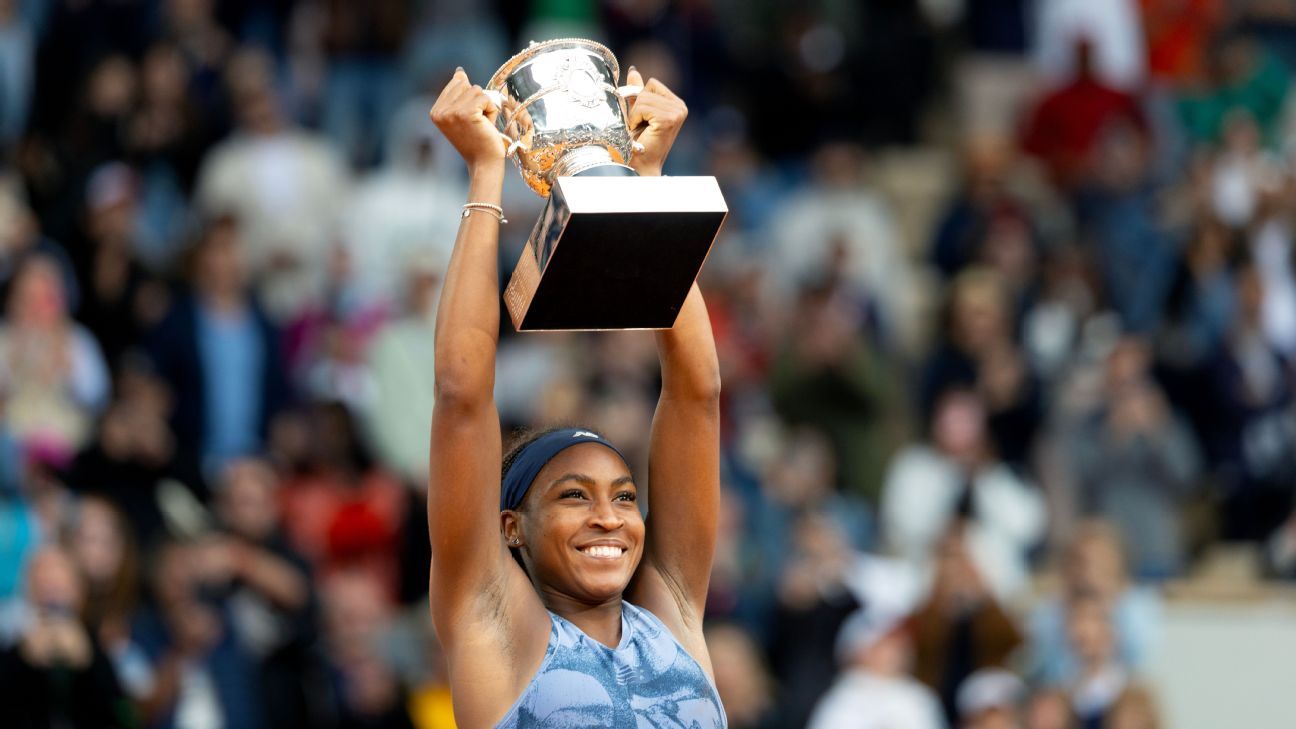
Pressure builds quietly across a season, turning familiar courts into arenas where every swing carries echoes of past triumphs and stumbles. Coco Gauff has a new approach for her second time around attempting to defend a Grand Slam title. She steps into the French Open with a lighter frame of mind, one shaped by recent swings of fortune rather than the need to guard a crown.
The American’s strategy heading into the French Open -- the clay-court major that starts Sunday and which she won a year ago -- goes something like this: don’t think about it as defending something. “I realize that the ‘defending’ means nothing in a way,” Gauff said. “I don’t really look at it as defending anymore.”
At the US Open, I was like, ‘I need to defend, defend.' When you’re playing a tournament that you didn’t win, what is it called? That’s why I just say now it’s just another tournament: ‘I won it last year. I’ll try again to do it this year.' I’m not going to be able to defend every year. I’m not Rafa.
Her first Grand Slam title defense at the US Open two years ago ended in the fourth round with 19 double faults. That memory lingers as a reminder of how fixation can tighten the grip on a racket.
Reframing the chase after Rome swings
Gauff‘s first Roland Garros title came with a victory over top-ranked Aryna Sabalenka in the final a year ago. Just like last year, Gauff was the runner-up at the Italian Open, a clay-court warmup for Roland Garros. The loss in Rome to Elina Svitolina still offered value through its raw edges.
“There’s a lot of positives I can take from this tournament and a lot I can learn from,” Gauff said after losing the final in Rome to Elina Svitolina. “This week I experienced all the ups and downs of a tournament. ... I’ve been down, had the lead, lost the lead. I’ve been in the final, been down match point. I think I’ve experienced every scenario that can prepare me for Roland Garros.” Those match-point deficits and lead reversals translate directly to the slower surfaces ahead.
Heavy topspin crosscourt exchanges will test timing, while inside-out forehands can open angles when opponents lean defensive. Gauff now views each point as part of a longer arc instead of a single stand against history. Serve adjustments fuel growing steadiness Another big lesson that Gauff will take from Rome is a positive vibe on her serve after years of struggles.
In two of her wins at the Foro Italico, she committed only one double fault. She had seven in the final, though. “I think it’s a real improvement,” Gauff said after getting 78% of her first serves in against Sorana Cirstea in the semifinals. “it’s the first time in my career I feel like I’m really stable with that shot.”
Serve adjustments fuel growing steadiness
The technical tweaks show in toss consistency and weight transfer. “I’m tossing a bit more consistent. My weight is a little bit better. Also just the trust, the confidence in it is a lot better,” she said. “Because my confidence in it is better, then I’m actually consistently tossing the ball in the right spot, having my technique be the same on each serve regardless where my target is. That’s the biggest difference.” A more reliable first serve opens the door to smarter 1–2 patterns that pull rivals wide before closing with down-the-line winners.
The No. 1 player was upset by American Hailey Baptiste in the Madrid Open quarterfinals and lost in the third round at the Italian Open to Cirstea. Aryna Sabalenka also appeared visibly bothered by lower back pain in Rome. Elena Rybakina, ranked No. 2 and this year’s Australian Open champion, is another player who excels on hard courts and has achieved mixed results on clay.
These surface transitions add layers to the mental load players carry into Paris. Depth across the draw reshapes expectations Iga Swiatek, the four-time French Open champion, lost to Svitolina in the Rome semifinals and is still reshaping her game under new coach Francisco Roig, who used to work with Rafael Nadal.
Depth across the draw reshapes expectations
Swiatek’s 26-match winning streak at Roland Garros ended in the semifinals last year with a loss to Sabalenka. Marta Kostyuk won the Madrid Open and then withdrew from the Italian Open due to hip and ankle issues. Such interruptions remind everyone how quickly plans shift on clay.
Mirra Andreeva, 19, is already performing on all surfaces. The Russian won a title on clay in Linz, Austria, and reached the Madrid final before losing to Gauff in three sets in the Rome quarterfinals. At the other end of the age spectrum, Cirstea is having a breakthrough season at age 36 with a run to the Rome semifinals. She plans to retire at the end of the year.
Jessica Pegula, the No. 5 player, suggested that there is a long list of possible title contenders. “Especially on clay, it’s always like that,” Pegula said. “There’s a lot more chances for people.” Svitolina, who is from Ukraine like Kostyuk, claimed the Rome title for her first WTA 1000 trophy in eight years and is back in the top 10 after a maternity leave. But she has never been past the semifinals of a Grand Slam -- and never past the quarterfinals at the French Open.
The field’s breadth invites calculated risks: slice approaches to disrupt rhythm, or sudden inside-in accelerations when openings appear. Gauff’s evolving serve and mindset position her to absorb these variables without the old defensive tension. Each session now builds toward measured aggression rather than preservation. The draw rewards players who stay present and adjust on the fly as the tournament unfolds.