Gauff’s Racket Rage After AO Quarterfinal Rout

Coco Gauff’s serve faltered badly in a 59-minute loss to Elina Svitolina at the Australian Open, sparking a post-match outburst caught on camera that reveals the pressures on the young star.
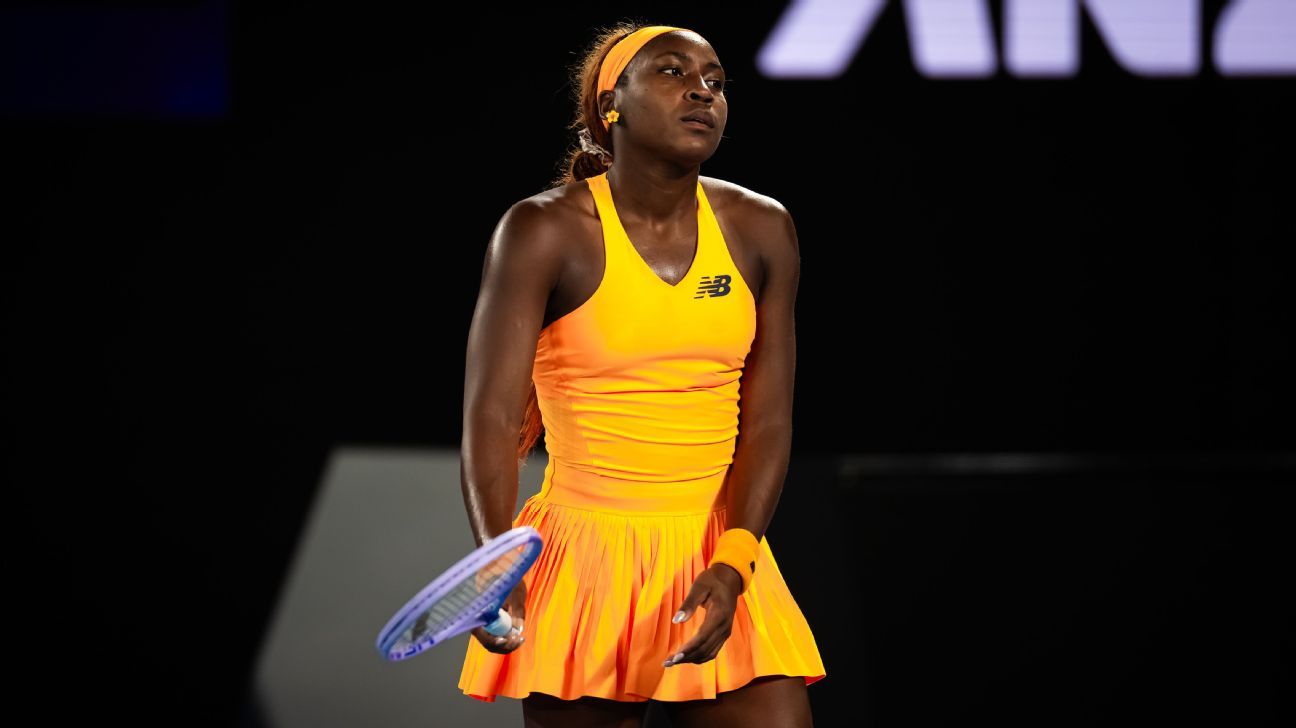
MELBOURNE, Australia—Coco Gauff‘s Australian Open quarterfinal against Elina Svitolina ended in a blur of frustration on Rod Laver Arena. The third seed, a two-time major winner still chasing deeper runs Down Under, saw her serve crumble under the hard-court bounce. Svitolina pounced with sharp returns, breaking her four times in the first set alone amid five double faults that echoed through the hushed stands.
The match clocked just 59 minutes, a 6–1, 6–2 scoreline that masked Gauff’s deeper struggles. She landed 74% of first serves but won only 41% of those points, her heavy topspin deliveries sitting up for Svitolina’s crosscourt replies. Across 15 games, unforced errors stacked to 26, with a meager three clean winners and just 2 of 11 points on second serves, where underspin floated short and invited aggression.
“Certain moments—the same thing happened to Aryna [Sabalenka] after I played her in the final of the US Open—I feel like they don’t need to broadcast,” Gauff said in her postmatch news conference. “I tried to go somewhere where I thought there wasn’t a camera because I don’t necessarily like breaking rackets. I broke one racket [at the] French Open, I think, and I said I would never do it again on court because I don’t feel like that’s a good representation. So, yeah, maybe some conversations can be had, because I feel like at this tournament the only private place we have is the locker room.”
Serve vulnerabilities expose tactical gaps
Svitolina stepped inside the baseline early, taking Gauff’s first serves on the rise and redirecting them down the line to disrupt rhythm. Gauff’s usual 1–2 pattern—serve into a deep forehand—faltered as the Ukrainian mixed flat backhands with inside-in forehands, forcing defensive slices that rarely held up. The hard courts amplified every glitch, turning Gauff’s power into liability when her toss drifted under pressure.
Two more breaks came in the second set, Svitolina’s steady baseline exchanges wearing down the American’s confidence. At 21, following her 2023 US Open win at 19, Gauff has navigated prodigy status since her Slam debut at 15, but Melbourne’s pace highlighted adaptation needs. Her kick serves lacked bite, allowing returns that pulled her wide and opened the court for winners.
Frustration vents beyond the court
As the final point fell, Gauff walked off composed, seeking a quiet corner in the arena’s vast layout. Cameras caught her seven times smashing the racket into a concrete ramp—once per service game lost, plus one more—a raw release from bottled tension. She later explained it as healthier than lashing out at her team, emphasizing emotional outlets away from young fans.
“They’re good people. They don’t deserve that, and I know I’m emotional,” Gauff said. “So, yeah, I just took the minute to go and do that. I don’t think it’s a bad thing. Like I said, I don’t try to do it on court in front of kids and things like that, but I do know I need to let out that emotion.”
This marks her second straight quarterfinal exit here, after a 2024 semifinal, underscoring the grind of sustaining excellence amid rising expectations. Svitolina’s clinical play advances her toward a potential semifinal, her veteran poise contrasting Gauff’s raw drive.
Hard-court lessons fuel rebound
Gauff’s Melbourne exit fits a broader arc of pressure from a packed schedule, where hype clashes with on-court demands. Refining second-serve variety—perhaps more slice to vary bounce—could counter aggressive returns like Svitolina’s. Incorporating down-the-line backhands to break patterns might reclaim control on faster surfaces.
The crowd’s shift from cheers to murmurs mirrored the match’s tempo, the humid air thick with what-ifs. Yet at 21, Gauff’s resilience promises evolution, turning this setback into momentum for clay and grass ahead. Svitolina’s blueprint shows how adaptability upends seeding, but Gauff’s fire ensures her story endures beyond one loss.