Djokovic battles heat and fatigue in Shanghai grind

Novak Djokovic confronts physical exhaustion under Shanghai’s humid skies, rallying past Jaume Munar to etch another milestone in his storied career.
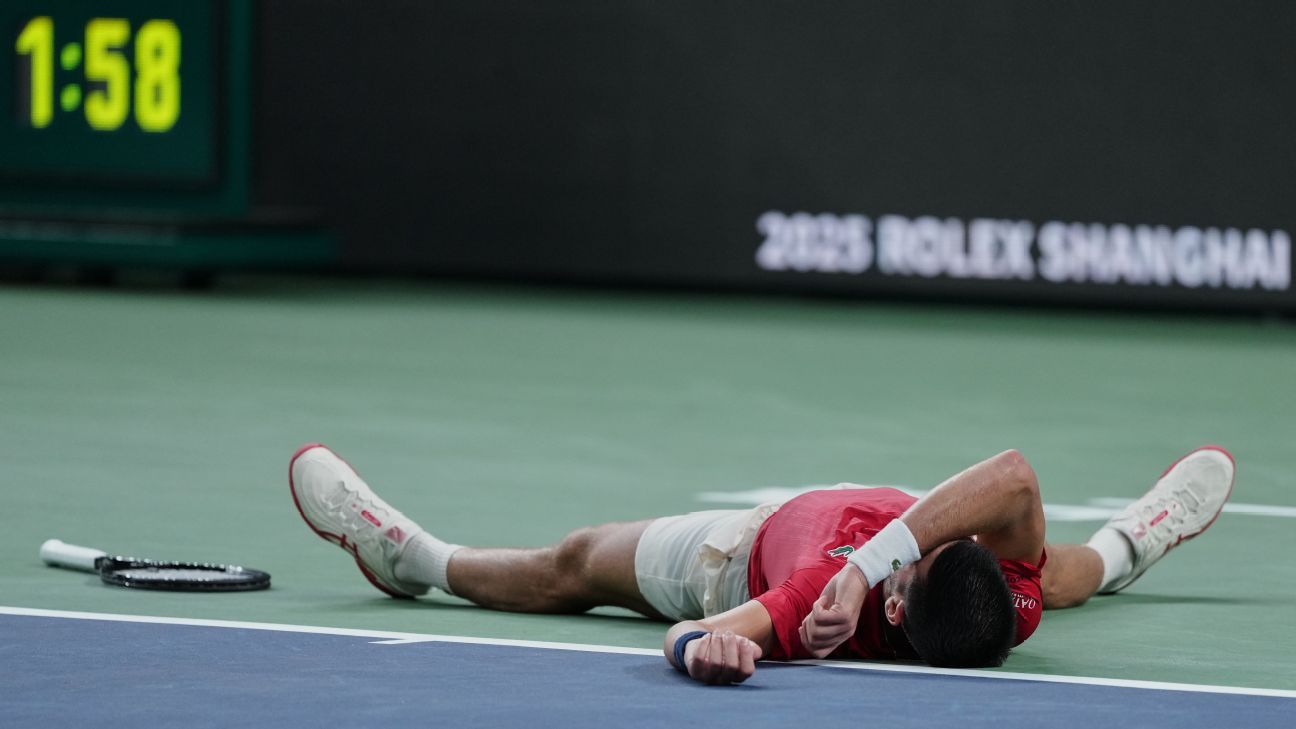
In the sweltering humidity of the Shanghai Masters, Novak Djokovic endured a punishing encounter with Jaume Munar, dropping the second set before prevailing 6-3, 5-7, 6-2. The conditions amplified every baseline exchange, turning the court into a test of willpower as much as skill. Djokovic’s first-set dominance came through controlled crosscourt rallies that pinned Munar back, but the Spaniard’s steady returns began to erode that edge as the match wore on.
Mid-match crisis tests endurance
A prolonged rally capped the second set with Djokovic’s forehand drifting wide, sending him crumpling to the court in visible distress, forearm draped over his eyes as he lay sprawled for tense seconds. He sat up slowly, head between his knees, before a trainer assisted him to his chair for medical treatment ahead of the decider. This rare display of vulnerability revealed the toll of a grueling season, where high-stakes clashes across surfaces have left even the 38-year-old’s ironclad resilience showing faint cracks.
The crowd’s murmurs filled the humid air, their energy a subtle undercurrent to the Serbian’s struggle, as whispers of concern spread through the stands. Djokovic‘s tactical foundation—mixing inside-out forehands with defensive slices—had held firm earlier, but the heat disrupted his rhythm, forcing longer loops and exposing movement limitations. Yet, this moment underscored his psychological edge, the ability to channel discomfort into focus that has defined two decades of triumphs.
Tough day at the office. Very challenging physically.
Declining the on-court interview, he wrote on X his candid reflection on the ordeal, a post dated October 7, 2025 that included a nod to his support and affection for the city, alongside an image.
Tough day at the office. Very challenging physically. Luckily, I have the greatest support in the world 🫶🏼. 我爱上海 pic.twitter.com/PgGHHA0Zqm
— Novak Djokovic (@DjokerNole) October 7, 2025
Third-set surge restores control
Reinvigorated after treatment, Djokovic struck immediately in the third, breaking Munar when the Spaniard flubbed a routine overhead at 40-15, the ball floating long under mounting pressure. He varied his patterns with underspin backhands to counter Munar’s topspin drives, pulling the set out 6-2 as the humidity dulled his opponent’s precision. The shift highlighted Djokovic’s adaptability, turning defensive crosscourts into aggressive inside-in winners that reclaimed the match’s tempo.
This recovery not only secured the win but marked a historic note: he became the oldest player to reach the quarterfinals at an ATP Masters 1000 event, eclipsing Roger Federer‘s age from his 2019 Shanghai quarterfinal run by two months. Chasing a record-extending 41st Masters title, the victory amplified the narrative of a season where every point carries the weight of legacy, his all-court game thriving despite the physical demands.
Quarterfinals demand fresh adjustments
Next, Djokovic faces Zizou Bergs of Belgium, whose aggressive net rushes and left-handed serve could probe the Serb’s recovering mobility in tight exchanges. The Belgian’s power might force quicker decisions on these medium-paced hard courts, where lower bounce in the humidity favors varied returns over raw pace. Meanwhile, tenth-seeded Holger Rune mirrored the day’s endurance theme, outlasting big-serving Frenchman Giovanni Mpetshi Perricard 6-4, 6-7 (7), 6-3 by employing drop shots and crosscourt angles to neutralize the booming deliveries.
For Djokovic, this Shanghai run embodies the broader chase—conserving energy for playoffs while fending off rising challengers, his tactical refinements like the one–two combinations ensuring he remains the benchmark. The crowd’s roars, blending with the sticky air, propel him forward, a reminder that in tennis’s relentless grind, resolve often outlasts the heat.