Djokovic withstands Paris heat to outlast Royer

A 39-year-old champion mixes patience and precision to survive a four-set grind against a younger Frenchman while the clay bakes under a relentless sun.
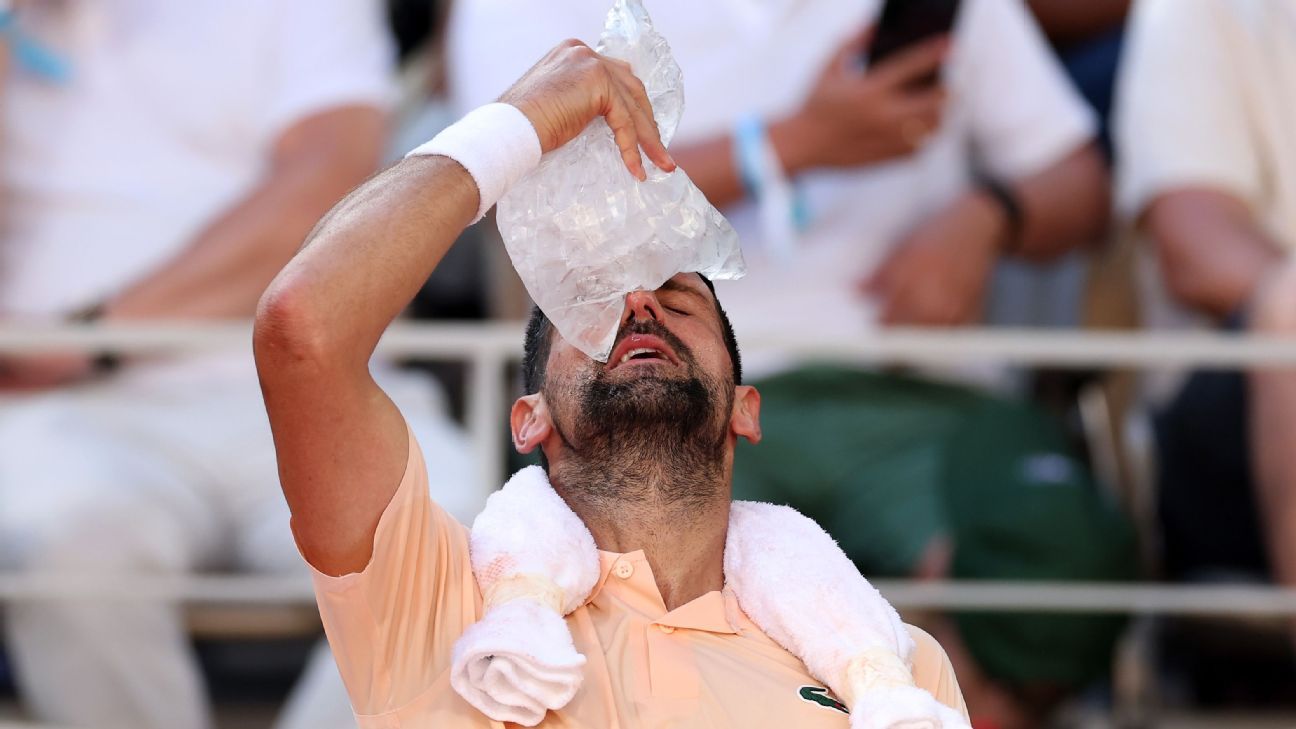
Novak Djokovic placed ice packs around his neck and on top of his head during changeovers to keep cool amid the Paris heat wave at the French Open on Wednesday. Temperatures climbed past 90 degrees for the fourth straight day, turning every rally into a test of endurance on the slow clay. The 24-time major winner leaned on experience to navigate the physical demands while the partisan crowd added another layer of tension inside Court Philippe-Chatrier.
Experience guides adjustments on slow clay
Djokovic, 39, was pushed by 74th-ranked French player Valentin Royer, who is 15 years younger than him, for more than 3½ hours before he reached the third round with a 6-3, 6-2, 6-7 (7), 6-3 victory. He mixed inside-out forehands with occasional slice to disrupt rhythm after dropping the third set. The 24-time major winner converted four match points only after extending one rally long enough for a netted forehand from Valentin Royer.
Djokovic came to Roland Garros with questions over his form after he lost his only clay-court match before the tournament, falling to Croatian qualifier Dino Prizmic at the Italian Open after two months out due to a right shoulder injury. Recovery allowed a shift toward crosscourt heavy topspin to pin opponents behind the baseline. That same pattern reappeared when break points arrived, turning defense into controlled offense.
It was a very, very difficult match in difficult conditions. A big challenge for me. ... Experience helped me a lot.
But Djokovic is playing himself back into form after coming back from a set down to beat Giovanni Mpetshi Perricard, another Frenchman, in a first-round match that lasted nearly three hours. The one-two combination of serve followed by inside-in forehand became more reliable once shoulder mobility returned. Those adjustments carried forward, limiting unforced errors even when the crowd noise peaked during service tosses.
Crowd energy tests focus under pressure
Up next for Djokovic is potentially a bigger test against either 19-year-old Brazilian Joao Fonseca or the 20-year-old Prizmic, who were playing later. Fonseca has been touted as a future Grand Slam contender, while Djokovic himself pointed to big things ahead for Prizmic after their meeting in Rome. The prospect of facing another young talent keeps the focus on tactical discipline rather than past results.
No. 11 Andrey Rublev and No. 13 Karen Khachanov were among those also advancing to the third round Wednesday. Their steady progress showed that established players can still find rhythm even when the draw opens space for surprises. Meanwhile Jakub Mensik collapsed to the clay because of cramps and had a tough time getting up after besting Mariano Navone in a fifth-set tiebreaker. The match lasted 4 hours, 41 minutes.
In the night session, second-seeded Alexander Zverev beat Tomas Machac 6-4, 6-2, 6-2. The straight-sets result offered a contrast in efficiency on the same day the main stadium witnessed extended battles. Djokovic improved to 14-0 in his career against Frenchmen at Roland Garros and reached the third round in Paris for a 21st straight year.
Form returns ahead of tougher tests
Djokovic wasted a chance to close the match out earlier when he missed a backhand long in the third-set tiebreaker then required four more match points in his final service game before a forehand from Royer finally landed in the net to conclude a long rally. When it was finally over after 3 hours, 44 minutes, Djokovic first nearly stumbled to the clay then performed his violin celebration. A pair of Djokovic fans inside the main stadium held up a sign with a goat on it that read 39 is the new 29.
it’s a very important victory. The conditions are difficult for players. I had chances in the third set, and it was my fault because I was twice a break up. He also noted the relief of avoiding another French opponent soon, laughing that two matches already felt like two weeks. The schedule ahead will test whether the recent clay form can carry through deeper rounds.