Alcaraz’s Australian Open Breakthrough Beckons

Carlos Alcaraz dominates the majors but stalls at the Australian Open. With flawless early wins in 2026, can he shatter his quarterfinal barrier and claim the title in Melbourne?
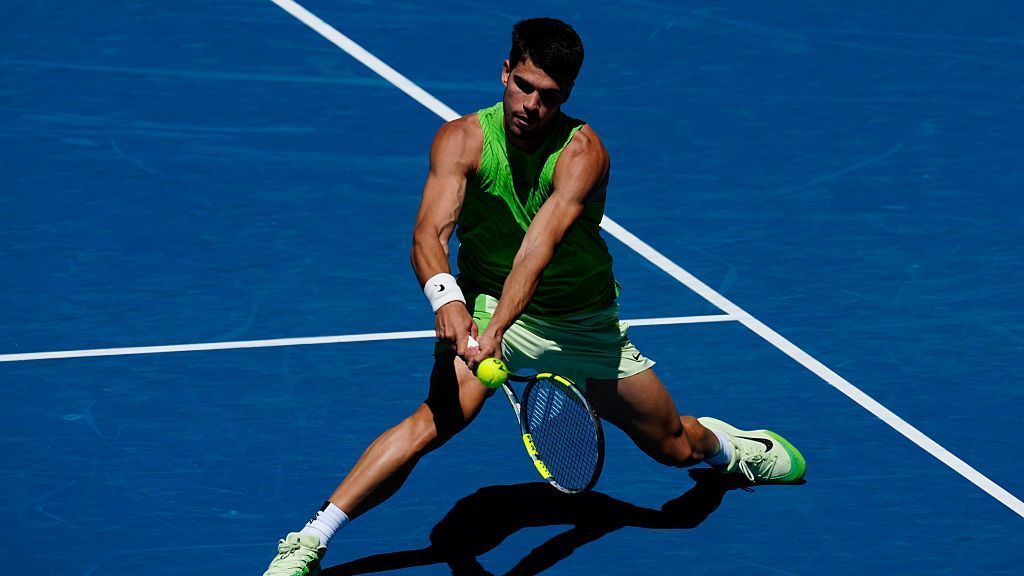
MELBOURNE, Australia—Carlos Alcaraz steps onto Melbourne Park’s hard courts carrying the weight of an incomplete Grand Slam collection. The world No. 1 has twice lifted the trophies at Wimbledon, the French Open, and the US Open, yet the Australian Open remains untouched—no final, no semifinal, not even a deep run past the quarters. Since August 2022, his 40-month surge has netted eight Masters 1000 titles, a youngest-ever No. 1 ranking at 19, and $50 million in earnings that rank fifth all-time, but this Down Under drought defies his 89% win rates elsewhere against a mere 73% here.
That gap feels almost personal, a puzzle the Spaniard attacks with the same ferocity he brings to baseline rallies. His most vivid memory from Melbourne traces to 2022, a third-round marathon against eventual semifinalist Matteo Berrettini. The then-18-year-old dug deep under the Rod Laver Arena sun, trading heavy topspin forehands and crosscourt backhands in a fifth-set decider that stretched beyond four hours, only to fall short and foreshadow the talent that would redefine the tour.
“I’m hungry for the title,” Alcaraz said on the eve of the tournament. “This is my main goal for this year. The first tournament, the main goal. I just really want to perform better than I did previous years.”
Early exits sharpen his resolve
Subsequent trips only deepened the frustration. In 2023, a hamstring injury forced withdrawal before the draw, robbing him of a chance to build on that Berrettini battle. He returned in 2024 as world No. 1, only to meet an ultra-efficient Alexander Zverev in the quarterfinals, where the German’s deep returns and inside-in forehands stifled Alcaraz’s rhythm on the quicker surface.
OH MY ALCARAZ 😱
This is UNREAL 🔥@carlosalcaraz • @wwos • @espn • @tntsports • @wowowtennis • #AO26 pic.twitter.com/fSZZ2aITyo— #AusOpen (@AustralianOpen) January 23, 2026
Last year’s quarterfinal against 10-time champion Novak Djokovic added another sting, a four-set defeat where the Serb’s defensive slices and net rushes forced Alcaraz into longer points than his explosive style prefers. Those losses—to players of that caliber in the quarters—stand out as anomalies for a top seed, yet they ignited his best season: eight titles, including French and US Open repeats, with 71 wins from 80 matches and nine straight finals from April to September.
Alcaraz has channeled that momentum into 2026, gliding through the first three rounds without dropping a set. His round-of-32 clinic against France’s Corentin Moutet lasted two hours, blending athletic retrievals with down-the-line winners that left the seeded opponent scrambling, the crowd’s cheers echoing off the arena walls as Alcaraz’s energy infected every point.
Tactical tweaks target hard-court pace
The Australian Open’s Plexicushion demands adjustments Alcaraz has honed: earlier returns to counter big serves, more underspin on backhands to skid low against the medium bounce, and varied 1–2 patterns to open angles his forehand exploits. Against Moutet, he mixed slice approaches with aggressive net rushes, converting breaks efficiently while the humid air thickened around Rod Laver Arena. Now, American Tommy Paul looms in the fourth round, his flat backhands and serve-volley forays testing whether Alcaraz can maintain topspin depth on returns.
The winner advances to face either 10th-seed Alexander Bublik or Australia’s top-ranked Alex de Minaur, both thriving in Melbourne’s conditions—Bublik with erratic knucklers that disrupt timing, de Minaur with speedy counters that turn power into passing shots. Alcaraz’s preparation emphasizes mental resets, stepping in on returns to neutralize the surface’s speed, a evolution from past years where pressure sparked unforced errors in tight games.
“it’s tricky not to have gone further than quarterfinals here in Australia because I feel like I’m playing good tennis here. The last two years I’ve been playing really good tennis,” Alcaraz said earlier in the week. “Zverev and Djokovic ... it’s unusual players you play against in quarterfinal if you are [ranked] one or two in the world.”
Career slam whispers in Melbourne’s heat
Seizing the title would mark Alcaraz as the ninth man with a career Grand Slam, the youngest at 22, eclipsing compatriot Rafael Nadal‘s record by nearly two years. The psychological lift from those other majors—where his inside-out forehands and one–two setups dominate—fuels his belief that this year differs, with improvements in sliding on hard courts and drilling inside-in shots to punish short balls. Jake Michaels, the Melbourne-based writer who has covered Grand Slams worldwide since 2013, notes the Spaniard’s growing poise amid the packed stands and rising temperatures.
As the draw compresses, Alcaraz’s hunger meets the tournament’s tactical demands, from Paul’s baseline steadiness to potential quarterfinal traps. The crowd’s anticipation pulses through the venue, syncing with his leaps after overheads and roars after winners. If he sustains this form, the Norman Brookes Challenge Cup could finally fill that void, rewriting his Australian story with a surge of dominance.
“Completing the career Grand Slam is something amazing to do. To be the youngest [to have] done it before is even better,” Alcaraz said. “I’m just happy with the way I see myself improving every match, every practice. I know that I’m going to keep going forward. I’m feeling this year is probably one of those years that I will be able to, or I will have a chance.”