Challenger Tour’s Prize Money Boom Signals Brighter Futures

With $32.4 million on the line for 2026, the ATP Challenger Tour eases the grind for emerging players, turning financial pressures into fuel for sharper rallies and bolder strategies on courts worldwide.
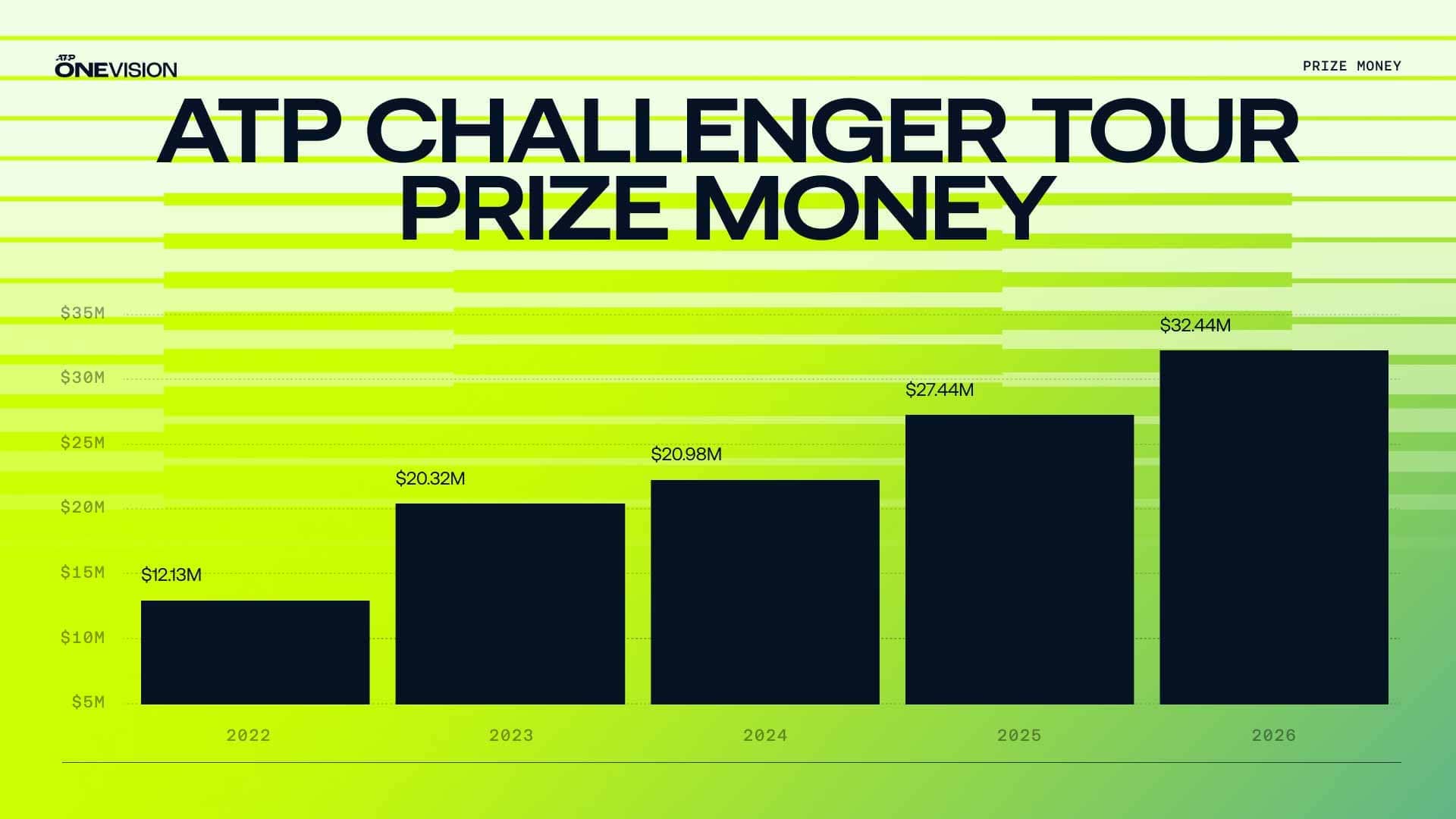
In the high-stakes world of the ATP Challenger Tour, where young players chase breakthroughs amid grueling schedules, the announcement of a record $32.4 million in prize money for 2026 marks a turning point. This includes an additional $5 million in singles compensation over 2025 levels, representing a 167% surge since 2022 that promises to reshape the mental landscape of the circuit. As these athletes navigate the tactical demands of varied surfaces—from the grip of clay to the speed of hard courts—the influx allows them to prioritize shot selection over survival, fostering deeper focus during extended crosscourt exchanges.
OneVision drives strategic investments
Central to this evolution is OneVision, the ATP’s long-term strategic plan that has propelled unprecedented growth in the Challenger Tour’s financial foundation. Key initiatives include the commercialization of rights through Tennis Data Innovations, the rollout of premium Challenger 175 events, and the formation of a dedicated team to cultivate new revenue streams. These efforts not only bolster purses but also enable players to refine their game without the shadow of budget constraints, perhaps extending a one–two pattern with an inside-out forehand to exploit weaker backhands in crucial moments.
The psychological lift is palpable, as rising talents can now invest in recovery and coaching to sustain intensity through long rallies, reducing the isolation that often creeps in during weeks of travel. This stability encourages risk-taking on court, like deploying underspin slices to disrupt aggressive serves, knowing a strong season’s earnings provide a safety net.
Challenger Tour prize money has nearly tripled since 2022. This is what OneVision was designed to do – create the foundation for investment in our sport to deliver greater financial security to more players. There’s more room to grow, and we’re working to unlock the opportunities to build on this progress.
Broadcast expansion connects global audiences
Building on 2025’s advancements, the global distribution of media rights—highlighted by a landmark partnership with Tennis Channel—has elevated the Challenger Tour’s reach to 20 countries, drawing a record 33.8 million viewers. This visibility transforms remote venues into stages buzzing with virtual energy, where the tension of a down-the-line pass feels amplified by distant cheers. Players, once battling doubt in relative obscurity, now draw motivation from broader recognition, sharpening their mental edge for tiebreaks and service holds.
The atmosphere shifts as well, with crowds in packed stands mirroring the online surge, injecting adrenaline that aids in executing precise volleys or countering with crosscourt winners. For these competitors, the exposure validates their path, allowing them to channel emotions into tactical poise rather than frustration from unseen struggles.
Calendar growth unlocks competitive pathways
Looking to 2026, the tour’s calendar expands from 216 to 265 events, incorporating 50 new Challenger 50 tournaments that scatter opportunities across continents and surfaces. This proliferation means more chances to adapt strategies—honing inside-in approaches on grass or endurance-building crosscourt loops on indoor clay—while financial security lets players commit fully to the grind. ATP Chairman Andrea Gaudenzi emphasizes how these changes fortify the route to the ATP Tour, turning potential burnout into calculated ascents.
As the circuit pulses with renewed possibility, young stars can focus on the rhythm of rallies and the psychology of matchups, their minds clear for the breakthroughs that define champions. This foundation sets the stage for a generation to emerge stronger, ready to dominate the professional ranks with strategies honed free from fiscal chains.