Sabalenka Backs Herself in Dubai’s Battle of the Sexes

Aryna Sabalenka channels her World No. 1 fire into an unpredictable exhibition against Nick Kyrgios, where one-serve rules and a shrunken court test raw adaptability in Dubai’s arena.
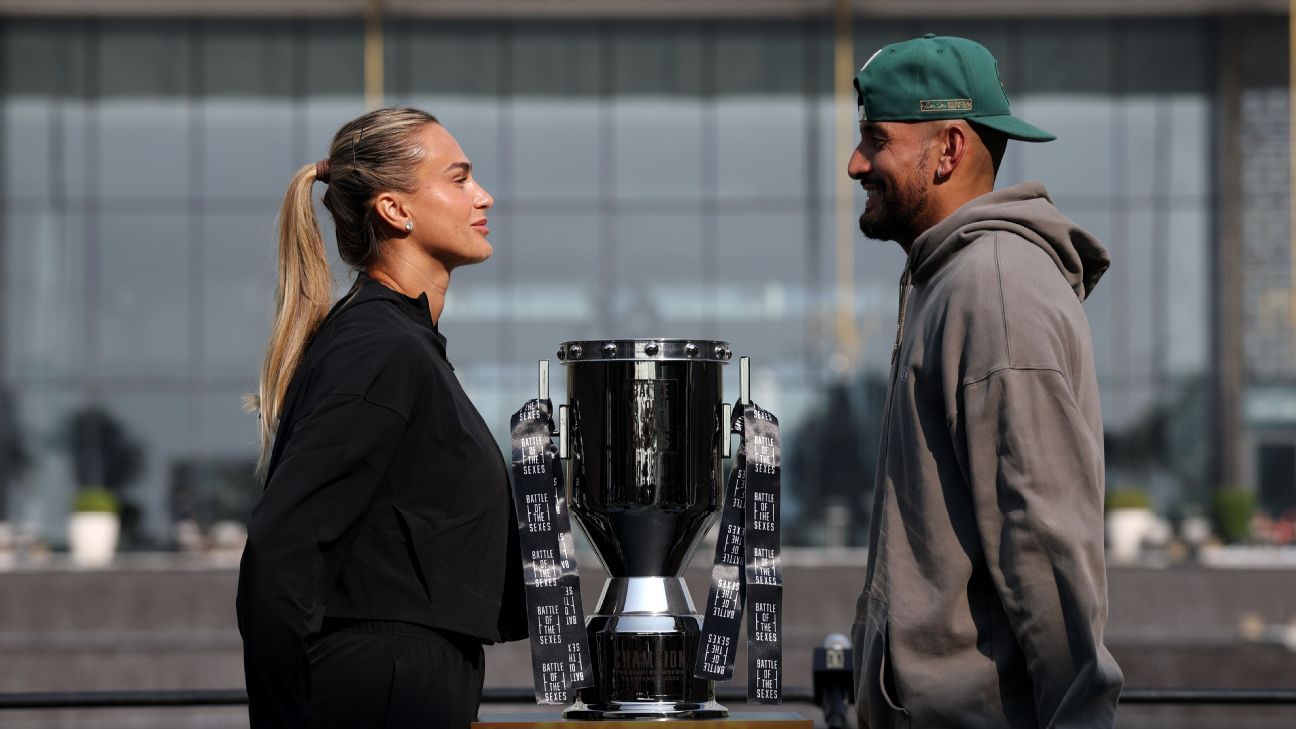
In Dubai’s buzzing Coca-Cola Arena, Aryna Sabalenka steps up for a modern twist on tennis history. The women’s World No. 1 faces Nick Kyrgios in a Battle of the Sexes exhibition on Sunday, echoing Billie Jean King’s 1973 defeat of Bobby Riggs at the Houston Astrodome. This three-set clash uses modified rules—one serve per point, her side of the court reduced by nine percent, and a 10-point tiebreak to decide close sets—forcing both into a high-wire act of precision and instinct.
Sabalenka, the 27-year-old four-time Grand Slam champion, enters with the confidence of a dominant 2025 season behind her. Her power baseline game, built on heavy topspin forehands and relentless returns, now adapts to this leveled field. Off-court friends pause their banter as she eyes victory, drawn to the thrill of the unknown that mirrors the sport’s core rush.
“Me.”
When pressed on the winner, her reply lands like a flat serve. She thrives on the chaos, calling it a huge challenge against Kyrgios’s erratic style. This setup promises quick points on the indoor hard court, where balls skid fast and low, amplifying her aggressive inside-out shots while cramping his angles.
Navigating one-serve volatility
The single-serve rule strips away safety nets, turning every point into a first-strike battle. Sabalenka must thread her 120-mph serves through tighter margins on her reduced court, pairing them with a one–two pattern: deep placement followed by a crosscourt winner. Kyrgios, at 30 and ranked 673 after just five singles matches this year—his last in March—counters with flat trajectories and occasional underspin to disrupt her rhythm.
Her season’s mental grind, from clay-court endurance to grass sprints, prepares her for this pivot. The arena’s electric hum will build as she practices net approaches, exploiting the space constraints to pull him forward. Yet his history of unsettling top players adds tension; even she admits the unpredictability fuels her drive.
“This event is really unpredictable. I don’t know what to expect and that’s what I love because this is the feeling that you chase when you play sport.”
Sabalenka sees it as training, a display of toughness to inspire others. On this swift surface, her topspin loops flatten for sharper down-the-line passes, testing Kyrgios’s footwork in the confined geometry.
Kyrgios taps unpredictable edge
The Australian maverick arrives prepared, his injuries a backdrop to a game that once baffled the elite. He draws on battles where his serve-volley rushes and drop shots threw off precision, much like the chaos that stumped Novak Djokovic, Roger Federer, and Rafael Nadal. In this format, his strength lies in short points, using inside-in forehands to shift momentum before she settles.
Limited play has honed his focus, turning rust into calculated risks. The energy differs from Grand Slam finals he’s reached, but he promises a fresh style effective against her power. “I’ve seen some pretty scary opponents on my time. I’m well equipped and I know that Aryna has got some serious weapons at her disposal.”
Their clash blends her controlled aggression with his improvisation, the crowd’s roars echoing the Astrodome’s legacy. As sets unfold, tactical adjustments—like her slicing backhands to counter his net play—could decide the duel. Kyrgios leans into the mental game, admitting even he doesn’t always know his next move.
“I’m going to bring something she hasn’t seen before. I’ll play the style of tennis that I know is effective.”
Challenging boundaries on court
Beyond the lines, this match sends a message of resilience across divides. Sabalenka hopes it shows young players her grit, embracing the unknown as she has all season. Kyrgios, rebuilding amid setbacks, views it as a step toward bigger returns, his bravado masking the physical unknowns.
The indoor hard’s grip favors bold strikes, where a single fault or unforced error swings points wildly. As Dubai’s lights frame their standoff, the outcome hinges on who adapts faster—her baseline fire or his wildcard flair. This exhibition could sharpen both for the tour ahead, blending entertainment with enduring lessons in adaptability.
For context on the year’s elite performers, explore The best tennis players of 2025: Alcaraz, Sabalenka, Sinner and more. In other news, British No. 1 Jack Draper to miss 2026 Australian Open with arm injury reshapes early schedules.