Andreeva quiets doubt to lift her first major

A teenager who once burst onto the scene at 15 now stands as champion after navigating wind, neutral status and internal pressure on clay in Paris.
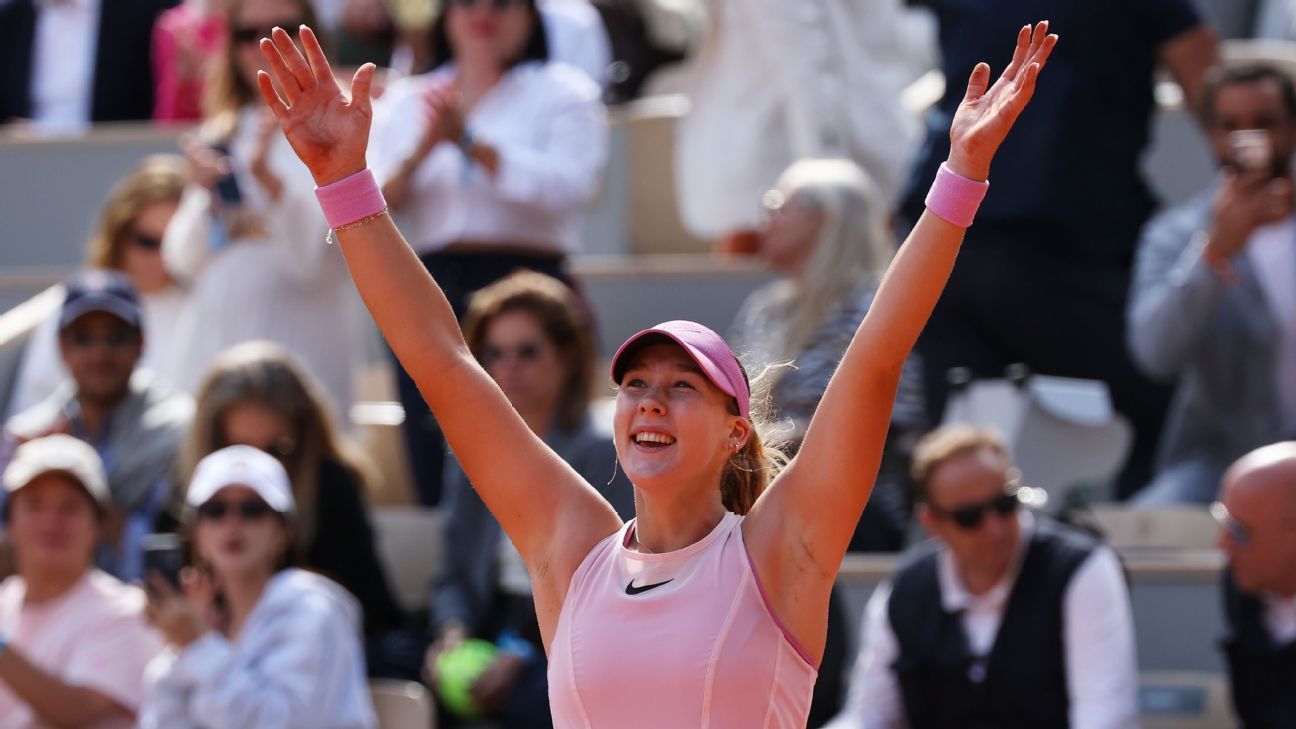
Russian teenager Mirra Andreeva arrived in the French Open final already carrying the weight of early expectations and neutral-flag scrutiny, yet she met the moment with precise adjustments that neutralized Maja Chwalinska array of spins on a blustery clay afternoon.
Wind forces early adjustments
From the opening game the gusts across Court Philippe-Chatrier pushed balls long and forced both players to shorten swings. Andreeva responded by stepping inside the baseline on second serves and flattening her forehand inside-out to keep Chwalinska pinned to the backhand corner. The eighth-ranked player held serve in the fifth game after two wind-assisted errors from the qualifier, then broke immediately when Chwalinska double-faulted into the net.
By the middle of the first set the teenager had shifted her 1–2 pattern to favor heavy crosscourt drives that rode the breeze rather than fighting it. Chwalinska tried to counter with drop shots and slice, yet Andreeva read the underspin early and moved forward to take the ball on the rise. The 6-3 set ended when Andreeva threaded a backhand down-the-line that the wind carried just inside the sideline.
Belief quiets internal demons
Chwalinska entered the final ranked 114 and carrying the hope of becoming the first qualifier to lift the trophy at Roland Garros. Her game relied on mixing heavy topspin with low slices and occasional drop shots to disrupt rhythm. Against Andreeva those weapons lost bite once the Russian began taking the ball earlier and redirecting pace back into the same court quadrants.
The second set followed the same tactical arc. Andreeva absorbed a short slice and answered with an inside-in forehand that pulled Chwalinska wide, then finished the point with a crosscourt backhand winner on her first match point. She dropped to her knees on the clay as the crowd noise swelled from scattered Russian voices calling “Davai Mirra.” Earlier in the fortnight Andreeva had defeated Marta Kostyuk in the semifinals under the same neutral status that has shadowed every match since 2022.
The tactical lessons from that encounter carried forward: stay compact on the return and trust the crosscourt forehand to open the court when the wind gusted. Chwalinska acknowledged the gap after the 6-2 loss. “I felt like I have no weapon against her today,” she said. “She definitely handled the wind much better than me, and she played so smart.”
“I want to thank myself for believing in myself, always giving my 100%, even when it’s tough,” Andreeva said. “Trying every day to be better, as a person and as a player. Believing I can do this, fighting so many demons inside of me. Only I know how tough it was for me and how nervous I was these two weeks.” At 19 she became the youngest player to win the women’s singles title since Monica Seles, who was 18 when she landed her third straight French Open in 1992. Andreeva has now gone a step further than her coach, Conchita Martinez, who lost the 2000 French Open final to Mary Pierce.
The final was played under mostly sunny skies, but wind was a factor in the first Grand Slam final for both players. When Andreeva executed a backhand cross-court winner on her first match point, she dropped on her knees to the clay to celebrate. “I’ve been watching Roland Garros on TV since I was very, very young, so it’s also a big dream of mine to win this tournament,” Andreeva added. “I honestly cannot believe that I’m holding this trophy right now.”
Mirra, Mirra on the wall... 👀 #RolandGarros pic.twitter.com/9Lwoo2pDbI
— Roland-Garros (@rolandgarros) June 6, 2026
Grass offers next test
The runner-up finish lifts Chwalinska nearly 100 spots to world number 21 and triples her career prize money to roughly 2.46 million euros after the 1.4 million euros earned here. Those numbers matter for a player who must now decide whether to enter Wimbledon qualifying or seek a wild card on a surface where she once felt most comfortable. Chwalinska will now turn her focus to grass courts. If she does not receive a wild card, she would need to go through qualifying at Wimbledon.
“Last year it was a struggle for me on grass, but before, I loved playing on grass. I feel like I can use a lot of touch and slices,” she said. “I move pretty well on the court and I anticipate pretty well. I’m ready for the challenge.” Andreeva, already the youngest French Open champion since Monica Seles in 1992, spoke about the personal demons quieted by the victory. Her next test arrives on grass, where the same inside-out patterns that worked on clay will require fresh timing against faster bounces.
Alexander Zverev plays Flavio Cobolli in the men’s final Sunday to conclude the wildest Grand Slam in recent memory. The tactical clarity Andreeva showed in Paris offers a blueprint for that transition. By reading spin early and using the wind as an ally rather than an obstacle, she turned a difficult matchup into her first major title.