De Minaur’s Steady Climb Amid Unreal Expectations

In Melbourne’s electric night, Alex de Minaur pushes Carlos Alcaraz to the brink before the world No. 1 pulls away. His quarterfinal exit sparks familiar critiques, but a closer look reveals a player thriving on consistency, not conquest.
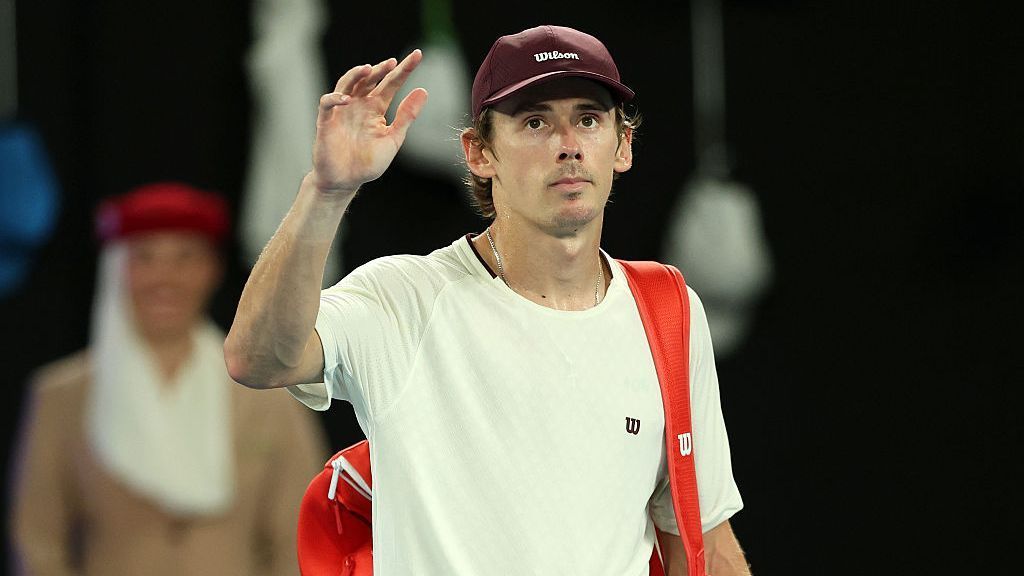
MELBOURNE, Australia—Rod Laver Arena throbs under the lights as the crowd’s roar swells, willing Alex de Minaur forward in his home Slam quarterfinal. He darts across the baseline, speed his sharpest weapon against Carlos Alcaraz, the world No. 1 whose groundstrokes crack like thunder. For two hours and 15 minutes, de Minaur battles, breaking serve twice in a tense first set before Alcaraz surges to a 7-5, 6-2, 6-1 victory—their sixth meeting, all owned by the Spaniard.
De Minaur’s fewer unforced errors speak to his tactical poise, retrieving wide balls with flat backhands that redirect pace crosscourt. Yet Alcaraz’s heavy topspin forehands skid low on the plexicushion hard courts, opening angles de Minaur’s reach can’t fully cover. The home favorite feeds off the energy, stretching points with underspin slices to disrupt rhythm, but the match tilts as Alcaraz unleashes inside-out winners that pin him deep.
“You try to do the right things, you try to keep on improving, but when the results don’t come or the scoreline doesn’t reflect those improvements, then of course you feel quite deflated,” de Minaur said in his press conference following the loss. “You just got to keep on moving. it’s the only way. I mean, as tough as it is when you get results like this, you get back up, you get back on the horse.”
Expectations weigh heavy at home
Australia’s top-ranked Alex de Minaur exits the Australian Open in the quarterfinals for the fifth straight year, a pattern that draws groans from fans craving a breakthrough. The narrative of underdelivery ignores his cemented top-10 status and perennial second-week appearances at majors. He’s reached quarterfinals in six of the last eight Slams, a mark of reliability that echoes through Melbourne’s humid air.
His 2025 season painted a picture of endurance: fourth round or better at all but one Masters 1000, quarterfinals four times, capped by an ATP Finals semifinal. Psychologically, the home Slam amplifies the pressure, turning each deep run into a referendum on his major drought. De Minaur glides on court with electric retrieval, forcing extra shots from opponents, but lacks the booming serve or lethal forehand that define the elite’s firepower.
The crowd senses his grit, chanting as he chases down lobs and fires down-the-line passes. Yet losses like this one fuel debates on his ceiling—will he ever lift a Grand Slam trophy? Only four men reach semifinals per event, one claims victory; de Minaur’s consistency merits appreciation over critique.
Elite clashes forge quiet resilience
Since 2024, de Minaur’s quarterfinal foes form a gauntlet: Alexander Zverev, Novak Djokovic, Jack Draper through a hip injury, Jannik Sinner twice, Felix Auger-Aliassime, and now Alcaraz—all Grand Slam caliber, most ranked above him. He adapts on the fly, dropping low slices to jam forehands or using a 1–2 pattern to probe weaknesses. Against Alcaraz, his speed neutralizes early power, but the Spaniard’s variety—dropshots followed by overhead smashes—exploits any hesitation.
De Minaur has never lost an Australian Open match to a lower-ranked player, a flawless 7-0 streak underscoring his tactical edge. The mental toll mounts in these battles, yet he rebounds, viewing them as proof of contention. Over 40 months, Alcaraz’s achievements rival all but a dozen legends, making this defeat a clash of eras, not a shortfall.
“I can decide to look at it two different ways,” de Minaur said. “I can look at it, the fact that I’m losing to—at the Australian Open—I’ve lost to Rafa, Novak, Jannik twice, now Carlos. I’m not losing too many matches to players I possibly shouldn’t lose to, right?”
For comparison, Nick Kyrgios reached one Melbourne quarterfinal 11 years ago, four overall; de Minaur, four years younger, has two here and seven total. His game maximizes speed over strength, extending rallies on hard courts where balls skid and demand quick feet. These matchups build resolve, hinting at tactical evolutions like bolder inside-in forehands to come.
Appreciating the consistent challenger
De Minaur’s five straight Round of 16s at the Australian Open mark the first for an Australian man since John Newcombe in 1977. The public’s hunger for majors overlooks this steadiness, a quiet victory in a sport of peaks and valleys. As he eyes upcoming hard-court swings, his post-match candor reveals a mind geared for the grind—deflated but determined.
On Melbourne’s pacey surface, his flat groundstrokes and court coverage shine, turning defense into opportunities. Losses to the top seeds sharpen his edge, fostering adjustments like varied serves or net rushes. Australia’s top player didn’t falter; he met a force redefining dominance, his path forward rooted in embracing the long haul where persistence might unlock that elusive title.
The groans will fade, but de Minaur’s rhythm endures, a reminder to value the fight over the finish. With the tour’s giants looming, his speed promises more nights like this—tense, tactical, and tenaciously his own.