Alcaraz’s Wrist Injury Halts Clay Court Chase

Carlos Alcaraz’s right wrist forces him out of Rome and Roland Garros, casting a shadow over a season that began with major glory and now demands patient rebuilding amid rising rivalries.
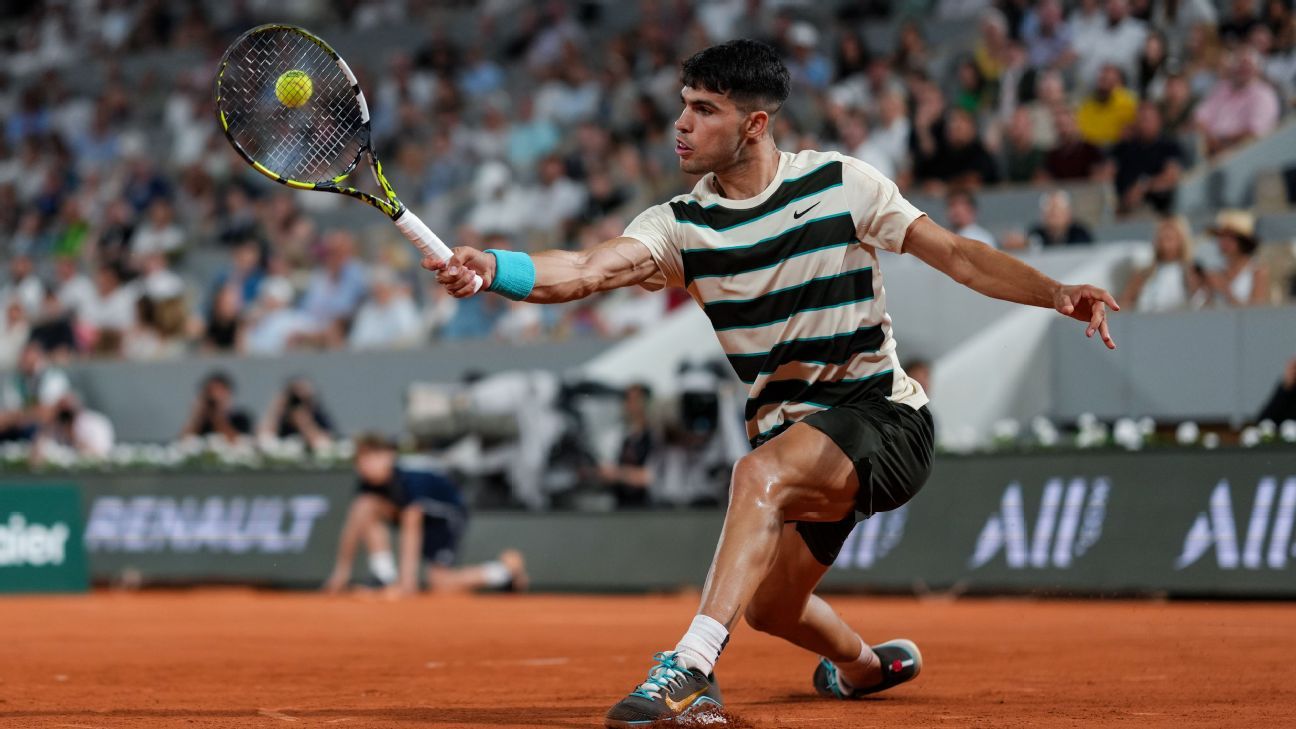
In Madrid’s crisp spring air, Carlos Alcaraz faces a stark reality: his right wrist injury will keep him from the red clay of Rome and Paris this year. The two-time defending champion at Roland Garros, who powered through a first-round win at the Barcelona Open earlier this month, felt the strain intensify overnight, leading to a swift withdrawal. He skipped this week’s Madrid Open, appearing instead at the Laureus World Sports Awards with his wrist immobilized, accepting the world sportsman of the year honor amid the setback.
Fresh medical tests on Friday confirmed the cautious path forward, pulling him from the Italian Open starting May 5 and the French Open on May 18. Alcaraz shared the news directly, emphasizing recovery over risk in a moment that tests his resilience.
“After the results of the tests carried out today, we have decided that the most prudent thing is to be cautious and not participate in Rome and Roland Garros,” he wrote on X. “it’s a complicated moment for me, but I’m sure we’ll come out stronger from here.”
From Australian fire to clay constraints
Alcaraz ignited 2026 by dismantling Novak Djokovic in the Australian Open final, becoming the youngest man to conquer all four majors with a blend of explosive serves and pinpoint inside-out forehands. That triumph carried him to a Doha title in February, his only one since, fueling expectations on clay where his heavy topspin bites deep into the surface. Yet the season’s rhythm faltered with a Monte Carlo final loss to Jannik Sinner, ceding the No. 1 ranking in a match of grinding rallies and tactical shifts.
Without Alcaraz’s presence, the clay swing loses its signature intensity—those prolonged exchanges where his one–two patterns force errors from deep positions. The injury disrupts not just points totals from last year’s wins but the psychological edge he holds in baseline duels, leaving rivals to navigate a less volatile circuit. His absence amplifies the surface’s demands, where slice backhands skid low and crosscourt winners stretch the court wide.
Sinner captures the rivalry’s quiet ache
Sinner, now leading the rankings, spoke after his Madrid opener, his voice carrying the weight of their shared battles. Their head-to-head, marked by Alcaraz’s triumphs in last year’s Italian Open and French Open finals—where he saved three match points in an epic on Philippe-Chatrier—has defined the tour’s pulse. Sinner then edged him in the Wimbledon final, only for Alcaraz to rebound in New York with down-the-line precision.
“Tennis needs Carlos,” Sinner said. “Tennis is a much better sport when he’s around. I hope he’s going to come back and he will not have any further injuries. But I also believe that it’s good that he and his team take the time. If you come back too early then maybe you have a bigger problem afterwards. We all want that he’s competitive when he comes back. The next goal I guess for him, and I hope so, it’s Wimbledon (in June). So I hope he’s going to be back there. I sent him a wish for a speedy recovery, though it’s painful and very sad for all tennis.”
This candid support reveals the human layer beneath their competition, where Sinner’s flatter groundstrokes contrast Alcaraz’s looping arcs, creating rallies that swing on subtle adjustments. Without those clashes, Rome’s Foro Italico and Paris’s clay courts will hum with a different energy, crowds missing the electric tension of Alcaraz’s drop shots skimming the line. Sinner’s words point to a shared hope, framing the injury as a temporary rift in a rivalry that elevates the sport.
Toward grass with guarded optimism
Alcaraz’s wrist recovery timeline now centers on June’s grass, where quicker points and lower bounces could suit his all-court game if healed fully—think aggressive net approaches and underspin slices disrupting returns. The clay void means no titles on his favored surface this year, shifting focus to preserving his explosive footwork without overtaxing the joint. Teams prioritize this pause to avoid chronic issues, turning enforced rest into a chance to refine patterns like inside-in forehands that carve sharp angles.
As the European swing unfolds, the tour feels Alcaraz’s absence in every extended rally, every unreturned serve. Yet his youth and track record suggest a forceful return, potentially reigniting the chase at Wimbledon against a field sharpened by his time away. In this interlude, the Spaniard rebuilds not just physically, but with the mental clarity to sustain his ascent amid the grind.