Alcaraz Returns to Doha Hungry for Growth

Carlos Alcaraz arrives in Qatar not resting on his Australian Open laurels, but dissecting his game for edges against rivals who study his every move in this pivotal 2026 swing.
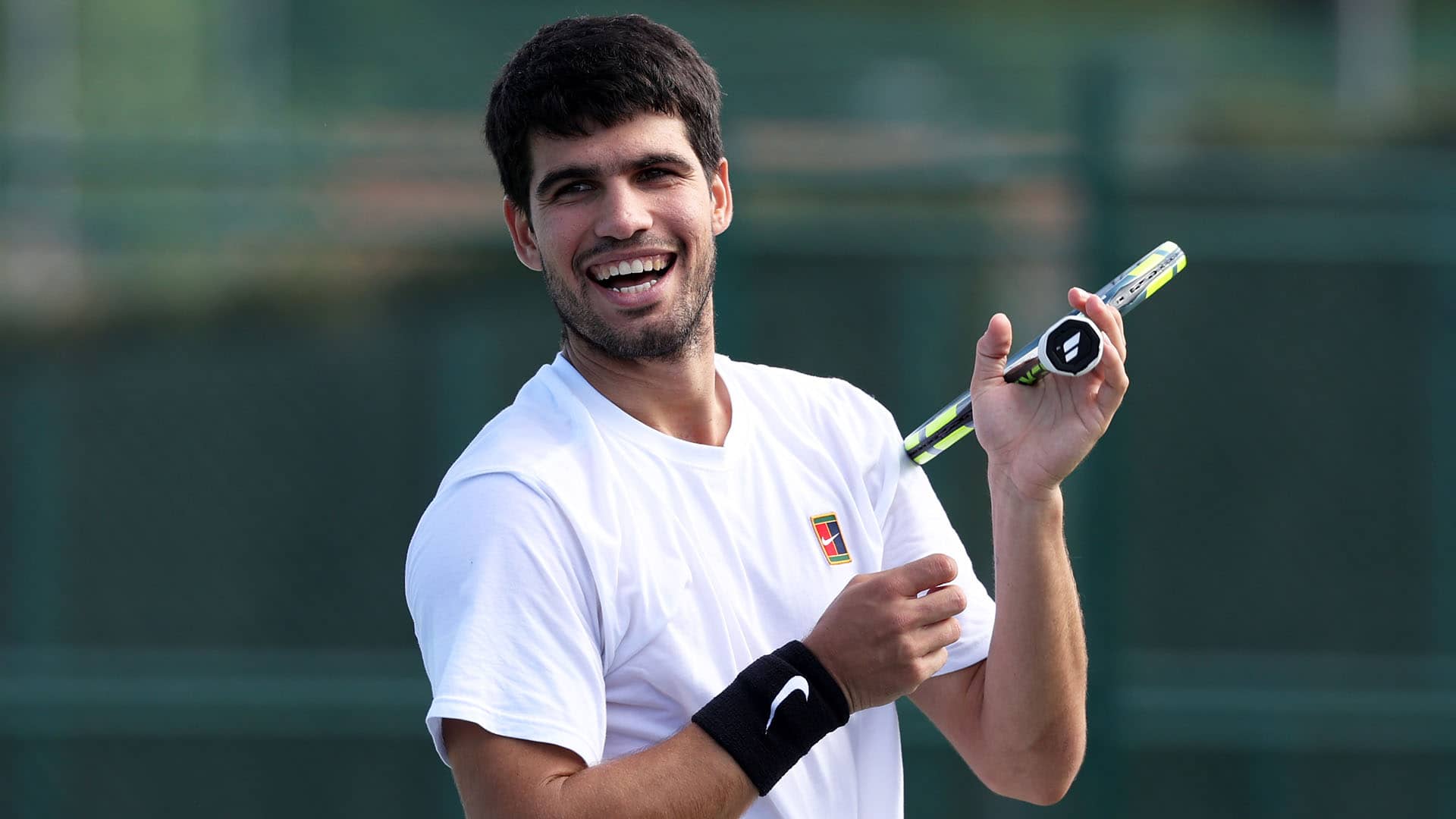
Carlos Alcaraz strides into Doha with the quiet intensity of a player who has scaled every peak yet senses the ground shifting beneath him. Fresh from his Australian Open triumph that sealed the Career Grand Slam, the world No. 1 could linger in the glow of a perfect 7-0 start to 2026. Instead, he turns inward, probing for vulnerabilities as he headlines the Qatar ExxonMobil Open.
The desert air carries a subtle charge, floodlights soon to pierce the evening sky over hard courts that demand precision amid gusts from the Gulf. Alcaraz, at 22, faces Arthur Rinderknech in his opener, a Top 30 contender whose flat groundstrokes test footwork on this quicker surface. Every rally here could echo the broader chase, where sustaining dominance means evolving faster than the field.
“Obviously I can see myself that [I have had] a lot of success so far, winning the biggest tournaments in the world,” said Alcaraz on Sunday at his pre-tournament press conference in Qatar. “But I just see myself with weaknesses. A lot of players, I know that they’re trying to catch me up in terms of they are studying my game, they study how I play, trying to beat me, trying to challenge me.
“I have to be ready for that, and I have to see where my level is, where my tennis is. I have to try to put myself in their minds and think what they could do when playing against me. So that’s what I mean about saying I have to improve some things. Obviously, you cannot be lagging in the level, you just have to keep it going.”
Weaknesses sharpen the champion’s edge
Alcaraz’s candor cuts through the post-victory narrative, revealing a mindset that treats success as a starting line, not a finish. He imagines opponents mapping his heavy topspin forehands, plotting returns to jam his inside-out attempts or force errors with deep crosscourt lobs. On Doha’s grippy hard courts, lower bounce than Melbourne’s amplifies these threats, pushing him to refine his 1–2 patterns—perhaps mixing in more underspin slices to disrupt aggressive returns.
This self-scrutiny fuels his 25 tour-level titles, a tally built on relentless adaptation rather than raw talent alone. Rivals dissect footage of his explosive transitions, seeking ways to extend rallies and expose second-serve dips. Alcaraz responds by simulating their tactics in practice, turning potential cracks into fortified strengths that could carry him deeper than last year’s quarterfinal here.
The crowd’s murmurs build as he warms up, sensing a top seed who arrives not invincible, but invigorated by the hunt for perfection. His focus on process over prizes sets the tone, with goals centered on sharper serve placement and varied approach shots to pin baseliners back. These tweaks promise to elevate his all-court game, preparing him for the season’s unforgiving stretch.
Sinner casts a familiar rivalry shadow
One obvious example of the rivals Alcaraz was referring to is Jannik Sinner, the second seed whose flat-hitting arsenal could ignite a 17th head-to-head chapter in the final. The Italian’s precise backhand down-the-line slices through defenses, neutralizing Alcaraz’s drop shots with relentless depth. Their electric rivalry, now 16 matches deep, thrives on mutual evolution, each studying the other’s rhythms to steal momentum in prolonged exchanges.
Alcaraz tempers visions of that showdown, insisting on a match-by-match grind through a draw stacked for a 500-level event. Against Rinderknech‘s booming serve, he’ll probe with deep returns, aiming to draw short balls for punishing forehand winners. The field’s early firepower mirrors the ATP’s parity, where upsets lurk in every net cord or unforced error.
“I know how difficult every match is. Every match is different, our play is totally different,” said the Spaniard. “I think this draw is a really tough one for a 500 tournament. We can see the first matches how good matches that we have in the first round.
“So [I’m] just thinking about a match at a time, and let’s see how far I can go. Obviously my mind is trying to go as far as I can. If it’s possible to play a final, obviously that would be great, and that’s what I’m looking for, so let’s see. I’m not thinking about playing or just putting myself in the final too early. I want to think day by day.”
Process fuels the Doha campaign
Before settling in Qatar, Alcaraz detoured to Bahrain, where he visited his fellow Spanish sporting superstars Fernando Alonso and Carlos Sainz at F1 pre-season testing. The roar of engines and precision of laps grounded him, drawing parallels to the split-second decisions that define his baseline battles. Now, with focus locked on the courts, his team charts a path untethered to scorelines, emphasizing growth in every facet.
Doha’s outdoor hard courts test his adaptability, with wind altering ball flights and heat sapping energy in long rallies. He eyes improvements like boosting first-serve percentages to counter returners targeting his second delivery, or incorporating more serve-and-volley to break predictable patterns. Success here means executing these evolutions, building resilience for the clay swing ahead.
The compact stands pulse with anticipation, fans drawn to a No. 1 who embraces pressure as fuel. Alcaraz’s drive ensures 2026 unfolds not as a coronation, but a continuous ascent, where each adjustment propels him toward unseen heights.
“Coming here, these days, my team and I, just we set up some goals for this tournament,” revealed the 25-time tour-level champion. “We are not talking about results at all. it’s just more about the process to be better, still in the process to grow up. There are some things that I really want to be better and [I want to] develop my game in a way that I really want to show up and to pull off here in this tournament.
“That would be a really successful week for me, besides results. I [want to] see myself that I’m just doing the right things on and off the court.”


