Miami’s No. 1 Throne Awaits Conquerors

The Miami Open presented by Itau has crowned every active ATP No. 1, from Djokovic’s iron grip to Sinner’s fresh surge, turning South Florida’s hard courts into a battleground for supremacy.

In the humid haze of South Florida, the Miami Open presented by Itau strips players to their core, revealing who can handle the weight of world No. 1 dreams amid the hard-court swing’s early fury. Every active member of the ATP No. 1 Club—Novak Djokovic, Carlos Alcaraz, Daniil Medvedev, and Jannik Sinner—has seized the title here, their victories echoing the tournament’s role as a mirror to the men’s game’s shifting power. Past giants like Roger Federer with four triumphs, Andy Murray and Andy Roddick with two each, Andre Agassi with six, Pete Sampras with three, Jim Courier and Mats Wilander with one apiece, and Ivan Lendl with two have all navigated this gauntlet, proving Miami‘s fast surfaces demand tactical precision and mental steel.
Djokovic forges lasting dominance
Novak Djokovic’s six Miami titles tie Andre Agassi for the record, spanning from his 2007 breakthrough to a blistering run between 2011 and 2016 that captured four during year-end No. 1 seasons. He completed the Sunshine Double four times, pairing Indian Wells wins with South Florida glory, while finals losses in 2009 to Andy Murray and 2025 to Jakub Mensik tested his edges, leaving a 49-8 record that speaks to unyielding adaptation. On these grippy courts, he wove heavy topspin forehands with sliding defense, forcing rivals into risky inside-out attempts that often sailed wide under pressure.
The Serb’s deep returns neutralized big serves, preserving energy through three-set grinds where slice backhands disrupted rhythm and opened angles for down-the-line winners. Crowd murmurs built to roars as he reset mentally after early majors like the Australian Open, turning Miami into a launchpad for clay-court campaigns. His longevity here hints at tactical tweaks that could redefine 2026 rivalries.
Alcaraz erupts into elite contention
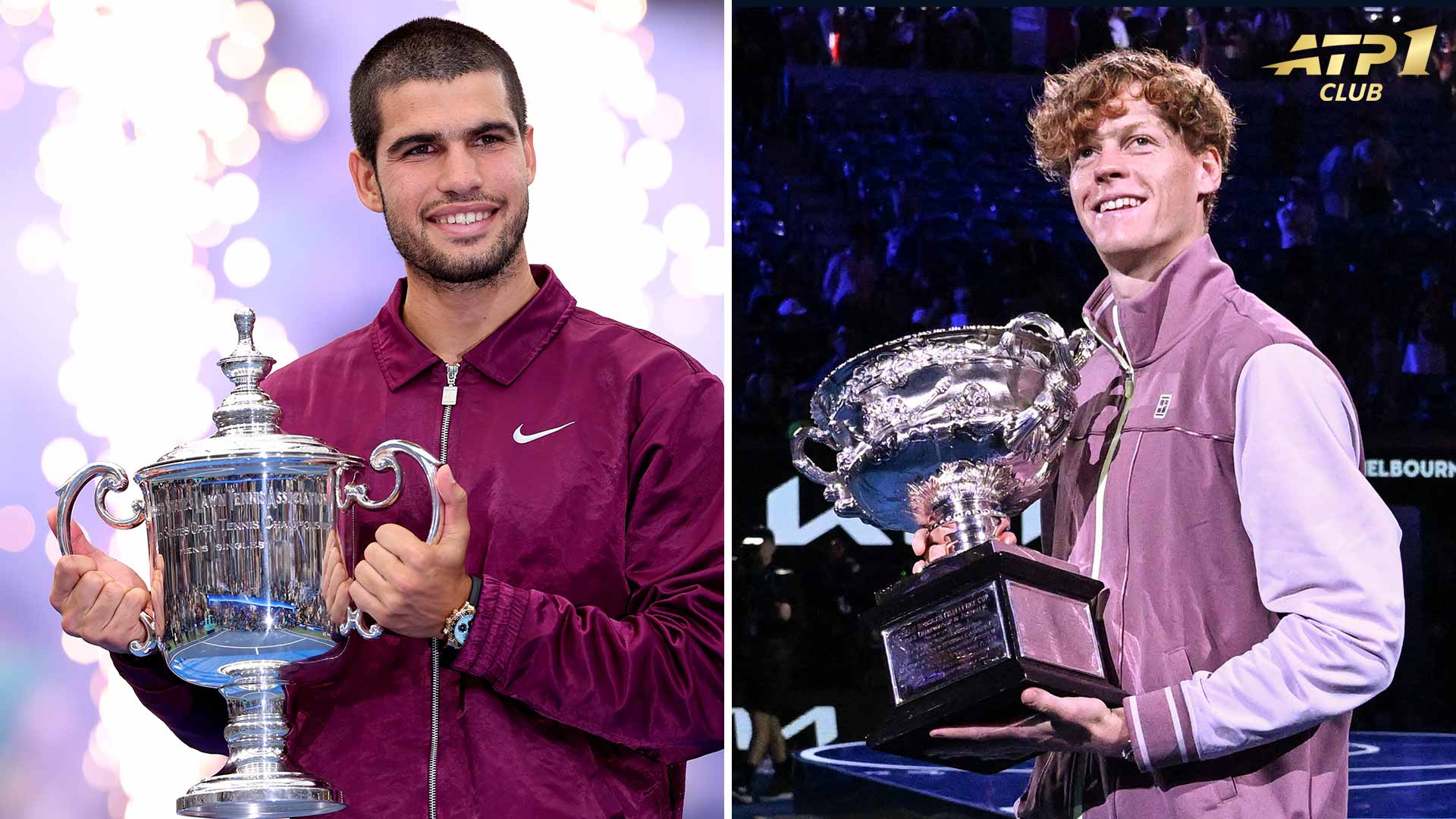
Carlos Alcaraz‘s 2022 victory at age 18 shattered Djokovic’s youngest-champion mark, capping an electric draw with a straight-sets defeat of Casper Ruud in the final for his first Masters 1000 crown. This surge followed his US Open breakthrough, where he became the youngest No. 1 ever, the Miami title affirming his rise amid a packed schedule that blurred youth and exhaustion. He unleashed inside-in forehands that ripped crosscourt, blending drop shots with net approaches to shatter baseline defenses on the quicker surface.
The Spaniard’s one–two combinations—serve followed by a flattened drive—exploited Miami’s lower bounce, pinning opponents and converting breaks with relentless coverage. Stadium energy surged with his every leap, easing the psychological press of consecutive deep runs and fueling poise for European swings. As 2026 approaches, this blueprint positions him to challenge atop the rankings once more.
Medvedev and Sinner claim hard-court crowns
Daniil Medvedev‘s 2023 title ended a red-hot spring, his fourth trophy in six weeks after Rotterdam, Doha, Dubai successes and an Indian Wells runner-up, where he outlasted Jannik Sinner in the final with angular returns and crosscourt lobs that extended points into errors. The Russian’s flat backhands absorbed pace on the true hard courts, using underspin passes to counter aggression and secure a five-title year that bolstered his No. 1 push. Humidity thickened the air, but his deep positioning turned rallies into endurance tests he dominated.
Jannik Sinner’s 2024 breakthrough followed final defeats to Hubert Hurkacz in 2021 and Medvedev in 2023, dropping just one set en route to victory after his Australian Open major, part of eight titles including the Nitto ATP Finals that crowned him Italy’s first No. 1. He varied serve placements wide to open courts for down-the-line finishes, his inside-out forehands slicing through defenses with flat efficiency suited to Miami’s speed. Persistence turned crowd cheers into momentum, healing past scars and lightening the load for surface transitions.
These conquests weave into Miami’s legacy, where tactical evolutions on fast hard courts have propelled No. 1 ascents for decades. As the 2026 edition nears, the tournament promises fresh clashes, testing whether new challengers can join this exclusive club amid the grind.