Alcaraz’s Grit Edges Zverev in Melbourne Marathon

Carlos Alcaraz clawed through pain and pressure to defeat Alexander Zverev in a five-set Australian Open semifinal that stretched limits, securing his place in history as the youngest to reach all four Grand Slam finals.
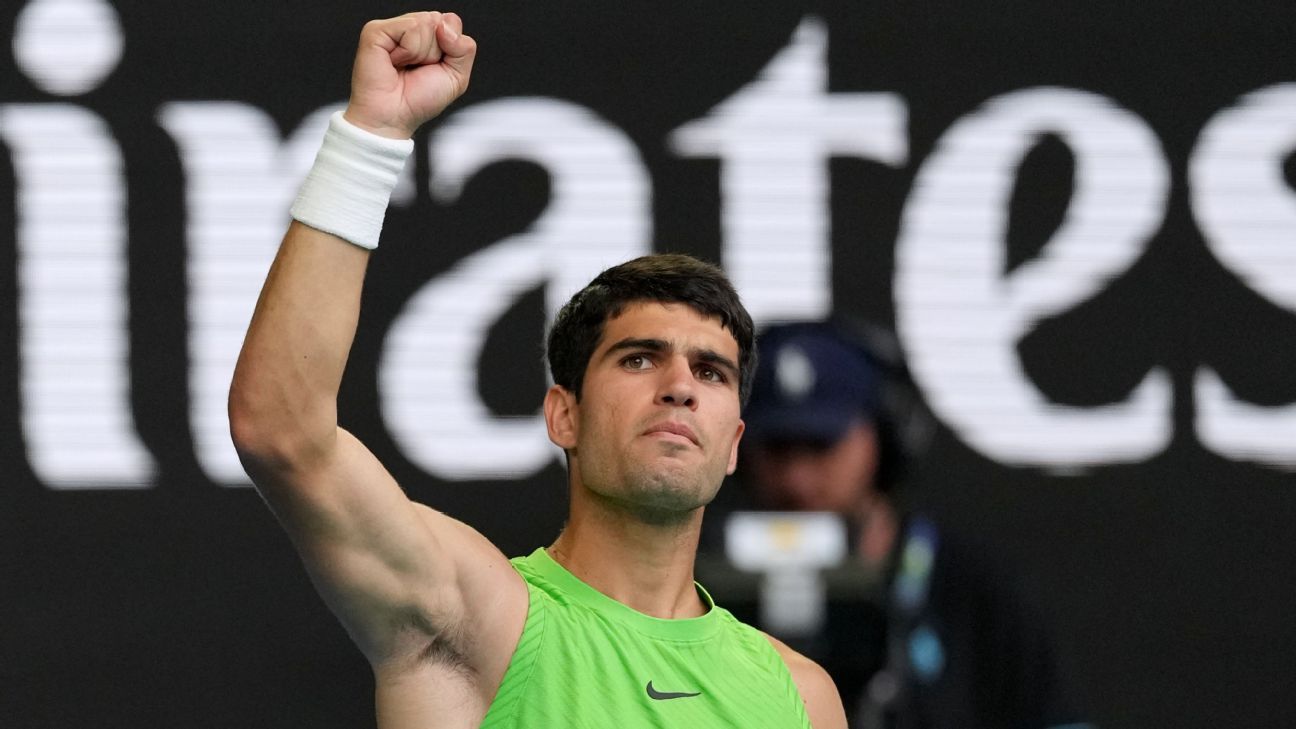
MELBOURNE, Australia—Carlos Alcaraz stepped onto Rod Laver Arena with the poise of a player chasing immortality. At 22, the Spaniard carried the momentum of an undefeated run through five rounds, his explosive groundstrokes slicing through opponents on these hard courts. But against Alexander Zverev, the semifinal twisted into a 5-hour, 27-minute battle—6-4, 7-6 (5), 6-7 (3), 6-7 (4), 7-5—the longest in Australian Open history, eclipsing the 2009 classic between Rafael Nadal and Fernando Verdasco.
“I think physically we just pushed each other to the limit today. We pushed our bodies to the limit,” Alcaraz said. “Just really, really happy to get the win, that I came back. I just rank this one in the top position of one of the best matches that I have ever won.”
Two sets ahead, Alcaraz owned the court with inside-out forehands that forced Zverev deep, his one–two serve patterns opening angles for crosscourt winners. The German, last year’s runner-up, fired back with flat backhands down-the-line, but Alcaraz’s retrievals kept the pressure on. This form mirrored the edge that helped him claim the US Open last year and split the last eight majors evenly with Jannik Sinner.
Pain disrupts the early command
In the third set’s ninth game, Alcaraz limped after a wide retrieve, clutching his upper right leg’s adductor muscle. He held for 5-4 before a medical timeout, where trainers massaged the area during the three-minute break. Zverev protested to officials, arguing that cramping typically doesn’t qualify for such treatment, his frustration evident amid the crowd’s growing tension.
Alcaraz returned with compromised footwork, his slides less explosive on the demanding hard courts. The pain felt isolated, not full cramps, but it slowed his pursuit of drop shots and allowed Zverev to extend rallies. Yet, the Spaniard’s heavy topspin still carried threats, pulling the German off balance in key exchanges.
Zverev surges as fatigue builds
Zverev won the third-set tiebreak 7-3, then the fourth 7-4, his deep second serves pinning Alcaraz back. The German broke early in the fifth for a 1-0 lead, defending five break points while serving at 5-4, the match hanging on his delivery. His inside-in backhands found gaps as Alcaraz’s movements turned cautious, the humid night air thickening the strain.
Alcaraz drew on his 14-1 record in prior five-setters, refusing to fade like Zverev would later admit to doing in his career’s longest match. The crowd’s energy surged in the sixth game, when Alcaraz sprinted for a drop shot, sliding into an angled forehand winner that reignited the arena. That point shifted the tempo, his underspin lobs buying time against Zverev’s aggressive returns.
“I’ve been in these situations, I’ve been in these kind of matches before, so I knew what I had to do,” Alcaraz said. “I had to put my heart into the match. I think I did it. I fought until the last ball.”
Trailing 5-4 in the decider, Alcaraz broke on a forehand error from Zverev, then held with a mix of slice serves and deep returns. He converted his first match point with a crosscourt backhand, collapsing in exhaustion as his racket slipped away. Zverev crossed the net for a hug, both players drained after pushing boundaries.
“He was cramping, so normally you can’t take a medical timeout for cramping,” Zverev said. “What can I do? I didn’t like it, but it’s not my decision. But, to be honest, I don’t want to talk about this right now, because I think this is one of the best battles there ever was in Australia. It doesn’t deserve to be the topic now.”
Now the top-ranked player and the youngest in the Open era to reach finals at all four Slams, Alcaraz eyes his first Australian Open title. He faces either two-time defending champion Sinner or 10-time winner Novak Djokovic, who bids for a record 25th major. This victory, forged in doubt and defiance, sharpens his edge for a final where belief meets legacy on these unforgiving courts.